MikeDunnAuthor · @MikeDunnAuthor
1861 followers · 3959 posts · Server kolektiva.social
Today in Labor History August 23, 1970: The Salad Bowl strike began. Led by Cesar Chavez and the UFW, it was the largest farm worker strike in U.S. history. The strike was not only a battle between farm workers and the large, corporate growers. In late September 1970, the UFW launched a consumer boycott of all lettuce which had not been picked by members of the United Farm Workers. Violence was widespread. In November, someone bombed a UFW regional office. In December, federal marshals arrested and jailed Chavez. Two days later, former Olympic gold medal decathlete Rafer Johnson and Ethel Kennedy, widow of Robert Kennedy visited him in jail. However, an anti-union mob attacked Kennedy and Johnson on the steps of the jail. Only the intervention of Salinas city cops and the Brown Berets prevent injury to the visitors and full-scale riot.
The turf war between the Teamsters and the UFW continued after the strike and grew increasingly violent. A UFW picketer was shot on August 3. And on August 9, five firebombs were thrown at UFW picket lines. Another two UFW members were shot on August 11, and a UFW picketer was shot to death on August 16, 1973. Chávez ultimately entered into talks with the Teamsters. On September 27, 1973, the Teamsters agreed to leave jurisdiction over farm field workers to the UFW.
#WorkingClass #LaborHistory #UnitedFarmWorkers #ufw #union #strike #CesarChavez #teamsters #immigrants #chicano #boycott #bomb #jail #BrownBerets
#workingclass #LaborHistory #UnitedFarmWorkers #ufw #union #strike #cesarchavez #Teamsters #immigrants #chicano #boycott #bomb #jail #brownberets
MikeDunnAuthor · @MikeDunnAuthor
1792 followers · 3787 posts · Server kolektiva.social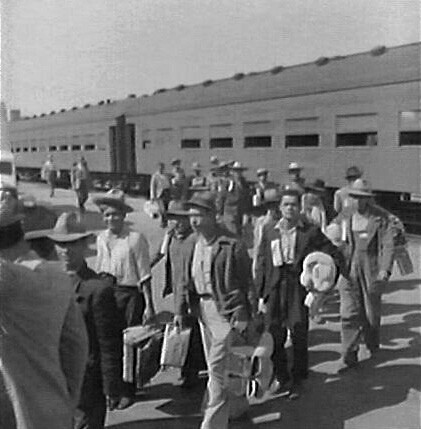

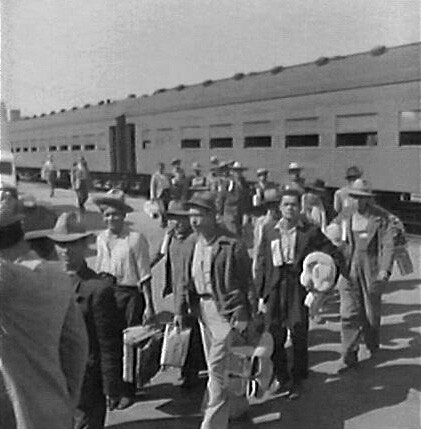
Today in Labor History August 4, 1942: U.S. and Mexico began the Bracero Program to provide cheap Mexican labor to replace U.S. workers who were being sent to fight in World War II, and to replace the 500,000 Mexican workers who were deported during the Great Depression in order to mollify xenophobic demands for “white jobs.” The Bracero program also gave farm-owners an alternative to hiring Anglo farm workers who hadn’t been drafted, many of whom were affiliated with the radical IWW. The Bracero program promised decent and sanitary housing and a minimum wage, but these were generally ignored by employers. Additionally, the workers were often subjected to racist attacks. The abuses contributed to the development of the Chicano Movement, the United Farm Workers and other forms of activism.
#WorkingClass #LaborHistory #bracero #chicano #ufw #union #UnitedFarmWorkers #racism #xenophobia #ww2 #IWW #MinimumWage
#workingclass #LaborHistory #bracero #chicano #ufw #union #UnitedFarmWorkers #racism #xenophobia #ww2 #IWW #minimumwage