Warrick Ball · @warrickball
109 followers · 527 posts · Server mas.to
Just missed another #TESStuesday but here are the clear solar-like oscillations in β Hyi anyway, using 20-second data from TESS Sector 67. TESS's PI recently spoke at a conference in Hawai'i and revealed that the spacecraft—already 5 years into its mission—could last *decades*...
#asteroseismology #tesstuesday

Santiago Andrés Triana · @repepo
126 followers · 48 posts · Server fediscience.orgDo you work on #fluiddynamics of #planetaryCores /moons/atmospheres or #stars? submit your abstract to our #interdisciplinary session for this year's AGU meeting in San Francisco!
https://agu.confex.com/agu/fm23/prelim.cgi/Session/185760
#AGU23 #InertialWaves #GravityWaves #Asteroseismology #Helioseismology #PlanetaryScience
#IcyMoons #GasGiants
#gasgiants #icymoons #planetaryscience #helioseismology #asteroseismology #gravitywaves #inertialwaves #agu23 #interdisciplinary #stars #planetarycores #fluiddynamics
Warrick Ball · @warrickball
97 followers · 435 posts · Server mas.toCan't help a bit of FOMO at not being at the Kepler & TESS Asteroseismic Science Consortia conference (#KASC14/#TASC7) this week. If anyone from the #asteroseismology/#astrodon community is there, do toot about it!
I appreciate the animated logo.
Warrick Ball · @warrickball
86 followers · 387 posts · Server mas.to
At the suggestion of some friends and collaborators, my review of #asteroseismology for the April edition of #Astronomy & Geophysics, magazine of the RAS, is now free on arXiv:
https://arxiv.org/abs/2306.15070
It lacks the formatting and some extra images added by A&G's production team, so I recommend reading the published version if you have access (e.g. through your University).
Warrick Ball · @warrickball
75 followers · 347 posts · Server mas.to
Another #TESStuesday, another old SIMBAD tab closed. This time it's the metal-poor subgiant HD 59984. This is a slightly (5-point) smoothed power spectrum for the 20s cadence data in Sector 34, with clear oscillations around ~1100 μHz. Huber et al. (2022) showed how (and why) this "fast" cadence data is better for bright solar-like oscillators. Here too, the the oscillations aren't nearly as clear in the data at 120s cadence.
#asteroseismology #tesstuesday
Warrick Ball · @warrickball
75 followers · 347 posts · Server mas.to
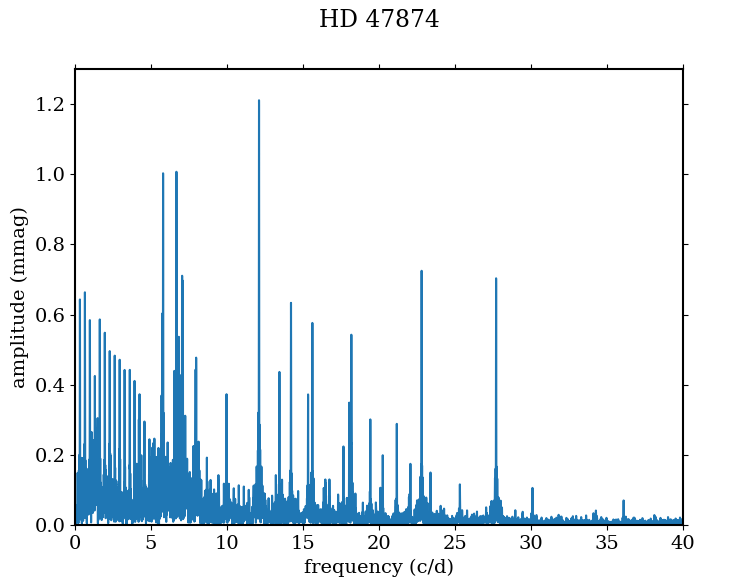
This #TESStuesday, I'm closing a tab with a mysterious SIMBAD search for HD 47874. Here's the amplitude spectrum for TESS Sectors 6 & 7. It appears to be a (blended?) eclipsing binary (hence the dense, low-frequency comb) that's also a high-order δ Scuti pulsator.
simbad.u-strasbg.fr/simbad/sim-basic?Ident=HD+47874
#asteroseismology #tesstuesday
Warrick Ball · @warrickball
68 followers · 289 posts · Server mas.to
NASA's K2 mission (Kepler after the second reaction wheel failed) seems an untapped resource for the #asteroseismology of solar-like oscillators, especially on the main-sequence. So it's great to see González-Cuesta et al. (featuring @sy_breton) analysing K2 data for 8 stars on arXiv yesterday:
https://arxiv.org/abs/2304.00087
Just look at these echelle diagrams!
Warrick Ball · @warrickball
68 followers · 286 posts · Server mas.to
For #TESStuesday, it's back to closing old SIMBAD tabs. In this case, at least I remember why I ever searched this star! χ Her is a subgiant and depleted in metals compared to the Sun. Its solar-like oscillations are nice and clear in the TESS data for sectors 50 & 51. #asteroseismology
#asteroseismology #tesstuesday
Warrick Ball · @warrickball
69 followers · 283 posts · Server mas.toBefore I even applied for my current RSE role, I was asked if I'd like to briefly review some recent results in #asteroseismology for #Astronomy & Geophysics, the magazine of the Royal Astronomical Society (RAS). The article, which they dubbed "Finger on the pulse of asteroseismology", has now been published:
https://academic.oup.com/astrogeo/article/64/2/2.30/7077792
There wasn't nearly enough space (nor did I have time) to be exhaustive but it offers a personal view into the state of asteroseismology. Hope you enjoy!
David Brückner · @DavidBrueckner
1492 followers · 408 posts · Server mas.to
RT @ISTAustria
Astrophysicist @lisa_Bugnet opens up a new field @ISTAustria & numerous opportunities for cross-disciplinary collaborations. Her research applies #asteroseismology to study the magnetic fields of #stars to better understand the evolution of stars. 🔗 https://bit.ly/3HJFL4F
Warrick Ball · @warrickball
67 followers · 253 posts · Server mas.to
I'll continue to keep #TESStuesday alive by closing tabs on SIMBAD searches that I don't fully remember making. Here's HD 59984, a metal-poor G0 subgiant. I think I looked these up while on a tangent about studying the Milky Way's formation using these stars, for which Fuhrmann & Chini (2021) gave a sample.
The solar-like oscillations are crystal clear in TESS's 20s data from Sector 34.
#asteroseismology #tesstuesday

SciHi Blog · @scihiblog
185 followers · 54 posts · Server fedihum.org
On December 27, 2006, the European space observatory CoRoT was launched. CoRoT‘s two objectives are to search for extrasolar planets with short orbital periods, particularly those of large terrestrial size, and to perform asteroseismology by measuring solar-like oscillations in stars.
http://scihi.org/corot-space-observatory/
#space #exoplanet #asteroseismology #historyofscience #astronomy
#space #exoplanet #asteroseismology #historyofscience #astronomy
Warrick Ball · @warrickball
44 followers · 91 posts · Server mas.to
More clearing up a hard drive turned up some old quick-look plots of TESS data, so for #TESStuesday (👀 @jradavenport ?), here's an amplitude spectrum of HR 1771. This is a binary comprising a red giant and early A-type dwarf, which might also be pulsating.
#asteroseismology #tesstuesday
Warrick Ball · @warrickball
44 followers · 91 posts · Server mas.toCleaning out some hard drive space and came across this ancient animation, where I superimposed a bunch of spherical harmonics in a bid to better depict what stellar oscillations might look like. Don't be fooled: there's little realism in this either! #asteroseismology
Warrick Ball · @warrickball
36 followers · 86 posts · Server mas.toCleaning out some hard drive space and came across this ancient animation, where I superimposed a bunch of spherical harmonics in a bid to better depict what stellar oscillations might look like. #asteroseismology
Warrick Ball · @warrickball
44 followers · 91 posts · Server mas.to
Work in progress highlighting classes of variable star for #asteroseismology in terms of luminosity and surface temperature. Lines mostly inferred from MESA Isochrones and Stellar Tracks (MIST) database. Regions from other versions of this plot and Appendix of Aerts, JCD & Kurtz's textbook.
I'm learning a lot about manipulating shapes in @libreoffice Draw!
Warrick Ball · @warrickball
44 followers · 91 posts · Server mas.to
I was experimenting with a diagram showing dipole (ℓ=1) eigenfunctions of a stellar model (1 Msun, 1.25 Rsun, just past TAMS). I've decided I can't quite get what I want but you can have what I created anyway.
Each eigenfunction (actually ξr√ρ) is scaled by its maximum and plotted at the mode frequency. Note the g-modes at low frequency and p-modes at high frequency.
(Do we have any good hashtags? #asteroseismology ? #astrophysics ?
#astrophysics #asteroseismology

Santiago Andrés Triana · @repepo
80 followers · 16 posts · Server mathstodon.xyz#Introduction
Hi all, I'm new here 😊 I spend most of my professional time solving this equation:
\[\partial_t \mathbf{u}+2\mathbf{\hat z}\times\mathbf{u}=-\nabla p+E\nabla^2\mathbf{u}, \]
i.e. the Navier-Stokes equation for a rotating fluid. I solve it numerically and sometimes using #fluiddynamics lab experiments. If I'm lucky I get to apply that to problems in #asteroseismology, or #helioseismology, or in #planetaryscience.
#planetaryscience #helioseismology #asteroseismology #fluiddynamics #introduction

European Research Council (ERC · @ERC_Research
466 followers · 865 posts · Server respublicae.eu




🪐 Do you know what #asteroseismology is about?
Find out the answer & more about stellar oscillations through the work of ERC grantee Conny Aerts @IvS_KULeuven - one of the 2022 #KavliPrize laureates 🏆 for #astrophysics.
@CORDIS_EU @KavliPrize
🐦🔗: https://nitter.eu/ERC_Research/status/1531992142976995329
#asteroseismology #KavliPrize #Astrophysics