Warrick Ball · @warrickball
109 followers · 527 posts · Server mas.to
Just missed another #TESStuesday but here are the clear solar-like oscillations in β Hyi anyway, using 20-second data from TESS Sector 67. TESS's PI recently spoke at a conference in Hawai'i and revealed that the spacecraft—already 5 years into its mission—could last *decades*...
#asteroseismology #tesstuesday
Warrick Ball · @warrickball
102 followers · 475 posts · Server mas.to
Instead of light curves, I'll use this #TESStuesday to remind you that TESS started science operations #onthisday, five years ago! 🛰️
It's currently set to continue until October 2024 as part of its second mission extension, but AFAIK it should be able to keep going for many years beyond that, as long as NASA keeps funding its mission.
And we still won't be able to keep up with the data.
https://www.nasa.gov/feature/goddard/2018/nasa-s-tess-spacecraft-starts-science-operations
Warrick Ball · @warrickball
75 followers · 347 posts · Server mas.to
Another #TESStuesday, another old SIMBAD tab closed. This time it's the metal-poor subgiant HD 59984. This is a slightly (5-point) smoothed power spectrum for the 20s cadence data in Sector 34, with clear oscillations around ~1100 μHz. Huber et al. (2022) showed how (and why) this "fast" cadence data is better for bright solar-like oscillators. Here too, the the oscillations aren't nearly as clear in the data at 120s cadence.
#asteroseismology #tesstuesday
Warrick Ball · @warrickball
75 followers · 347 posts · Server mas.to
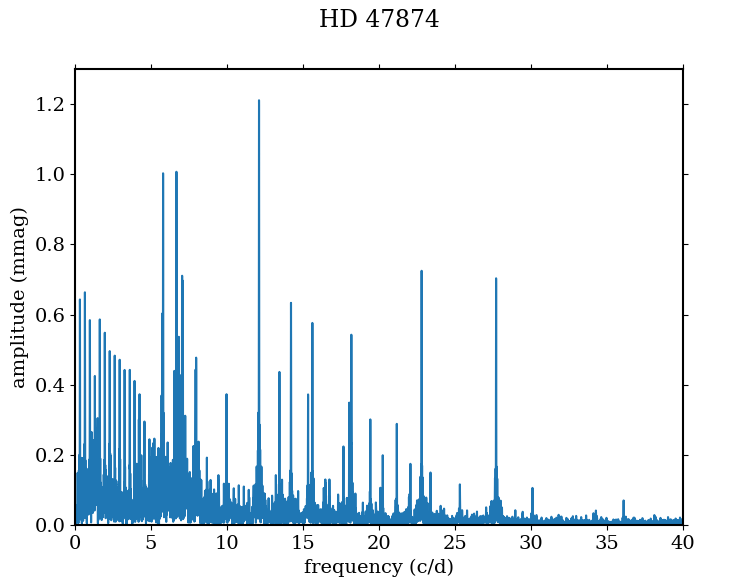
This #TESStuesday, I'm closing a tab with a mysterious SIMBAD search for HD 47874. Here's the amplitude spectrum for TESS Sectors 6 & 7. It appears to be a (blended?) eclipsing binary (hence the dense, low-frequency comb) that's also a high-order δ Scuti pulsator.
simbad.u-strasbg.fr/simbad/sim-basic?Ident=HD+47874
#asteroseismology #tesstuesday
Warrick Ball · @warrickball
68 followers · 286 posts · Server mas.to
For #TESStuesday, it's back to closing old SIMBAD tabs. In this case, at least I remember why I ever searched this star! χ Her is a subgiant and depleted in metals compared to the Sun. Its solar-like oscillations are nice and clear in the TESS data for sectors 50 & 51. #asteroseismology
#asteroseismology #tesstuesday
Warrick Ball · @warrickball
68 followers · 273 posts · Server mas.to
For #TESStuesday, how about quadruple star system TIC 219006972, which comprises two eclipsing binaries and is studied in detail in a paper by Kostov et al. on arXiv today:
https://arxiv.org/abs/2303.14275
The inner and outer orbits are all aligned, though I guess sufficiently misaligned (just a little) so that the components of A don't eclipse the components of B?
Warrick Ball · @warrickball
67 followers · 253 posts · Server mas.to
This #TESStuesday is more than just another closed tab. I spent some evenings last week selecting different eclipsing binaries for and adding some actual descriptions to my (still quite rough) Atlas of TESS Light Curves:
https://warrickball.gitlab.io/tess-atlas/eb/ea.html
Now featuring
- Algol (β Per),
- Thuban (α Dra),
- γ Per,
- ζ Phe,
- HW Vir
as well as oscillating Algol variables
- RZ Cas,
- AB Cas,
- Y Cam and
- AS Eri!
Hope to chip away at descriptions soon.
Warrick Ball · @warrickball
67 followers · 253 posts · Server mas.to
I'm still closing tabs for #TESStuesday. Here's HD 11964, a G9 subgiant, known to host two planets and a distant M-dwarf companion. It's also a solar-like oscillator, given the usual comb of peaks in this lightly-smooth power density spectrum of 20s cadence data from Sector 30.
Warrick Ball · @warrickball
67 followers · 253 posts · Server mas.to
Still just enough time this #TESStuesday to close another tab with a mysterious SIMBAD query. No idea why I looked up TIC 159387771 but the amplitude spectrum shows it's a "high-order" δ Scuti variable. Lots of pressure modes with radial order < 10ish.
http://simbad.u-strasbg.fr/simbad/sim-basic?Ident=TIC+159387771
Warrick Ball · @warrickball
67 followers · 253 posts · Server mas.to
I'll continue to keep #TESStuesday alive by closing tabs on SIMBAD searches that I don't fully remember making. Here's HD 59984, a metal-poor G0 subgiant. I think I looked these up while on a tangent about studying the Milky Way's formation using these stars, for which Fuhrmann & Chini (2021) gave a sample.
The solar-like oscillations are crystal clear in TESS's 20s data from Sector 34.
#asteroseismology #tesstuesday
Warrick Ball · @warrickball
67 followers · 253 posts · Server mas.to
I haven't forgotten about #TESStuesday (brainchild of @jradavenport). For the next few weeks, I'm going to... close tabs! I have a bunch of SIMBAD searches still open and can't remember why but some targets have interesting light curves.
Here's planet-hosting G1 dwarf HD 178085, which looks like a classic case of spots.
Warrick Ball · @warrickball
44 followers · 91 posts · Server mas.to
More clearing up a hard drive turned up some old quick-look plots of TESS data, so for #TESStuesday (👀 @jradavenport ?), here's an amplitude spectrum of HR 1771. This is a binary comprising a red giant and early A-type dwarf, which might also be pulsating.
#asteroseismology #tesstuesday
Warrick Ball · @warrickball
44 followers · 91 posts · Server mas.to




Hey @jradavenport, is #TESStuesday still a thing? I added some bright variables to my TESS Atlas and discovered that the bright Cepheids η Aquilae and ζ Geminorum aren't great examples of the class... e.g. AX Circini is much closer to the classic sawtooth (as is δ Cep but there are no pipeline data products 🙁 ).