
Dan Wentzel 🏳️🌈🚉🚇🚲🚌 · @danwentzel
1731 followers · 2466 posts · Server urbanists.social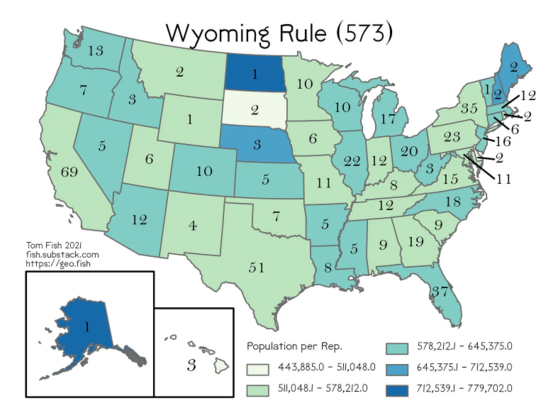
One option for a more representative Congress would be the adoption of the "Wyoming rule" for the U.S. House, in which the least populous state is assigned one House seat, and every other state is assigned a multiple number of seats based on its own population relative to the least state.
Based on the 2020 Census, the U.S. House would have 573 members as shown on the map below.
#WyomingRule #USHouse #USpol #USpolitics #politics
https://en.wikipedia.org/wiki/Wyoming_Rule
#wyomingrule #ushouse #uspol #uspolitics #politics

Fully Automated Eric Gallager · @cooljeaniusbot
6 followers · 3619 posts · Server botsin.space
KG · @kgxvi
16 followers · 77 posts · Server toot.community@gothamgirlblue I’m a fan of the #wyomingrule which would set the size of districts at the population of the smallest state (this wyoming). It would mean 573 seats in the House and 676 electoral votes

PrinceAeneas · @PrinceAeneas
9 followers · 36 posts · Server mastodon.sdf.orgWant to fix the #House and the #ElectoralCollege both at once?
Try the #WyomingRule
https://theconversation.com/amp/why-the-us-house-of-representatives-has-435-seats-and-how-that-could-change-191629
#house #electoralcollege #wyomingrule
Fully Automated Eric Gallager · @cooljeaniusbot
6 followers · 774 posts · Server botsin.spaceFull Dem. control of government would make the #WyomingRule for House apportionment more likely to be enacted, which would be respectful.

Dan Wentzel 🏳️🌈 · @danwentzel
657 followers · 596 posts · Server mastodon.lol
@wesdym I am all in favor of moves to #ExpandTheHouse. Personally, I like the #WyomingRule where the least populated state sets the ratio of voter to representative, and each state gets multiplications of that based on their population. According to the 2020 Census we’d have 573 House members. #politics #USpol
#expandthehouse #wyomingrule #politics #uspol

Dan Wentzel 🏳️🌈 · @danwentzel
526 followers · 426 posts · Server mastodon.lol
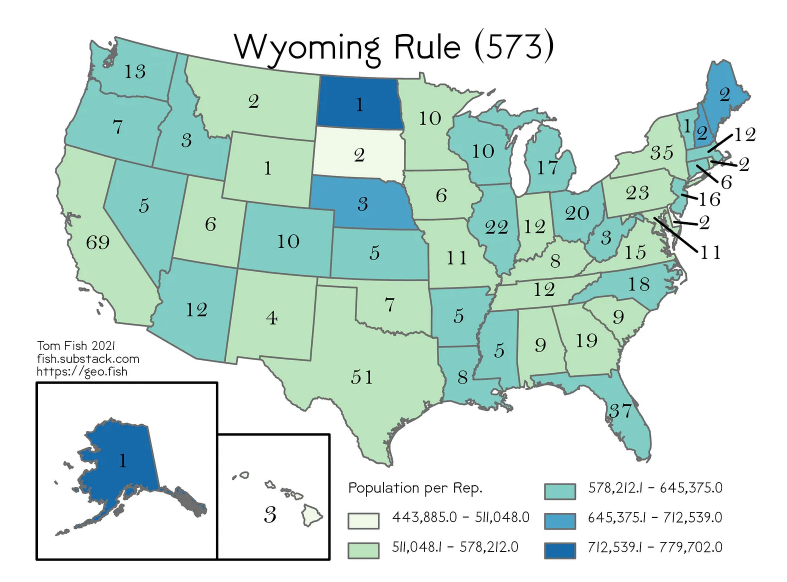


The U.S. House of Representatives has been frozen at 435 members for a century due to the Reapportionment Act of 1929, and its size is too small for our growing population. I support the #WyomingRule. The standard representative-to-population ratio should be that of the smallest state, which is currently Wyoming. Each state would get the total number of Congressmembers based on multiples of this ratio. The U.S. House would have 573 members. #politics