
Christopher Kyba · @skyglowberlin
488 followers · 825 posts · Server vis.social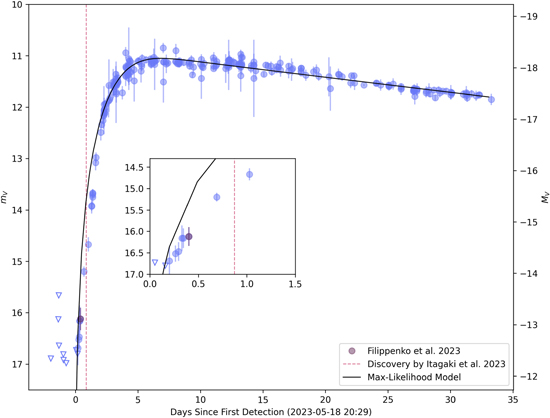
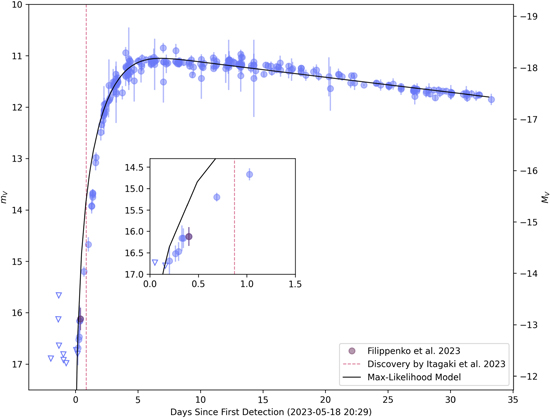
Check out this new paper, "Photometry of Type II #Supernova SN #2023ixf with a Worldwide #CitizenScience Network" https://iopscience.iop.org/article/10.3847/2515-5172/ace41f
I was a co-author, so I guess I can no longer claim that "I'm not an astronomer"... 😀
#citizenscience #2023ixf #supernova

Dr. John Barentine FRAS · @JohnBarentine
941 followers · 655 posts · Server astrodon.social
The AAVSO light curve of #supernova #2023ixf to date shows the fireball continuing to redden (i.e., it's getting fainter at blue wavelengths more quickly than in the red). There's still some subtype uncertainty; how this proceeds will determine if it's a IIP or a IIL. #astronomy
#supernova #2023ixf #astronomy

Ernie Jacobs · @Astro716
43 followers · 30 posts · Server astrodon.social
Check out the most recent post on my blog. all about capturing Supernova 2023ixf in M101. #astronomy #space #astrophotoraphy #Supernova #2023ixf #M101 #thepinwheelgalaxy https://astronomy716.blogspot.com/2023/06/chasin-sn-2023ixf-in-m-101.html
#astronomy #space #astrophotoraphy #supernova #2023ixf #m101 #thepinwheelgalaxy
Dr. John Barentine FRAS · @JohnBarentine
906 followers · 592 posts · Server astrodon.social
A gorgeous new image of Messier 101 (aka the 'Pinwheel #Galaxy') taken with the Gemini North 8-meter telescope was released today by #NOIRLab to mark completion of the repair and refurbishment of its primary mirror.
The bright blue star at left with the rays coming off it is supernova #2023ixf, a massive star at the end of life that blew itself up last month. It's still visible in small telescopes.
Dr. John Barentine FRAS · @JohnBarentine
884 followers · 567 posts · Server astrodon.social
Astronomers Telegram #16050: likely progenitor of SN #2023ixf found in archival HST data; "we obtain an approximate absolute magnitude (no extinction correction) of -4.66, which is in line with a supergiant progenitor."
Rob Agar🐀 · @SaveTheOkapi
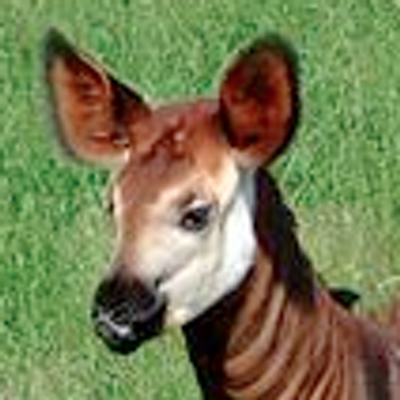
89 followers · 642 posts · Server mas.toTracked down #Supernova #2023ixf in M101 (the Pinwheel galaxy, just off the great bear’s tail)
A bright pinprick, about mag 12 - not bad for something 21 million light years away🤩
Dr. John Barentine FRAS · @JohnBarentine
884 followers · 559 posts · Server astrodon.social
My friend Scott Tucker, of Starizona here in Tucson, made the front page of spaceweather.com today with his excellent image of M101 and SN #2023ixf. The image was taken on Saturday, 20th May, when the brightness of the supernova was still rapidly rising.
Dr. John Barentine FRAS · @JohnBarentine
883 followers · 557 posts · Server astrodon.socialObserved SN #2023ixf tonight for the second night in a row. Last night I had it visually at magnitude +12.2; tonight it is considerably brighter at an estimated +11.1.
Dr. John Barentine FRAS · @JohnBarentine
883 followers · 556 posts · Server astrodon.social


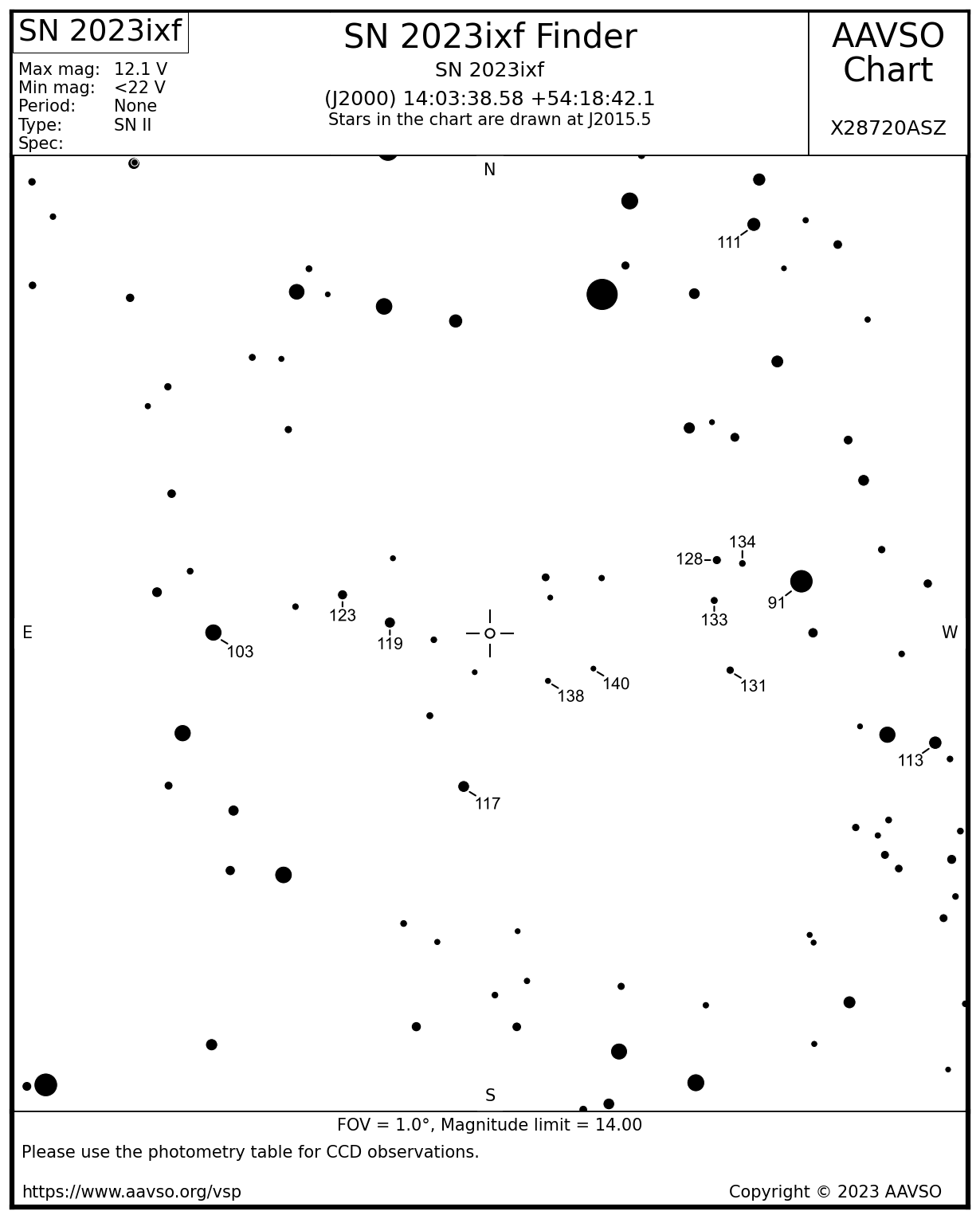
AAVSO finder chart for the field of #supernova #2023ixf in #M101, plotted with a 1º field of view and a limiting magnitude of 14. Comparison star magnitudes are shown without decimal points, so, e.g., "119" = magnitude +11.9.
#supernova #2023ixf #m101 #astronomy