Laurel · @LaurelQuarrel
24 followers · 173 posts · Server kolektiva.social
Women’s village: Jinwar
On autonomous spaces, the connection of struggles and women’s revolution in Rojava
[excerpts - article: 5 years ago]
We came to Rojava as women and feminist internationalists, eager to learn from the Kurdish Women’s Movement, to live and to work with our Kurdish friends and comrades and to be part of the revolutionary process of building up and defending vivid alternatives of social organizing – here and elsewhere in this world. We want to share and discuss our experiences, this time we want to write about our reflections on Jinwar.
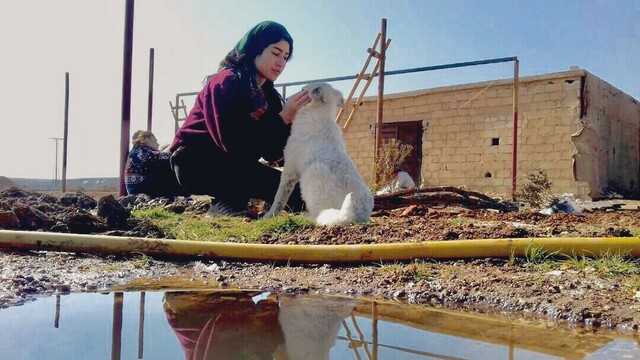
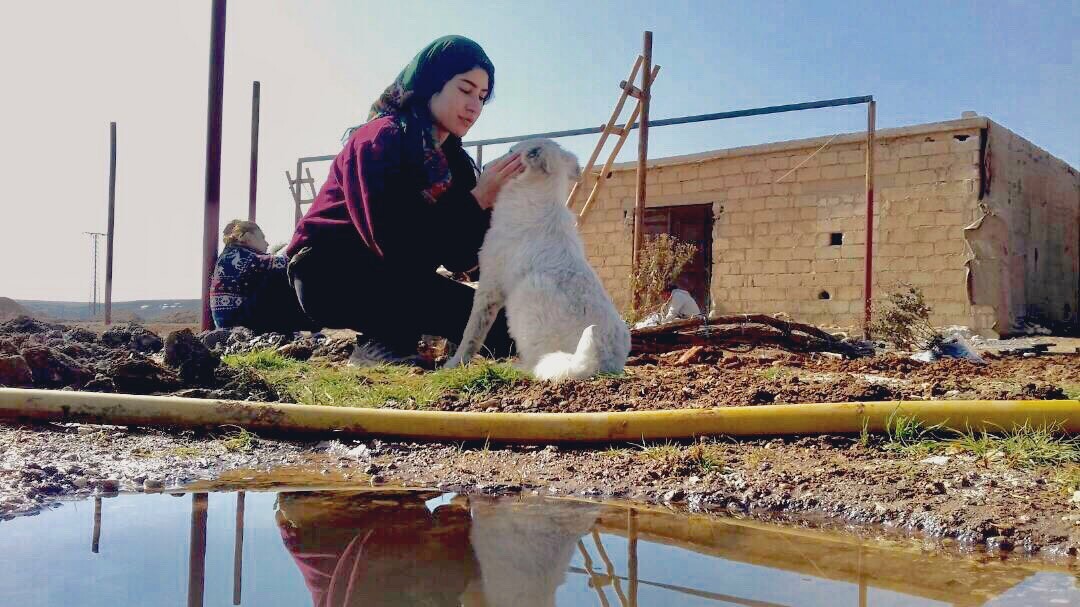
In between wheat fields a small village is being built up. The houses are made of mud in the traditional and most sustainable way, just as they have been built here in the region for thousands of years. The newly planted garden makes a change in the landscape; little fruit trees, olive trees, tomato plants, cucumber, watermelon, paprika, aubergine and a lot of wildly growing parpar (portulac) all around, needing just a little water and earth to grow without ever consciously being planted. Women work with their bare hands in the mud, creating bricks with which they will build up the houses of this village. The village is called Jinwar, and it will be a women’s village.
‘Jin’ itself is a meaningful expression in the Kurdish language: It means ‘woman’ but at the same time it is close to the word ‘jîn’ which means ‘life’. The Kurdish word ‘war’ means ‘space’, ‘land’, ‘home’. Jinwar will become a women’s space, a space where women will gather, live and work together, based on the vision of a free and communal life. It is a pioneering project that is deeply attached to the three basic principles of the democratic confederalist paradigm: democracy, ecology and women’s liberation.
In the last years the women in Rojava/Northern Syria have built up a base of self-organization in all areas of society that inspires women all over the world. Still women are facing a lot of difficulties while struggling for an autonomous life. Breaking away from patriarchal structures is challenging, here as everywhere. Indeed Jinwar teaches us to see the revolution from a holistic perspective. The women that struggle with rifles in their hands and the women that work with their hands full of mud are part of the same revolution, struggling on different fronts for the same vision of a free society.
The idea to create a womens village in Rojava has been a dream of women in the women’s movement for many years. One year ago several women and autonomous women’s organizations finally gathered and founded a committee for the creation of Jinwar. Afterwards half a year was spent on discussions, planning and making infrastructural preparations.
As Jinwar will be organized as a commune, the center of the village will be shaped by the place of the assemblies, as well as a tea garden and other places to meet, to live and to work together.
With the planting of the communal garden the women are aiming to create a base of self-sufficiency for the village, but also to maintain the connection to the earth and the food which nourishes as a fundamental part of life. In an area of quasi-desert and wheat mono-culture, being result of the Syrian regimes policy to industrialize agriculture since the 1970s, as well as the Turkish states warfare against the Rojava region (aiming to dry it out slowly by cutting off its water supplies), growing a big ecological garden and an orchard of fruit trees itself is an act of vivid resistance. It will change the territory, revive the ground and create an example of how a commune can live and work with the land in a sustainable way.
Women can never be free if they do not disconnect themselves from men and the patriarchal system in every aspect: mentally, physically and emotionally.Abdullah Öcalan
The village will be an autonomous space, a space of women to live freely and to regain the confidence, strength and creativity that have been undermined in the long historical process of an ever deeper and broader systematization of state, capitalism and patriarchy. Such an autonomous space can become a space to breathe, a space to overcome the destructive influence of the patriarchal system and to develop and practice a liberating approach towards life together. This actually applies an idea which Abdullah Ocalan calls theory of separation: Women can never be free if they do not disconnect themselves from men and the patriarchal system in every aspect: mentally, physically and emotionally. Consequently, only free and emancipated women, having a strong and meaningful base apart from patriarchal structures of power and oppression, can push men as well to challenge their privilege, their oppressiveness and oppression within the patriarchal structures and call them to take their responsibility in the struggle for gender liberation. For changing society we need spaces and structures of organizing ourselves. Jinwar can be one of these autonomous spaces a safe space and a brave space, a space of regaining and deepening knowledge and confidence without a patriarchal eye evaluating every move one makes. A space to connect the life of women today with the heritage of womens culture and wisdom of all times. A space of practicing alternative forms of communal living and working, reflecting on them, developing them further and defending them together.
Indeed Jinwar is a place where the socio-political ideals of the Rojava revolution, known as being a women’s revolution, can be realized in a small scale. Still Jinwar does not make the mistake to see itself as a closed community, aiming to realize a whole big social vision in a locked up space. The women of Jinwar see themselves as part of the revolution, being connected in the growing vision of democratic confederalism, sharing common ethical principles and basic methods of social organizing. As a women’s commune Jinwar will be part of the network of communes, cooperatives and councils organizing under the umbrella of Kongreya Star. In this way the autonomous women’s spaces and structures are connected to each other, being able to organize according to their needs. Furthermore there is a lot of exchange with the people from the villages around and women from different cantons and even countries come to join in the work and discussion.
Jineoloji seeks to formulate alternatives in all fields of society and bring them to live – namely in the fields of ethics/aesthetics, economy, demography, ecology, history, health, education and politics.
Jineoloji is not cut off society and perceives knowledge and truth as something that goes together with the practice of an ethical life. Based on the rich history of women’s knowledge and resistance in all times of history, Jineoloji seeks to formulate alternatives in all fields of society and bring them to live – namely in the fields of ethics/aesthetics, economy, demography, ecology, history, health, education and politics. These fields are no abstract categories, but they are all connected to a broader understanding and social practice. If there will be an education on economy and ecology in Jinwar, it will be connected to the reflection of the practice in the communal gardens and the network of cooperatives. If the topic is politics, the central question is how people interact with each other and how problems can be solved and decisions can be taken – be it in a womens commune, in a village council or on the level of the whole society. Jineoloji has been developed by the Kurdish Womens Movement, but it is being more and more discussed in other parts of the world, inspiring women and feminists from different backgrounds and bringing them together. In all these ways the experiences that are made in Jinwar can be given back to the whole society, becoming part of the transformation process towards a free and ethical society.
You deal with these contradictions, you see them with all their roots and layers, you do not avoid conflicts and every day you find solutions together.
Another impressive aspect about Jinwar: the absence of fear to deal with the contradictions and difficulties a revolutionary social process brings about. The struggle with patriarchal mentalities starts already in the planning and construction of the village. What do you do if you are about to build a wall out of kerpîç stones with a group of experienced women, but the first man passing by takes the stones out of your hand with the attitude of an expert, even if he has no idea of kerpîç work? What do you do if a gender mixed group comes to help with the work for the first time, but only the men appear for the collective lunch, because tradition says that women and men do not eat together, so it is not the men but the women who will stay in their place to eat the rests afterwards? it is based on the connection to the growing structures and vision of democratic confederalism, with women’s liberation as a common base for that women have fought a lot. the revolution and its values are under attack every day. There are attacks driven by deeply patriarchal and fascist mentalities, aiming to erase the revolutionary gainings and control womens strength and resistance; and there are attacks through the liberal forces of capitalist modernity, tending to slowly undermine the revolutionary ethic and substance. Jinwar is one of the representations of the global resistance and creation of alternatives, connected to all those who are struggling against patriarchal structures and mindsets; to those who have the will to live and defend a meaningful revolutionary life, culture and ethics. The struggle is the same. It is our aim to make this connection real, to learn from the experiences our friends make here, to join in the revolution and to connect, support, defend each other on a common base.
Jin Jiyan Azadi! #JinJiyanAzadi #Jinwar #Rojava #AANES #democraticconfederalism #March8 #IWD #internationalwomensday
https://internationalistcommune.com/jinwar/
#jinjiyanazadi #Jinwar #Rojava #AANES #democraticconfederalism #march8 #iwd #internationalwomensday
Laurel · @LaurelQuarrel
24 followers · 172 posts · Server kolektiva.social
Every day is March 8th
Today, the day has come, 8th March. Our day. Our day of celebration. All over the world, demonstrations and actions are taking place to celebrate our struggles, to make us aware of our strength and to gather energy for another year of struggle. No matter where we look, everywhere in the world we are rising up, everywhere huge protest movements and feminist organizing are emerging, in Argentina, Chile, Afghanistan, Sudan, Kurdistan…. We cannot and will not be ignored!
No wonder that we are confronted with more and more repression everywhere in the world. The states are afraid of us – and they should be! We are the ones who change the world, we are the ones who lead the revolutionary movements worldwide in search of a different life.
In Rojava, of course, we also celebrate 8th March; after all, we live in a women’s revolution. It’s women who are building up a life, away from states, capitalism, and patriarchy. But 8th March here is different from 8th March in Europe. It has a different meaning.
In Europe, 8th March is the day of the year. It is the day, when so many alliances and groups spent hundreds of hours of preparation in order to put hundreds of actions into practice. It is THE day of gender liberation. In Rojava, we also celebrate, of course, but it is not THE day, it is a day. One of many. After all, the phrase: “Every day of the year is 8th March”, has been made a reality by thousands of women here. If you want to rebuild a whole life, if a whole society wants to self-organize and free itself from patriarchy, you cannot rest a day.
8th March is a day to celebrate, but it is also a day to remember that we are under attack not just on one day but every single minute of our lives. It is a day to say no. It is a day to make every person in the world aware that we will not accept for even a single minute the conditions under which we live. It is a day to show that we will not allow one more assault, one more femicide, one more rape. It is a day to remind ourselves that it is our daily practice, our daily struggle that will destroy patriarchy.
Yes, in the end, it comes down to our daily practice. And it is important to understand that patriarchy is not only attacking us `from the outside`, not only in form of police, states, and violent men. Patriarchy attacks us in every place of our lives. In our friendships, in our political organizing, in ourselves. Every moment that we stand in front of the mirror and feel ugly is an attack. Every day that we secretly see our best friends as competitors is an attack. Every moment that we feel small, stupid, and worthless is an attack. And also every day that we feel lonely is an attack.
Patriarchy is not only the obvious violence we see every day on the streets and at home, but also all the small unspectacular moments. Patriarchy is much more than brute force, It is a part of every aspect of our lives.
It is a way of relating that determines who we get to be and how we can relate to each other, how we conduct friendships, what we feel and don’t feel, and ultimately how we relate to ourselves and who we are.
Patriarchy separates us from each other and makes us enemies.
8th March is a reminder that our whole life is a struggle. A struggle in every part of our lives, against the attacks from outside and a struggle against the attacks from inside, against all the little ugly feelings that we don’t talk about because we are too ashamed of them.
But, 8th March is also a day to remind ourselves that we have much to gain. That another life is possible, and that this other life is our life.
It is a day on which we should sit together, dream, and talk. We are looking for answers to so many questions.. What is a free life? What exactly does it mean in practice ? How do we want to relate to one another? Who are we when we are no longer determined by the desires, feelings, and expectations of patriarchy? How do we want to live together? What means love? How should we struggle?
In search of answers, theory is not enough for us; we are not satisfied with slogans.. We are searching for more! After all, another life is not just possible in 100 years. Another life is possible now, if we dare to fight together, to challenge ourselves and each other. Every day and in every aspect of our lives, against the enemy outside, but also against the enemy inside, against envy and competition, against worthlessness, against loneliness, against the hundred things that separate us from each other.
8th March started with Clara Zetkin and Şehîd Sara – Sakine Cansız made every day of the year an 8th March. Now it is up to us to continue the struggle. In Kurdistan and all over the world.
Jin Jiyan Azadi #JinJiyanAzadi #Jinwar #Rojava #AANES #IWD #internationalwomensday #march8 #Kurdistan
#jinjiyanazadi #Jinwar #Rojava #AANES #iwd #internationalwomensday #march8 #kurdistan