KB Leecaster · @GreenFire
1317 followers · 46826 posts · Server mstdn.socialIn the models with only short-duration lithium-ion batteries available, over 60 GW of battery capacity is built by 2040 to shift renewable generation and meet peak demand. However, this capacity only provides 538 GWh of energy storage.
Whereas when long-duration and multi-day storage are available, total storage capacity needs drop to around 40 GW. But critically, total energy storage capacity grows nearly 10x to over 5,000 GWh. #LDES #Batteries #MastodonEnergy
https://pv-magazine-usa.com/2023/08/21/multi-day-energy-storage-increases-grid-capacity-by-factor-of-ten/
#mastodonenergy #batteries #LDES
KB Leecaster · @GreenFire
1316 followers · 46248 posts · Server mstdn.socialSalt River Project, a community-based, not-for-profit public power utility serving the greater Phoenix metropolitan area, and CMBlu Energy (CMBlu), a designer and manufacturer of long-duration Organic SolidFlow™ energy storage systems, announced a pilot project to deploy long-duration energy storage #LDES in the Phoenix area. The 5-megawatt, 10-hour-duration project, named Desert Blume, will use CMBlu’s unique non-lithium technology. https://www.cmblu.com/en/press-and-media/srp-cmblu-desert-blume-ldes-solar/
KB Leecaster · @GreenFire
1266 followers · 43222 posts · Server mstdn.socialThe signal emerging is that Lithium is good but iron-air is much better when you're balancing a large grid like the State of #NewYork. With large deployment of multi-day storage a clean grid is 29% cheaper and has much lower fire hazard. Ultimately it will be a 'both and' with short, medium and long duration technologies that saves the day. #LDES #BatteryStorage https://pv-magazine-usa.com/2023/08/21/multi-day-energy-storage-increases-grid-capacity-by-factor-of-ten/
#batterystorage #LDES #NewYork
KB Leecaster · @GreenFire
1240 followers · 41754 posts · Server mstdn.social
KB Leecaster · @GreenFire
1189 followers · 39097 posts · Server mstdn.socialHear about:
Benefits of #LDES, including increased grid flexibility, resiliency, and reliability
How LDES is enabling a 24/7 carbon free world with 24/7 reliable, affordable, secure power
The diversity of long duration energy storage technologies
The #LDES ecosystem and collaboration opportunities to expand this $4 trillion market
The opportunity and urgent need for island nations and the Global South to take advantage of the benefits of Long Duration Energy Storage
KB Leecaster · @GreenFire
1189 followers · 39097 posts · Server mstdn.social
LISTEN UP! Recently CEO Julia Souder joined Tom Raftery for the Climate Confident podcast to discuss The Next Big Leap in Renewable Energy: Unveiling Long Duration Energy Storage #LDES
bblfish · @bblfish
346 followers · 617 posts · Server mathstodon.xyzYesterday afternoon I presented the IETF's upcoming HTTPSig protocol to the W3C Solid Community Group. I illustrated it by running my #scala crawler on #BigData published as Linked Data Event Streams (#LDES) protected with #SolidProject access control rules.
This is about as efficient as one can get, though Tim Berners-Lee did think of an extra optimisation, which I mention in the video recording below.
https://twitter.com/bblfish/status/1666547828506742788
#SolidProject #LDES #bigdata #scala
bblfish · @bblfish
344 followers · 606 posts · Server mathstodon.xyzMy #SolidProject client and server are now ready for efficient access control demos on #BigData using the HTTP WG's 's "Signing HTTP Messages".
I can demo with a server publishing N resources (in this case, #LinkedData Event Stream (#LDES) data.
The client is implemented in #Scala using #http4s, and the server uses #Akka.
The libraries can be compiled to JS for use on #nodeJS frameworks too. Native is not far off, either.
The client need make no more than N+2 requests:
1. Request 1 on a resource R returning a "401 Unauthorised"
2. a max of 2 requests to get the access control rules
3. from there on, N signed requests using #HttpSignatures (when those all fall in the same container space)
Solid clients are essentially like Search Engine crawlers fetching data on the web, so they need to jump around from website to website. Having approx 2 requests extra per website for auth is very interesting in that scenario.
Note: those 2 requests can be cached, so those may be only needed once over a long period of time. The connection efficiency is possible by combining the following pieces:
• using the IETF's HTTPSig (a version from the beginning of the year)
• using default rules (part of the spec)
• caching of ACLs on the client
• the use of a "defaultAccessContainer" link header to reduce the number of requests.
I am trying to work out who may be interested in such a technical demo, what a good time for it may be, ...
so please just comment here or send me a mail at henry.story@bblfish.net
#httpsignatures #SolidProject #nodejs #LDES #linkeddata #akka #http4s #scala #bigdata

data.europa.eu · @EU_opendata
261 followers · 1200 posts · Server respublicae.eu
RT @InteroperableEU: Do you still have questions about the added value of #LinkedDataEventStreams (#LDES) for your working context? Join the webinar on 21/04! During this webinar, the LDES context, use cases and a specification overview will be explained.
More info:
👉🏽https://joinup.ec.europa.eu/collection/semic-support-centre/event/second-webinar-ldes
🐦🔗: https://n.respublicae.eu/EU_opendata/status/1647954338239635459

Dylan Van Assche · @dylanvanassche
632 followers · 929 posts · Server fosstodon.org
Lídia Pereira · @lidiafopereira
3 followers · 667 posts · Server respublicae.eu
RT @SuzlCarp: At #CleantechForEurope Summit:
5 thematic roundtables chaired by @CleantechMEPs:
1. #IndustrialDecarbonisation by @MChahim
2. #GreenHydrogen by @lidiafopereira
3. #Geothermal by @martinhojsik;
4. #ElectricTrucks & #BatteryRecycling by @PetarVitanovMEP
5. #LDES by @nicogoncas
🐦🔗: https://n.respublicae.eu/lidiafopereira/status/1618198567436587008
#CleantechforEurope #industrialdecarbonisation #GreenHydrogen #geothermal #ElectricTrucks #BatteryRecycling #LDES

Martin Hojsik · @mhojsik
8 followers · 1766 posts · Server respublicae.eu
Veľmi zaujímavá diskusia o obrovskom potenciály geotermálnej energie a technológií
#CleantechforEurope
RT @SuzlCarp: At #CleantechForEurope Summit:
5 thematic roundtables chaired by @CleantechMEPs:
1. #IndustrialDecarbonisation by @MChahim
2. #GreenHydrogen by @lidiafopereira
3. #Geothermal by @martinhojsik;
4. #ElectricTrucks & #BatteryRecycling by @PetarVitanovMEP
5. #LDES by @nicogoncas
🐦🔗: https://n.respublicae.eu/martinhojsik/status/1618193082260021253
#CleantechforEurope #industrialdecarbonisation #GreenHydrogen #geothermal #ElectricTrucks #BatteryRecycling #LDES
bblfish · @bblfish
308 followers · 368 posts · Server mathstodon.xyzTechnical: an interview of @pietercolpaert on Linked Data Event Streams (#LDES), a semantic web specification to allow immutable streams organised in the form of trees to allow quick searching. (A Sequence is a tree too)
https://semiceu.github.io/LinkedDataEventStreams/
https://www.youtube.com/watch?v=2_IIDDDp3lU

Pieter Colpaert · @pietercolpaert
582 followers · 166 posts · Server mastodon.social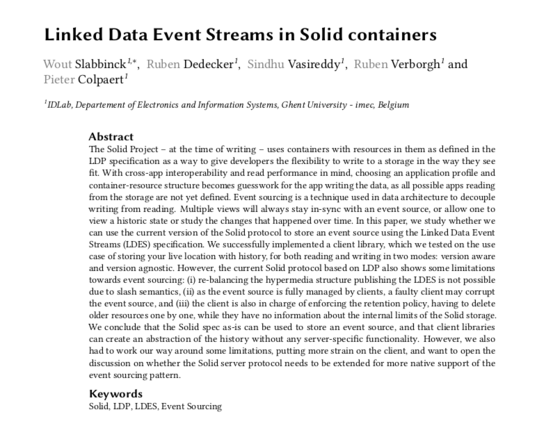
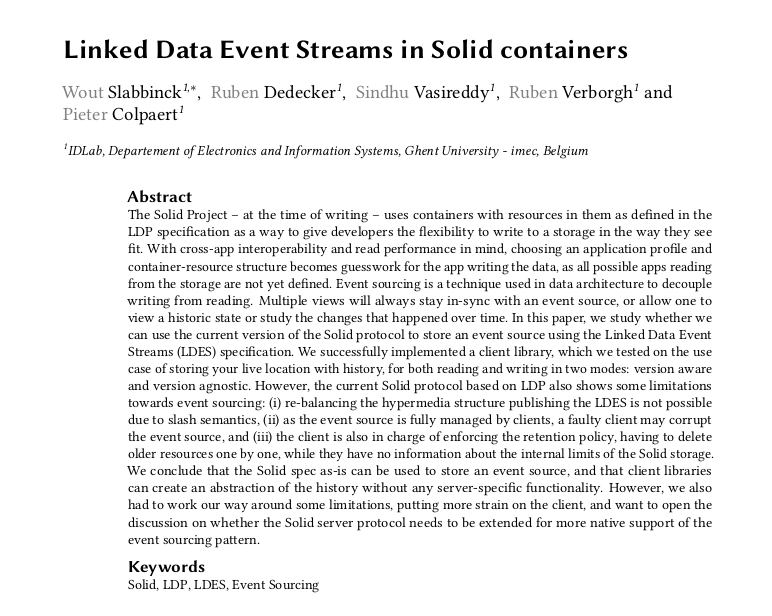
How do you keep history for e.g., your live location using the current #Solid protocol? We tried to find out by applying the concepts behind Linked Data Event Streams #LDES in #LDP.
While technically it is possible to store history in a #SolidProject pod (see NPM lib), in this paper we formulate our position that we should look at native support of event sourcing in the core Solid spec
* NPM library with too many work-arounds: https://www.npmjs.com/package/@treecg/versionawareldesinldp
* Position paper: https://raw.githubusercontent.com/woutslabbinck/papers/main/2022/Linked_Data_Event_Streams_in_Solid_containers.pdf
#solid #LDES #ldp #SolidProject
Pieter Colpaert · @pietercolpaert
574 followers · 158 posts · Server mastodon.social
You saw it here first: the official Linked Data Event Streams logo! #ldes
Website: https://tree.linkeddatafragments.org/linked-data-event-streams/
Pieter Colpaert · @pietercolpaert
545 followers · 140 posts · Server mastodon.socialKick-starting a matrix room on Linked Data Event Streams here 👇 #ldes
https://matrix.to/#/!HCYaBzWmkpZlPcCyAL:chat.semantic.works?via=chat.semantic.works&via=matrix.org
bblfish · @bblfish
155 followers · 176 posts · Server mathstodon.xyz
@burakemir @adamwarski @kien
The use of POST is mentioned in that exchange https://gist.github.com/jdarcy/60107fe4e653819138396257df302eef?permalink_comment_id=4370833#gistcomment-4370833 by @mariusor . I guess that POST is used by a server to notify listeners that something new is up, and then it may have been optimised by sending the body too? #LDES covers everything that Mariusor talks of on the immutable side of things, but notifications would still not be cachable. Are they over-using those?
bblfish · @bblfish
155 followers · 176 posts · Server mathstodon.xyz@burakemir @adamwarski @kien
The first bullet points out that for caching to work the URLs have to point to slowly changing resources - ideally immutable ones. If they are immutable then a client just need to fetch them once, and never again. Also if they are immutable (and that can be done by convention) then the content can be shared, since any client can check the resource by fetching the original URL if needed.
That is the point of #LDES https://github.com/SEMICeu/LinkedDataEventStreams

bblfish · @bblfish
151 followers · 171 posts · Server mathstodon.xyz@jducoeur @pmok @kien @Schlining @pietercolpaert
Yes, before one looks at the evolutionary path forward we need to see if #LDES actually solves the surmised problem. LDES has uses in Big decentralised Data beyond #Mastodon so we're not wasting our time.
*If* it helps then one could keep publishing the data the way it is now and also publish it in a RESTful manner too. Formats like JSON-LD allow one to do a duck-rabbit on JSON so as to minimise transition costs...
https://json-ld.org
bblfish · @bblfish
151 followers · 171 posts · Server mathstodon.xyz



@pmok @kien @jducoeur @Schlining @pietercolpaert
We should say that RPC is a smell.
Linked Data *Event Streams*, by offering a way of publishing data as an immutable referential explicit and cachable resources definitely seems like it could answer the RPC problem found in #ActivityPub.
I will be implementing some #LDES use cases in #Scala next, which will give me a good idea of how it works.
https://www.youtube.com/watch?v=89UVTahjCvo
Note that #SPARQL, the #RDF query language feels like a form of RPC...
#rdf #sparql #LDES #scala #activitypub