
Moritz Strohm · @mstrohm
28 followers · 1592 posts · Server kanoa.de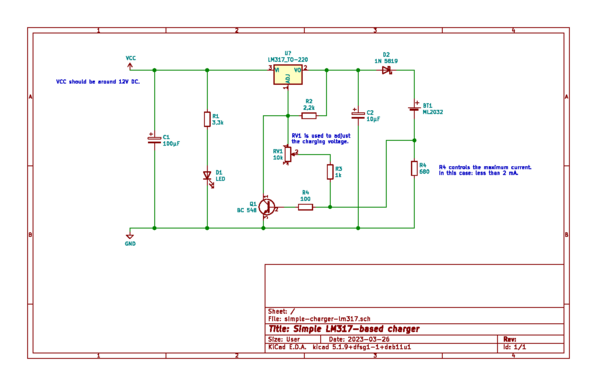
This is a circuit for a ML2032 lithium manganese dioxide button cell charger. It uses a LM317 voltage regulator in CCCV mode and charges with a bit less than 2 mA.
Here is the project with all the sources: https://codeberg.org/ncc1988/ml2032-chargers
Do not charge CR2032 button cells with this circuit, because they might explode!
#ML2032 #ButtonCell #Battery #Charger #Electronics #Circuit #OpenHardware
#ML2032 #buttonCell #battery #Charger #electronics #circuit #openhardware
Moritz Strohm · @mstrohm
28 followers · 1592 posts · Server kanoa.deI'm using ML2032 rechargeable button cells as replacements for CR2032 button cells in some appliances like LCD clocks or bicycle mileometers. They work great! I cannot see any loss in performance when using ML2032 cells instead of CR2032 cells.
The only drawback is the long charging time, caused by the low maximum charging current of 2mA at 65mAh capacity. But that is OK, since I can reduce waste by using rechargeable batteries. 😉
#ML2032 #cr2032 #battery #RechargeableBattery #energy
Moritz Strohm · @mstrohm
28 followers · 1591 posts · Server kanoa.de
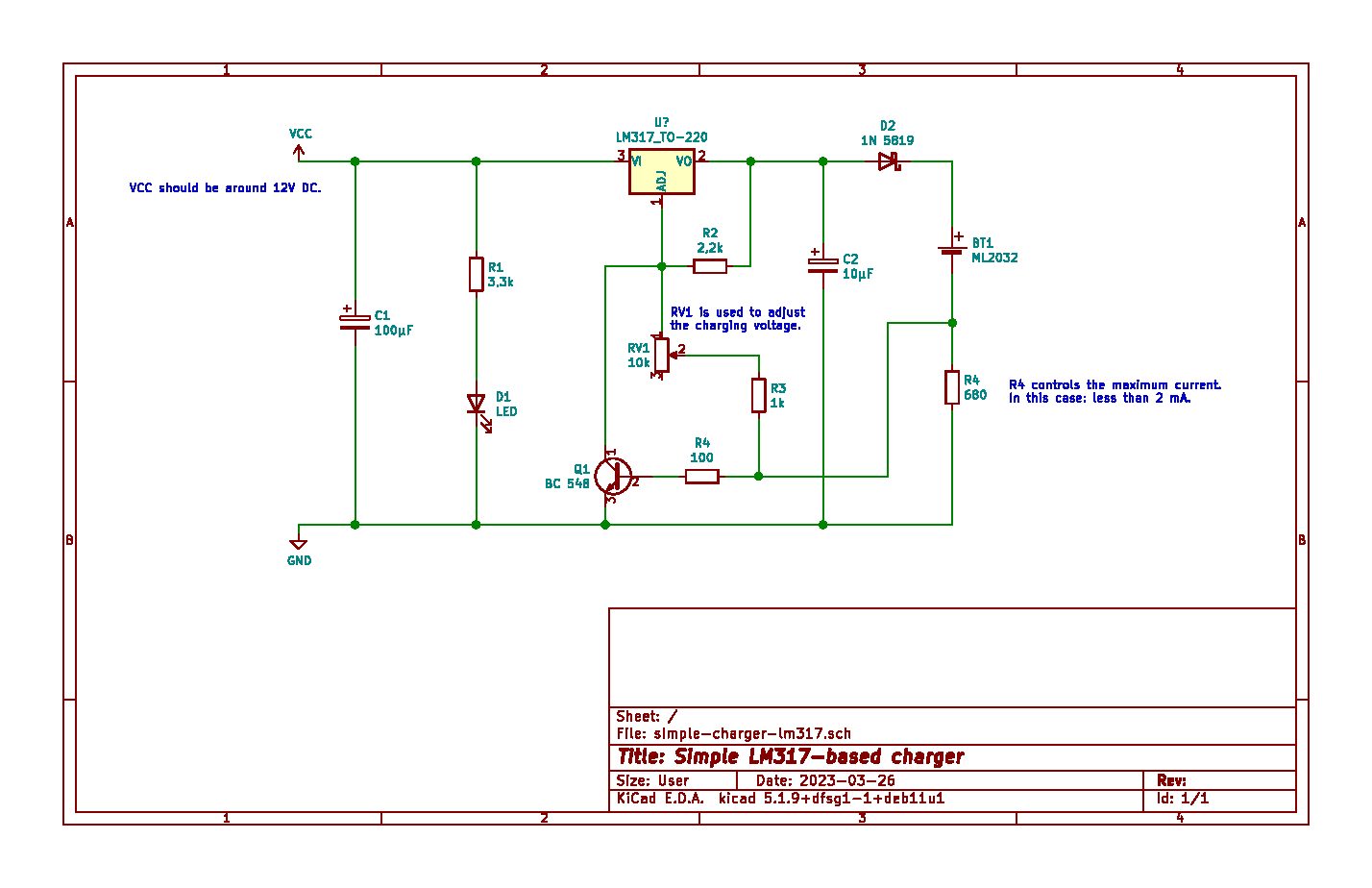
This is a circuit for a ML2032 lithium manganese dioxide button cell charger. It uses a LM317 voltage regulator in CCCV mode and charges with a bit less than 2 mA.
Here is the project with all the sources: https://codeberg.org/ncc1988/ml2032-chargers
Do not charge CR2032 button cells with this circuit, because they might explode!
#ML2032 #ButtonCell #Battery #Charger #Electronics #Circuit #OpenHardware
#ML2032 #buttonCell #battery #Charger #electronics #circuit #openhardware

Moritz Strohm · @mstrohm
26 followers · 1249 posts · Server kanoa.de
I started replacing non-rechargeable CR2032 batteries with rechargeable ML2032 batteries. Although I don't have a charger for them yet, I still have at least one month to build one. 🙂
If all goes well, I can use a microcontroller to charge them safely. That charger project is being developed on Codeberg: https://codeberg.org/ncc1988/ml2032-charger
#cr2032 #ML2032 #battery #RechargeableBattery

Moritz Strohm · @mstrohm
22 followers · 1215 posts · Server www.kanoa.de

I started replacing non-rechargeable CR2032 batteries with rechargeable ML2032 batteries. Although I don't have a charger for them yet, I still have at least one month to build one. 🙂
If all goes well, I can use a microcontroller to charge them safely. That charger project is being developed on Codeberg: https://codeberg.org/ncc1988/ml2032-charger
#cr2032 #ML2032 #battery #RechargeableBattery
Moritz Strohm · @mstrohm
26 followers · 1249 posts · Server kanoa.deI started work on the ML2032 charging circuit:
https://codeberg.org/ncc1988/ml2032-charger
The schematic is GPLv3 licensed and the microcontroller software will also be released under that license.
#ML2032 #Electronic #Charger #Microcontroller #FLOSS #OpenHardware
#ML2032 #electronic #Charger #microcontroller #floss #openhardware
Moritz Strohm · @mstrohm
22 followers · 1215 posts · Server www.kanoa.deI started work on the ML2032 charging circuit:
https://codeberg.org/ncc1988/ml2032-charger
The schematic is GPLv3 licensed and the microcontroller software will also be released under that license.
#ML2032 #Electronic #Charger #Microcontroller #FLOSS #OpenHardware
#ML2032 #electronic #Charger #microcontroller #floss #openhardware
Moritz Strohm · @mstrohm
22 followers · 1215 posts · Server www.kanoa.deThe last devices in my home that are powered with non-rechargeable batteries use CR2032 button cells. I'm thinking about using ML2032 rechargeable button cells instead, but first I have to build my own (safe) charger first and make sure that overvoltage and overcharge protection works, since you can only buy the cells in Germany but no safe chargers for them.
ML2032 information (requires JavaScript): https://biz.maxell.com/en/rechargeable_batteries/ml.html
#cr2032 #ML2032 #electronic #batteries
Moritz Strohm · @mstrohm
26 followers · 1249 posts · Server kanoa.deThe last devices in my home that are powered with non-rechargeable batteries use CR2032 button cells. I'm thinking about using ML2032 rechargeable button cells instead, but first I have to build my own (safe) charger first and make sure that overvoltage and overcharge protection works, since you can only buy the cells in Germany but no safe chargers for them.
ML2032 information (requires JavaScript): https://biz.maxell.com/en/rechargeable_batteries/ml.html
#cr2032 #ML2032 #electronic #batteries