
Albert Cardona · @albertcardona
1203 followers · 459 posts · Server mathstodon.xyz
@dantracey @kristinmbranson @annikabarber @debivort @giorgiogilestro
Find the original basin-1 neurons at the #VirtualFlyBrain at "Tools - CATMAID - Hosted EM Data - Larval - Larva (ABD1.%)" which opens a #CATMAID server https://abd1.5.catmaid.virtualflybrain.org/?pid=1&zp=10485&yp=40560.65722061269&xp=42396.0789533435&tool=tracingtool&sid0=1&s0=4.5&help=true&layout=h(XY,%20%7B%20type:%20%22neuron-search%22,%20id:%20%22neuron-search-1%22,%20options:%20%7B%22annotation-name%22:%20%22papers%22%7D%7D,%200.6)
Find them via Neuron Search (icon with a "?").
The "Construction time" is wrong (see "Summary info" of the Selection Table) because these neurons were imported from #TrakEM2. Old enough to predate the #CATMAID software!
#neuroscience
#neuroscience #TrakEM2 #catmaid #VirtualFlyBrain
Albert Cardona · @albertcardona
913 followers · 2 posts · Server mathstodon.xyz#TrakEM2 runs as a plugin of #FijiSc https://fiji.sc/ and in fact motivated the creation of the #FijiSc software in the first place, to manage its many dependencies and facilitate distribution to the broader #neuroscience community.
#TrakEM2 was founded in 2005, when TB-sized datasets were rare and considered large. Largest dataset I've successfully managed with #TrakEM2 was ~16 TB. For larger volumes see #CATMAID.
For 3D visualization #TrakEM2 uses the 3D Viewer https://imagej.net/plugins/3d-viewer/
#catmaid #neuroscience #FijiSc #TrakEM2
Albert Cardona · @albertcardona
826 followers · 1 posts · Server mathstodon.xyz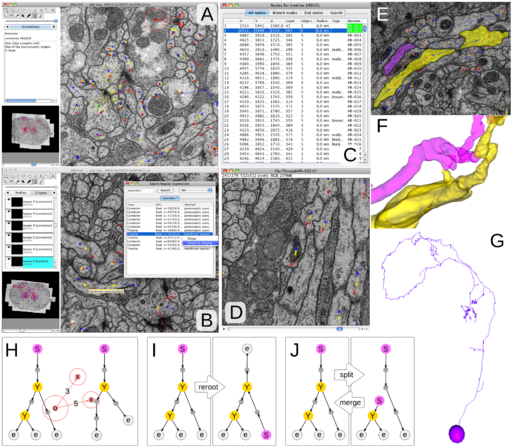
#introduction To fill in my profile tags, a thread:
#TrakEM2 open source software mostly for #connectomics, and supports manual and automatically montaging and aligning overlapping 2D image tiles (with #SIFT features and rigid or elastic transformation models), and reconstructing by painting volumes or tracing branched neuronal arbors neurons plus synapses to map a #connectome from #vEM (volume electron microscopy).
See: https://journals.plos.org/plosone/article?id=10.1371/journal.pone.0038011
Git repository at: https://github.com/trakem2/
#vem #connectome #sift #connectomics #TrakEM2 #introduction

Albert Cardona · @albertcardona
697 followers · 557 posts · Server qoto.org@manlius Yes, a lot, but generated mostly with #CATMAID which is more purpose-built for #connectomics.
An early reconstruction of a neural circuit done with #TrakEM2 was by Davi Bock et al. 2011 on the mouse visual cortex, "Network anatomy and in vivo physiology of visual cortical neurons" https://www.nature.com/articles/nature09802
Another one with #TrakEM2 was by Dan Bumbarger et al. 2013 "System-wide rewiring underlies behavioral differences in predatory and bacterial-feeding nematodes" where they compared #celegans with another nematode, #pristionchus pacificus that has the exact same amount of neurons but connected differently https://www.sciencedirect.com/science/article/pii/S0092867412015000
Later ones with #CATMAID include:
The polychaete worm #Platynereis by @jekely 's group, "Whole-animal #connectome and cell-type complement of the three-segmented Platynereis dumerilii larva" Verazto et al. 2020 https://www.biorxiv.org/content/10.1101/2020.08.21.260984v2.abstract
And all of ours in #Drosophila larva. See the #VirtualFlyBrain server which hosts the #vEM of the whole central nervous system and lists all the neurons included in each published paper (currently 23), shared among the papers and all connecting to each other: https://l1em.catmaid.virtualflybrain.org/?pid=1&zp=108250&yp=82961.59999999999&xp=54210.799999999996&tool=tracingtool&sid0=1&s0=2.4999999999999996&help=true&layout=h(XY,%20%7B%20type:%20%22neuron-search%22,%20id:%20%22neuron-search-1%22,%20options:%20%7B%22annotation-name%22:%20%22papers%22%7D%7D,%200.6)
The 24th will come soon, featuring the complete whole #Drosophila larval brain with ~2,500 neurons. It's under review.
#catmaid #Celegans #pristionchus #Platynereis #connectome #Drosophila #VirtualFlyBrain #vem #connectomics #TrakEM2
Albert Cardona · @albertcardona
697 followers · 557 posts · Server qoto.org@leoboeger The famous #pristionchus! Proud to have helped Dan Bumbarger [1] back in Zurich in 2010 or so when he visited me to learn how to register his serial sections with #TrakEM2. It’s been a while.
[1] Bumbarger et al. 2013 https://www.sciencedirect.com/science/article/pii/S0092867412015000
Albert Cardona · @albertcardona
697 followers · 557 posts · Server qoto.org
Albert Cardona · @albertcardona
697 followers · 557 posts · Server qoto.org
Now onto #FijiSc: Fiji is a recursive acronym meaning "Fiji is just ImageJ" https://fji.sc (and the paper https://www.nature.com/articles/nmeth.2019 ) –and #ImageJ is a #java open source software for image processing https://imagej.nih.gov/ij/index.html written by Wayne Rasband from the #NIH Research Branch.
An analogy: think of ImageJ as the kernel and Fiji as the rest of the operating system.
#FijiSc brings to #ImageJ:
(1) a package manager to install and update plugins, and that crucially enables reproducible science by exporting the whole set of plugins and libraries as an executable;
(2) a Script Editor https://imagej.net/scripting/script-editor supporting many languages (#python, #groovy #ruby #scala #clojure and more), all with access to a huge collection of #JVM libraries;
(3) huge amount of libraries such as #ImgLib2, #JFreeChart for plotting, for GUIs, etc.
There are many, many plugins. A tiny sample:
Machine learning-based image segmentation:
- #LabKit https://imagej.net/plugins/labkit/
- #WEKA Trainable Segmentation https://imagej.net/plugins/tws/index
3D/4D/ND Visualization:
- 3D/4D Viewer #3DViewer https://imagej.net/plugins/3d-viewer/index with ray-tracing, orthoslices, volume rendering, and more
- #BigDataViewer #BDV https://imagej.net/plugins/bdv/index for interactively navigate N-dimensional image volumes larger than RAM
Image registration and serial section alignment:
- #BigStitcher for registering 3D/4D tiled datasets, with multiview deconvolution and more https://imagej.net/plugins/bigstitcher/index
- #TrakEM2 for montaging in 2D and alinging in 3D collections of serial sections, typically from #vEM (volume electron microscopy) https://syn.mrc-lmb.cam.ac.uk/acardona/INI-2008-2011/trakem2.html
- #mpicbg libraries for extracting #SIFT and #MOPS features, then finding feature correspondences and estimating rigid and elastic transformation models https://www.nature.com/articles/nmeth.2072
Summarizing #FijiSc is impossible. See the online forum where questions find answers by the hand of the broader community of users and developers https://forum.image.sc/
#java #nih #python #groovy #ruby #BigDataViewer #BigStitcher #TrakEM2 #sift #FijiSc #imagej #scala #clojure #jvm #ImgLib2 #JFreeChart #LabKit #weka #3DViewer #bdv #vem #mpicbg #mops
Albert Cardona · @albertcardona
697 followers · 557 posts · Server qoto.org

To fill in my profile tags, a thread:
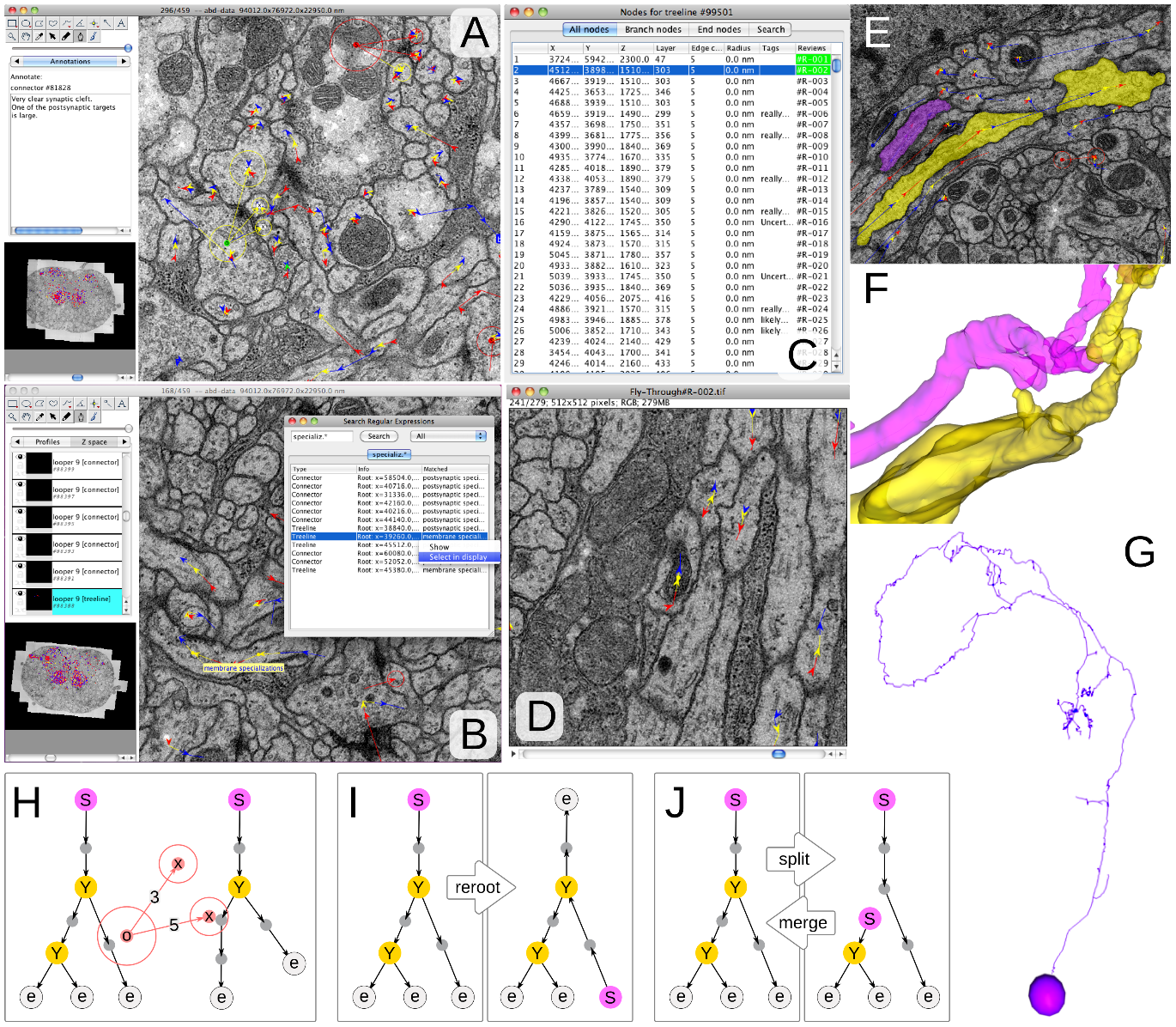
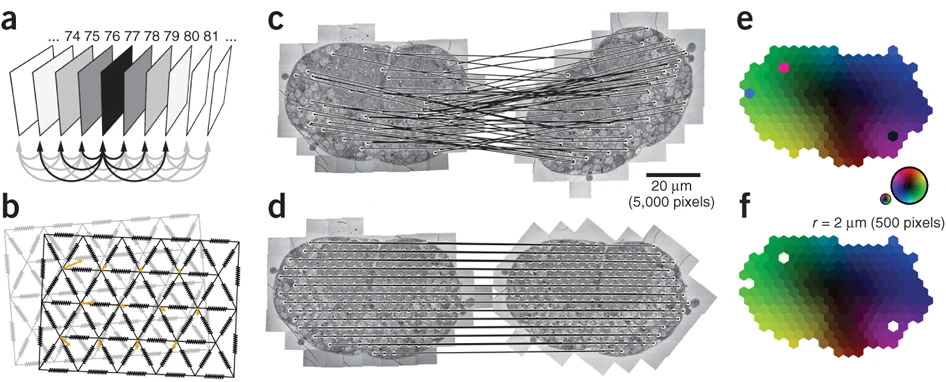
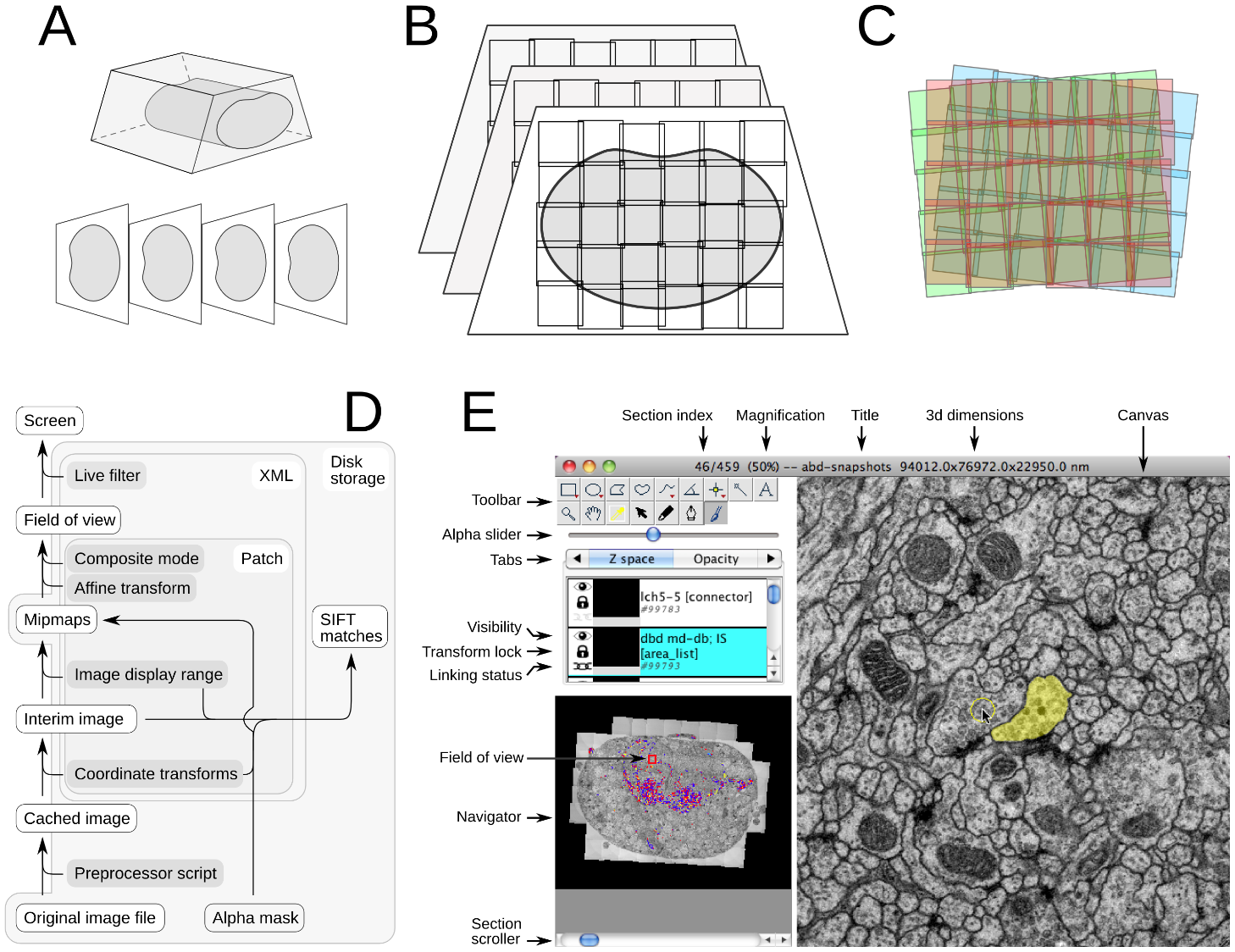
#TrakEM2 is open source software mostly for #connectomics (but found uses well beyond), and provides the means for both manual and automatic montaging and aligning overlapping 2D image tiles (with #SIFT features and rigid or elastic transformation models), and then reconstructing with mostly manual means–by painting with a digital brush–the volumes of structures of interest, as well as trace the branched arbors of e.g., neurons and annotate their synapses, therefore mapping a #connectome from #vEM (volume electron microscopy).
#TrakEM2 paper at https://journals.plos.org/plosone/article?id=10.1371/journal.pone.0038011
Git repository at https://github.com/trakem2/
For 3D visualization, #TrakEM2 uses the 3D Viewer https://imagej.net/plugins/3d-viewer/
As software, #TrakEM2 runs as a plugin of #FijiSc https://fiji.sc/ and in fact motivated the creation of the #FijiSc software in the first place, to manage its many dependencies and therefore facilitate distribution to the broader #neuroscience community.
#TrakEM2 was founded in 2005, when terabyte-sized datasets were rare and considered large. The largest dataset that I've successfully managed with #TrakEM2 was about 16 TB. For larger datasets, see #CATMAID below.
#connectomics #sift #connectome #TrakEM2 #vem #FijiSc #neuroscience #catmaid
Albert Cardona · @albertcardona
697 followers · 557 posts · Server qoto.orgAbove, my #introduction of interests. Here, who I am, what I do: a neuroscientist at the #MRCLMB and University of Cambridge, UK, studying the neural circuit basis of behavior, originally in #Drosophila but now also in #cephalopods (#pygmysquid #Idiosepius), the lancelet #Amphioxus and other animals. Our main approach: whole brain #connectomics with #vEM (volume electron microscopy) as the basis for computational modeling to guide neuronal activity perturbation and monitoring experiments with #optogenetics and #electrophysiology (#ephys for short).
Once upon a time I founded the #ImageJ -based #TrakEM2 software for image registration and neuronal arbor reconstruction and annotation, which spurred founding the #FijiSc (https://fiji.sc) image processing software, and later the #CATMAID web-based software for #connectomics.
Always open to inquires from prospective students and postdocs, and collaborations.
#introduction #vem #optogenetics #electrophysiology #ephys #imagej #TrakEM2 #MRCLMB #Drosophila #cephalopods #pygmysquid #Idiosepius #Amphioxus #connectomics #FijiSc #catmaid