BOSC (OpenBio's Conference) · @BOSC
209 followers · 94 posts · Server genomic.socialThanks to @GigaScience for this great write-up about ISMB/BOSC, and for your rockin' birthday party, and of course, for being a sponsor of #BOSC2023! 💚🍐 http://gigasciencejournal.com/blog/going-large-language-models-at-ismb2023/
BOSC (OpenBio's Conference) · @BOSC
209 followers · 93 posts · Server genomic.socialWe encourage #BOSC2023 presenters to share their slides and posters on
#F1000Research, where they can appear in both the BOSC and ISMB collections. Just go to https://f1000research.com/collections/bosc and click the orange “Submit” button near the top right.

Kirt in Queensland · @kirt
294 followers · 242 posts · Server aus.socialI've think worked out the confusion, the partly overlapping hashtags #BOSC2023 #ISMBECCB2023 made me think that it was a satellite meeting for #SMBE2023
But it's actually completely separate?
or are #BOSC2023 and #ISMBECCB2023 also separate to each other?
some of it was recoded? how long is that available for?
is recording access registered only?
cc other mes @kirt@mastodon.social @kirt@ecoevo.social @kirt@genomic.social
and friends @quinsibell @TashTaylor
now I need to work out what I'm registered for … I might have registered for clashing things because I neglected to put #smbe2023 in my calendar…
#bosc2023 #ismbeccb2023 #smbe2023
Kirt in Queensland · @kirt
294 followers · 242 posts · Server aus.socialnote to self, people and topics to follow from my @kirt@ecoevo.social profile
@OpenBio
@openbioeconomy@bird.makeup
BOSC (OpenBio's Conference) · @BOSC
209 followers · 93 posts · Server genomic.social
8/8 #BOSC2023 #ISMBECCB2023 summary.
Thank you everyone attending in person or online. We hope to have the talk videos freely available on our YouTube channel (https://www.youtube.com/@OBFBOSC), and encourage our presenters to share their slides and/or posters in our collection on F1000 http://f1000research.com/collections/bosc/
BOSC (OpenBio's Conference) · @BOSC
209 followers · 93 posts · Server genomic.social7/n #BOSC2023 #ISMBECCB2023 summary
The final session of talks, “FAIR and open data”, paved the way for a closing panel on Open and Ethical Data Sharing (https://www.open-bio.org/events/bosc-2023/bosc-2023-panel/) that expanded upon some of the points made by the two keynote speakers, including the observation that there’s no published ethical code for bioinformaticists, and the idea that we individually, and our scientific societies, can be advocates for better parctices in ethical data sharing.
BOSC (OpenBio's Conference) · @BOSC
201 followers · 86 posts · Server genomic.social6/n #BOSC2023 #ISMBECCB2023 summary
The next session, #OpenScience, represented the breadth of BOSC topics, including talks relating to open infrastructures and ecosystems, citizen science, training, outreach, and reproducibility. After lunch, a joint session brought together BOSC and the Bio-Ontologies COSI for talks relating to standards (including, of course, #ontologies) and frameworks for open science.
#bosc2023 #ismbeccb2023 #OpenScience #Ontologies
BOSC (OpenBio's Conference) · @BOSC
201 followers · 85 posts · Server genomic.social5/n #BOSC2023 #ISMBECCB2023 summary
... [BOSC keynote speaker] Joe Yracheta, the founder of the Native BioData Consortium, discussed our ethical responsibilities as people who work on open source tools and open bioinformatics research to ensure that indigenous data is ethically sourced and used.
BOSC (OpenBio's Conference) · @BOSC
201 followers · 85 posts · Server genomic.social4/n #BOSC2023 #ISMBECCB2023 summary
The second day of BOSC started with a thought-provoking keynote by Joseph Yracheta entitled “The Dissonance between Scientific Altruism & Capitalist Extraction: The Zero Trust and Federated Data Sovereignty Solution”, which examined thorny questions about the current open data environment and how it impacts American Indian / Native American communities.
BOSC (OpenBio's Conference) · @BOSC
201 followers · 85 posts · Server genomic.social... [BOSC Opening Keynote speaker] Sara El-Gebali (@yalahowy), made many points that resonated with the BOSC audience, such as the need to revamp research reward systems to take into account open science practices, not just one-dimensional publication metrics. After the keynote, Day 1 of BOSC had themed sessions: Translational bioinformatics; Workflows; Data analysis and visualization; and a new (for BOSC) session on AI/ML.
BOSC (OpenBio's Conference) · @BOSC
201 followers · 82 posts · Server genomic.social2/n #BOSC2023 #ISMBECCB2023 Summary
The first BOSC keynote was delivered by Sara El-Gebali, who spoke inspiringly about “A New Odyssey: Pioneering the Future of Scientific Progress Through Open Collaboration,” with case studies showing how open collaboration can strengthen inclusive scientific communities and vice-versa. For example, 95.5% of genomic research participants in GWAS are people of European heritage; this has led to the development of drugs that don’t work for most of the people ...
BOSC (OpenBio's Conference) · @BOSC
201 followers · 82 posts · Server genomic.social1/5 - #BOSC2023 #ISMBECCB2023 Summary
The 23rd annual Bioinformatics Open Source Conference, BOSC 2023 (open-bio.org/events/bosc-2023), kicked off with a welcome from chair Nomi Harris, an overview of BOSC’s parent organization, the Open Bioinformatics Foundation, and a report about the pre-BOSC CollaborationFest (#CoFest), a collaborative work event (including but not limited to hacking) hosted by the nearby ENS de Lyon.
#bosc2023 #ismbeccb2023 #cofest
BOSC (OpenBio's Conference) · @BOSC
201 followers · 82 posts · Server genomic.social
Unfortunately, the technical issue (Juno doesn't play well with Linux) was not resolvable; we regret that Brett was not able to livestream his #BOSC2023 talk. But you can now see it at https://youtube.com/watch?v=DzfQWFvBBMM&ab_channel=CuriiCorporation
@biocrusoe @tetron
BOSC (OpenBio's Conference) · @BOSC
201 followers · 82 posts · Server genomic.social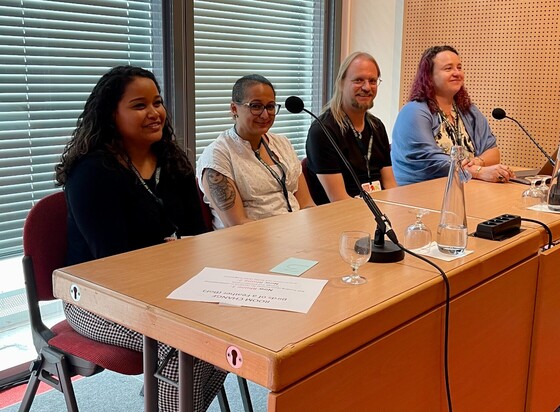
Photo of the moderator and in-person panelists (Joseph Yracheta is participating virtually) #BOSC2023
Harry Caufield · @jhc
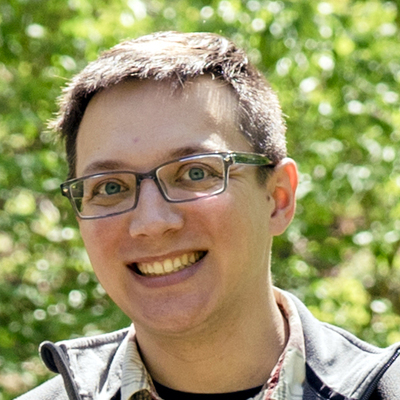
96 followers · 110 posts · Server fediscience.orgClosing #bosc2023 is a panel on open and ethical data sharing.
Panelists:
Sara El-Gebali
Bastian Greshake Tzovaras
Monica Munoz-Torres
Joseph Yracheta
Verena Ras
Harry Caufield · @jhc
96 followers · 108 posts · Server fediscience.orgAnja Adamov: Sequence data resources don't all work with the same tools. But q2-fondue will fetch NCBI SRA records then convert into a standardized format, ready for further analysis. It can scrape from a Zotero citation library too. Get it here: https://github.com/bokulich-lab/q2-fondue
Harry Caufield · @jhc
96 followers · 107 posts · Server fediscience.orgXiaofeng Liao: FAIR Data Cube is tools and services for standardizing multi-omics metadata, data transformation, and federated computing.
What does it have to do with cubes? (A cube has multiple sides, like multi-omics)
Take a look: https://github.com/Xomics/FAIRDataCube
Harry Caufield · @jhc
95 followers · 103 posts · Server fediscience.orgBhavesh Patel: How do we make research software reusable? Actionable advice is out there in the FAIR-BioRS guidelines, an effort started at BOSC CoFest 2022.
See http://github.com/fair-biors
Harry Caufield · @jhc
95 followers · 102 posts · Server fediscience.org
Matthew Crown: Microbiome composition changes with geographic location, so you probably want to annotate that metadata consistently, right? OMEinfo helps to link and visualize location data.
Harry Caufield · @jhc
93 followers · 99 posts · Server fediscience.orgJustin Reese: do you want to build a knowledge graph but don't know where to start? Would you like it to be compatible with other graphs, queryable, and ready for machine learning? You'll probably find KG-Hub useful.
Read more at http://kghub.org