
Quinn Dombrowski · @quinnanya
1947 followers · 1824 posts · Server mstdn.social
Rachel Pierce: Digital collections need to be integrated into broader system of archival management, including metadata & description. Describing digital collections appropriately runs against tradition of something only existing in one place: it has to exist in two. Can reimagine description by reframing archive as an archival body (per Jamie Ann Lee). #archives #DHNB2023
Quinn Dombrowski · @quinnanya
1947 followers · 1824 posts · Server mstdn.social
Rachel Pierce: sustainability of images in databases has repercussions for sustainability of modes of history-making. Each rebuilding of database is new moment of fact-making, and affects the kinds of histories you can write over time. Digital archives make it clearer that archives are processes, not something stable. #DigitalHumanities #DHNB2023 #archives
#archives #dhnb2023 #digitalhumanities
Quinn Dombrowski · @quinnanya
1947 followers · 1824 posts · Server mstdn.socialA little late to Rachel Pierce's presentation on "Picturing Swedish Women’s History: Digitizing Photographs from the KvinnSam Archives", but current discussion is on how to bring things together from disparate archives without losing context. Created thematized "historical portals" in lieu of a finding aid. Database and other materials are on servers that will be retired, so those structures will be archived & images will be (again) displaced from their context. #DHNB2023
Quinn Dombrowski · @quinnanya
1947 followers · 1824 posts · Server mstdn.social
I don't have answers here, but what came to mind was several older blog posts by @nowviskie. Preservation will have to take on different shapes, even unexpected ones. Maybe some things we print out. Maybe some data we embroider into dresses or knit into scarves. Institutions and organizations have a role to play here, but I suspect in the end, so much will come down to the choices of individuals and small groups to carry forward the things they love. #DHNB2023
Quinn Dombrowski · @quinnanya
1947 followers · 1824 posts · Server mstdn.social
Who's responsible for Voyant? Who's responsible for any of the things that are common-good resources, and defy easy preservation? I used to hope that #ADHO would take on a larger, more central role in maintaining things that are simultaneously everyone and no one's problem, but instead (for better and worse) it's moved towards decentralization. So we're back to the struggles of collective action. #DHNB2023
Quinn Dombrowski · @quinnanya
1947 followers · 1824 posts · Server mstdn.social
In terms of resources that defy easy solutions for preservation, I think of #Voyant. It's not even just that it's a widely used, very accessible, and beloved tool for teaching DH and publicly-engaged humanities. It's also, in some way, an embodiment of a beloved colleague who we lost too soon, and how he did DH. We've collectively written tributes, memorial lectures, put together awards, but it's more and different and harder work to try to keep Voyant alive. #DHNB2023
Quinn Dombrowski · @quinnanya
1947 followers · 1824 posts · Server mstdn.social
What's worked well for #DigitalHumanities when it comes to project sustainability is different ways of freezing things for future use -- like berries for a future smoothie or squid for a stir-fry. But not everything makes a good smoothie. What about tools that depend on user input and data and interaction? Web archive it all you want, store as many copies of the source code as you want, that alone won't get you something useful. #DHNB2023
Quinn Dombrowski · @quinnanya
1947 followers · 1824 posts · Server mstdn.social
Project Bamboo, honestly, had little to say about preservation. It was about use, and new ways to connect different pieces of the scholarly workflow so they could be used together. We didn't talk much about what happened when data could no longer be hosted or algorithms needed a rewrite and no one had the time or resources to do that -- we were too focused on getting infrastructure off the ground, and TBH, probably subconsciously figured the librarians would deal with it somehow. #DHNB2023
Quinn Dombrowski · @quinnanya
1947 followers · 1824 posts · Server mstdn.social
Still, we're no closer to the dream of Project Bamboo for some kind of infrastructure that can bring together disparate collections with scalable algorithms, in a way that everyone gets credit. The closest thing I can think of is #HathiTrust -- and that only works within its own texts and ecosystems. Good luck combining that with things your university has subscribed to. (Also, it's not easy to use!) #DHNB2023
Quinn Dombrowski · @quinnanya
1947 followers · 1824 posts · Server mstdn.social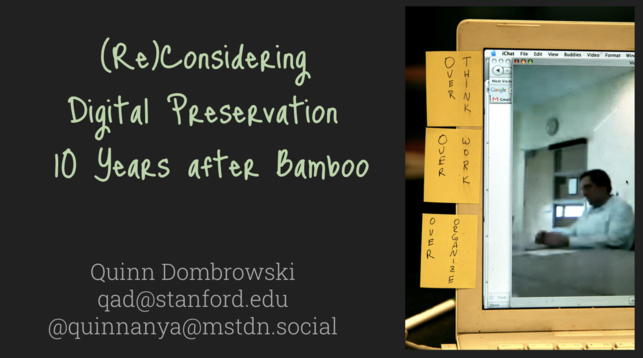
My talk was on "(Re)Considering Digital Preservation 10 Years after Bamboo", the Mellon-funded #DigitalHumanities cyberinfrastructure planning project where I got my start. There's a lot to be happy about: the emergence of disciplinary repositories for the humanities like @hcommons.social CORE, the move towards #MinimalComputing, the tendency to think about DH projects as data that can be archived, not just pretty websites. (Yeah that's @miriamkp as a data superhero.) #DHNB2023
#dhnb2023 #minimalcomputing #digitalhumanities
Quinn Dombrowski · @quinnanya
1947 followers · 1824 posts · Server mstdn.socialHelena Byrne: If you just follow web archiving friendly standards, you'll have a really boring website. But there are some things you can do to improve it: don't rely on cloud storage (always block web archive crawlers), sitemaps are important. If you publish a website, archive it as soon as its's published. #WebArchiving #DHNB2023
Quinn Dombrowski · @quinnanya
1947 followers · 1824 posts · Server mstdn.socialOlga Holownia: "You're lucky if you have your projects in Portugal, Iceland, Australia -- these are the key countries for open access." #OpenAccess #WebArchiving #DHNB2023
#dhnb2023 #webarchiving #openaccess
Quinn Dombrowski · @quinnanya
1947 followers · 1824 posts · Server mstdn.socialPedro Gomes: Arquivo.pt Annual Award 2023 is coming; award for using material in Arquivo.pt web archives. https://sobre.arquivo.pt/en/collaborate/arquivo-pt-awards/arquivo-pt-award-2023/ #DHNB2023
Quinn Dombrowski · @quinnanya
1947 followers · 1824 posts · Server mstdn.socialSlides and notes from my talk coming last, but the final talk is Pedro Gomes on arquivo.pt, which began by archiving Horizon 2020 projects. Open data sets available at EU Data Portal used to identify URLs to be archived. Several of the projects already disappeared or will soon. Stored 17.3 TB of data between 2020-2021. #DHNB2023
Quinn Dombrowski · @quinnanya
1947 followers · 1824 posts · Server mstdn.socialHelena Byrne notes Conifer and @webrecorder as a DIY solution, but you do have to manage the files yourself. Several other options including British Library, arquivo.pt, and @internetarchive Wayback Machine for places where you can submit links, with different turnaround times for archiving. #DHNB2023 #WebArchiving
Quinn Dombrowski · @quinnanya
1947 followers · 1824 posts · Server mstdn.social
Helena Byrne: overview of web archiving in UK and Ireland. UK Web Archive has derived data you can download (.uk content from @internetarchive from 1996 - April 2013). #DHNB2023
Quinn Dombrowski · @quinnanya
1947 followers · 1824 posts · Server mstdn.socialHelena Byrne: Need for #WebArchiving include LOCKSS: Lots of Copies Keep Stuff Safe, link rot, content drift (site becomes something else). https://timetravel.mementoweb.org/ is a union catalogue of web archives -- @internetarchive but also others. Lack of other archives may be due to permissions restrictions (eg UK, France, Nordic archives). #DHNB2023
Quinn Dombrowski · @quinnanya
1947 followers · 1824 posts · Server mstdn.social
Helena Byrne starts off with different ways to use #WebArchives in research: as a reference resource, as point of study, as a preservation tool. #DHNB2023
Quinn Dombrowski · @quinnanya
1947 followers · 1824 posts · Server mstdn.socialOlga Holownia: case study of vefsafns.is -- new university maintenance policy that sites can be removed if it's not continually developed, even though it was designed to be a long-term open-ended DH project. "We assumed someone somehow would maintain it." Used WordPress & Wikimedia at university IT's advice. Site was archived regularly, but archives didn't include searchability or interactive features, which limited functionality. #DHNB2023
Quinn Dombrowski · @quinnanya
1947 followers · 1824 posts · Server mstdn.social


Olga Holownia describing landscape of #WebArchiving tools. Webrecorder introduced WACZ (WARC + bundled metadata) format. More resources available in Google Doc: https://docs.google.com/document/d/1_sj72E1hffXdfc5Vt2Np2eNYvV0d9GRPBKRKBsFXnds/edit#heading=h.lb68nb36jdyl. #DHNB2023