JdeBP · @JdeBP
36 followers · 253 posts · Server tty0.socialIt's amazing to see the built in X text window in cacaflame actually run faster, tunnelled over the exact same SSH connection, than sending the original text and colour control sequences to a terminal emulator to have the terminal emulator render them locally instead of the X server.
It says something about how bloody inefficient streamed ECMA-48 text is. There's a reason that back in the BBS days, people were inventing binary protocols such as AVATAR.
JdeBP · @JdeBP
31 followers · 188 posts · Server tty0.social
MobaXTerm fares somewhat better, getting REP of non-BMP characters right.
But conversely it seems unable to comprehend unscii-16, and insists upon unscii font glyphs being only 8 lines high, resulting in massive gutters between rows.
And only unscii has the glyphs for MouseText. They're not in Cascadia Mono, for example.
#mobaxterm #mousetext #unicode #ecma48
JdeBP · @JdeBP
31 followers · 187 posts · Server tty0.social
Microsoft Terminal goes badly wrong when REP is combined with characters outwith the BMP. Microsoft Terminal Preview is better, but still goes wrong sometimes when (as in the second image here on the bottom scrollbar) told to REP a character.
#microsoftterminal #mousetext #unicode #ecma48
JdeBP · @JdeBP
31 followers · 187 posts · Server tty0.social
JdeBP · @JdeBP
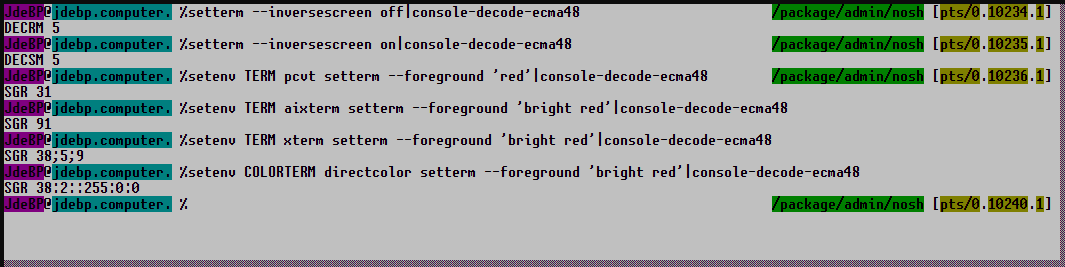
31 followers · 187 posts · Server tty0.socialTry inverting the screen and switching between DEC VT520 "light" and "dark". (As you can see, my toolkit has a handy tool for doing this, but it's a simple exercise in printf(1) without.) If that's not satisfactory, then fiddle with the #terminal emulator's palette configuration.
There's nothing that you can do otherwise. In GUIs, applications have "Give me the user's choice of title bar colour" library calls. There's none of that for Unix TUIs.
#terminal #t416 #decvt #ecma48
JdeBP · @JdeBP
31 followers · 187 posts · Server tty0.social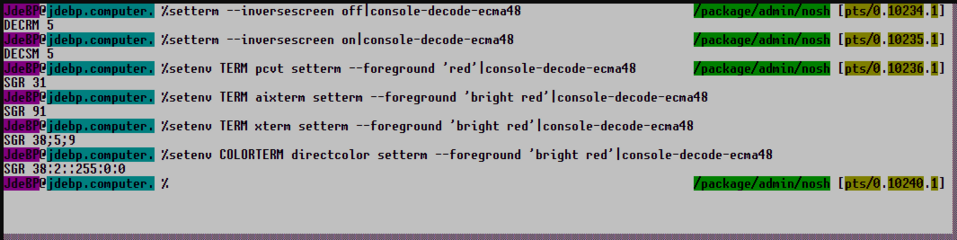


@RL_Dane @teamtuck (continued...)
The _only_ control that you have is DECSCNM, an extension to ECMA-48 control sequences from DEC VTs that many terminal emulators (sort of, rxvt getting it wrong, for example) also support.
It basically inverts the sense of the SGR 7 (negative image/reverse video) attribute for the entire display. DEC VT520 doco called it "light" and "dark".
https://vt100.net/docs/vt510-rm/DECSCNM.html
JdeBP · @JdeBP
31 followers · 187 posts · Server tty0.social@RL_Dane @teamtuck (continued...)
How the ECMA-48, #AIXTerm, and ITU T.416 indexed colours come out is up to the #terminal; as is, indeed, how the default colour comes out.
For these indexed colour schemes there's usually a palette that maps to RGB. Some terminal _emulators_ can adjust the palette. But real terminals didn't even have the 256-colour indexed system, let alone palettes.
The applications pretty much have no say.
#aixterm #terminal #decvt #ecma48 #t416
JdeBP · @JdeBP
31 followers · 187 posts · Server tty0.socialThe colour #terminal paradigm just doesn't work that way.
Applications can pick from the 8 colours of ECMA-48, or from that plus the additional 8 colours from IBM #AIXterm, or from the 256 indexed colour set of ITU T.416, or from the full ITU T.416 RGB direct colour system.
There are no "modes" or "themes". An application asks for the default colour, or for an explicit ECMA-48, AIXterm, T.416 indexed colour, or RGB direct colour.
#terminal #aixterm #decvt #ecma48 #t416