
Mr.Trunk · @mrtrunk
7 followers · 12433 posts · Server dromedary.seedoubleyou.meGizmodo: Webb Telescope Image Suggests Even the Most Distant Star Has Company https://gizmodo.com/webb-telescope-image-most-distant-star-company-1850726205 #jameswebbspacetelescope #gravitationallensing #macsj1149lensedstar1 #hubblespacetelescope #intergalacticstars #technologyinternet #gravitationallens #humaninterest #galaxycluster #brianwelch #whl0137ls #earendel #galaxy #cetus #webb
#jameswebbspacetelescope #gravitationallensing #macsj1149lensedstar1 #hubblespacetelescope #intergalacticstars #technologyinternet #gravitationallens #humaninterest #galaxycluster #brianwelch #whl0137ls #earendel #galaxy #cetus #webb

Louis Marmet · @redshiftdrift
110 followers · 211 posts · Server astrodon.social#ImpossibleGalaxyCluster #GalaxyCluster
"Unexpectedly calm and remote galaxy cluster discovered"
<<It would be like finding a tidy kitchen right after the dinner rush.>> = impossible😉
🔗 https://phys.org/news/2023-07-unexpectedly-calm-remote-galaxy-cluster.html
#impossiblegalaxycluster #galaxycluster

Daniel Fischer · @cosmos4u
1396 followers · 2437 posts · Server scicomm.xyzThe #eROSITA Final Equatorial-Depth Survey (#eFEDS): https://arxiv.org/abs/2305.00016 - A Machine Learning Approach to Infer #GalaxyCluster Masses from eROSITA X-ray Images.
#galaxycluster #efeds #erosita

ᴄᴏʀʀᴀᴅᴏ · @astrocorus
125 followers · 389 posts · Server astrodon.social
#Webb reveals #earlyuniverse prequel to huge #galaxycluster
https://phys.org/news/2023-04-webb-reveals-early-universe-prequel-huge.html
#Webb #earlyuniverse #galaxycluster
Daniel Fischer · @cosmos4u
1323 followers · 2185 posts · Server scicomm.xyz
Surface brightness discontinuities in radio halos - insights from the #MeerKAT #GalaxyCluster Legacy Survey: https://arxiv.org/abs/2302.07881 ("For the #BulletCluster, we find excellent agreement between the locations of the 4 radio discontinuities detected and the X-ray edges. [...] We conclude that radio halos are shaped by dynamical motions in the ICM and that they often display surface brightness discontinuities, which appear to be co-located with edges in the thermal gas emission.")
#BulletCluster #galaxycluster #meerkat
Daniel Fischer · @cosmos4u
1269 followers · 2027 posts · Server scicomm.xyz
Whoa, there is still *really* cool stuff on the #birdsite ... like the reconstruction on the right of what a distant #galaxy actually looks like that #Webb sees heavily distorted and in two pieces (image on the left) - they used a model for the #GravitationalLensing caused by the foreground #GalaxyCluster to undo the light bending. It's all explained nicely (and exclusively?) in the thread https://twitter.com/templates_jwst/status/1641085011926368258 ... or https://nitter.net/templates_jwst/status/1641085011926368258#m while that alternative Twitter front-end is working.
#galaxycluster #gravitationallensing #webb #galaxy #birdsite
Daniel Fischer · @cosmos4u
1253 followers · 2011 posts · Server scicomm.xyz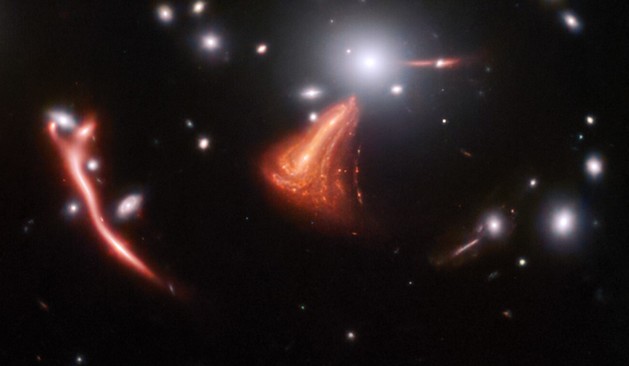
#GravitationalLensing by the #GalaxyCluster SDSS J1226+2149, imaged by the #JWST's NIRCAM from 1.2 bis 4.4 µm (particularly funny details): https://esawebb.org/images/potm2303a/
#jwst #galaxycluster #gravitationallensing
Louis Marmet · @redshiftdrift
75 followers · 336 posts · Server astrodon.social#GalaxyCluster #Mass #DarkMatter #MOND
Wait! They remove the complicated part from observations and the simple remainder matches the simple model?
How is that supposed to improve the model?
"The new equation ... make a linear fit between two parameters and ignore everything else"
🔗 https://phys.org/news/2023-03-artificial-intelligence-secret-equation-galaxy.html
#galaxycluster #mass #darkmatter #mond
Daniel Fischer · @cosmos4u
1243 followers · 1898 posts · Server scicomm.xyz
A fine example of #rampressurestripping - sorry for having to write it this way, you know, the hashtag requirement ... - of #galaxy moving through the #intergalacticmedium in a #galaxycluster, in a #Hubble image of JW100 in Pegasus: https://esahubble.org/images/potw2312a/
#hubble #galaxycluster #intergalacticmedium #galaxy #rampressurestripping

Phys.org · @physorg_bot
423 followers · 9963 posts · Server social.platypush.techReferenced link: https://phys.org/news/2023-03-diffuse-radio-emission-galaxy-cluster.html
Discuss on https://discu.eu/q/https://phys.org/news/2023-03-diffuse-radio-emission-galaxy-cluster.html
Originally posted by Phys.org / @physorg_com: http://nitter.platypush.tech/physorg_com/status/1635627865772380160#m
Study sheds more light on the diffuse radio emission from the #galaxycluster Abell 1213 @arxiv https://phys.org/news/2023-03-diffuse-radio-emission-galaxy-cluster.html
ᴄᴏʀʀᴀᴅᴏ · @astrocorus
107 followers · 221 posts · Server astrodon.social
The #galaxycluster that broke #modifiedgravity
https://bigthink.com/starts-with-a-bang/galaxy-cluster-broke-modified-gravity/
#galaxycluster #modifiedgravity
Daniel Fischer · @cosmos4u
1137 followers · 1326 posts · Server scicomm.xyz
Magnetic fields and relativistic electrons fill entire galaxy cluster: https://www.science.org/doi/10.1126/sciadv.abq7623 -> We studied the giant (5 Mpc) radio emission that embeds the #galaxycluster Abell 2255. This provides information on the non-thermal components at large distances from the cluster center: https://twitter.com/and_botteon/status/1587929356508475393

Ansgar Schmidt :verified: · @Ansi
439 followers · 1247 posts · Server mastodon.cloud
Hubble takes beautiful image of galaxies “dancing” https://www.optimistdaily.com/2022/12/hubble-takes-beautiful-image-of-galaxies-dancing/?utm_source=rss&utm_medium=rss&utm_campaign=hubble-takes-beautiful-image-of-galaxies-dancing #galaxyformation #galaxycluster #bestof2022 #darkmatter #evergreen #telescope #universe #science #hubble #space
#galaxyformation #galaxycluster #darkmatter #telescope #universe #science #hubble #space #bestof2022 #evergreen

Reymond Aguinaldo · @mondinspace
375 followers · 1244 posts · Server mastodon.social
Two views of the galaxy cluster #SMACS0723—#HubbleSpaceTelescope on the left, #JamesWebbSpaceTelescope on the right. #Hubble’s image on the left shows many faint stars and galaxies, but the #Webb image absolutely pops with light, revealing many hidden structures.
Hubble vs Webb: https://webb.nasa.gov/content/about/comparisonWebbVsHubble.html
#SpaceMastodon #Spacedon #Space #Astronomy #Astrodon #ScienceMastodon #Sciencedon #Science #JWST #HST #Galaxies #GalaxyCluster
#SMACS0723 #hubblespacetelescope #jameswebbspacetelescope #hubble #webb #SpaceMastodon #spacedon #space #astronomy #Astrodon #sciencemastodon #sciencedon #science #jwst #hst #galaxies #galaxycluster
Reymond Aguinaldo · @mondinspace
375 followers · 1244 posts · Server mastodon.socialThis deep field, taken by #Webb’s Near-Infrared Camera (NIRCam), is a composite made from images at different wavelengths, totalling 12.5 hours—achieving depths at infrared wavelengths beyond the #HubbleSpaceTelescope’s deepest fields, which took weeks.
#SpaceMastodon #Spacedon #Space #Astronomy #Astrodon #ScienceMastodon #Sciencedon #Science #JWST #Galaxies #GalaxyCluster
#webb #hubblespacetelescope #SpaceMastodon #spacedon #space #astronomy #Astrodon #sciencemastodon #sciencedon #science #jwst #galaxies #galaxycluster
Reymond Aguinaldo · @mondinspace
375 followers · 1244 posts · Server mastodon.social
Revisiting the #JamesWebbSpaceTelescope’s first image. It shows the galaxy cluster #SMACS0723 in unprecedented detail—and as it appeared 4.6 billion years ago. SMACS 0723 is a cluster of galaxies in the southern constellation #Volans and hasn’t previously been studied extensively.
More information about #JWST’s first images: https://www.nasa.gov/webbfirstimages
#SpaceMastodon #Spacedon #Space #Astronomy #Astrodon #ScienceMastodon #Sciencedon #Science #Webb #JWST #Galaxies #GalaxyCluster
#Volans #jwst #SpaceMastodon #spacedon #space #astronomy #Astrodon #sciencemastodon #sciencedon #science #webb #galaxies #galaxycluster #jameswebbspacetelescope #SMACS0723

.bee · @dotbee
37 followers · 37 posts · Server mastodon.art
#ngc7674 #spiralgalaxy #galaxyart #galaxycluster #cosmicart #pointilism #stippling #dotwork #drawing #spaceart
Inspired by @nasa_bot
#spaceart #drawing #dotwork #stippling #pointilism #cosmicart #galaxycluster #galaxyart #spiralgalaxy #ngc7674

Tim ☑️ 🔭🌃📷 🚴🌳 · @xylophilist
161 followers · 179 posts · Server mastodon.online
Markarian’s Chain
An arc of galaxies in the Virgo cluster. The first two galaxies (M86, M84) were noted by Messier; the chain is named for Benjamin Markarian who spotted it in the 1960s.
IG: https://www.instagram.com/p/Cc3O2__jDi9/
🔭: https://telescopius.com/pictures/view/115231/deep_sky/markarian-chain/galaxy/by-xylophilist
#Astrophotography #skywatcher80ed #galaxycluster #ThePhotoHour
#thephotohour #galaxycluster #skywatcher80ed #astrophotography
Arsène Ω🔻🌐🏳️🌈 · @Arsene
331 followers · 8915 posts · Server mamot.fr


APOD: 2020 October 10 - Virgo Cluster Galaxies
https://apod.nasa.gov/apod/ap201010.html
Galaxies of the Virgo Cluster are scattered across this deep telescopic field of view. The cosmic scene spans about three Full Moons, captured in dark skies near Jalisco, Mexico, planet Earth. About 50 million light-years distant, the Virgo Cluster is the closest large galaxy cluster to our own local galaxy group. […]
#galaxycluster #m87 #markarianschain
Arsène Ω🔻🌐🏳️🌈 · @Arsene
333 followers · 9607 posts · Server mamot.frAPOD: 2020 October 10 - Virgo Cluster Galaxies
https://apod.nasa.gov/apod/ap201010.html
Galaxies of the Virgo Cluster are scattered across this deep telescopic field of view. The cosmic scene spans about three Full Moons, captured in dark skies near Jalisco, Mexico, planet Earth. About 50 million light-years distant, the Virgo Cluster is the closest large galaxy cluster to our own local galaxy group. […]
#galaxycluster #m87 #markarianschain