
IB-Doku · @ibdoku
1001 followers · 1268 posts · Server ruhr.social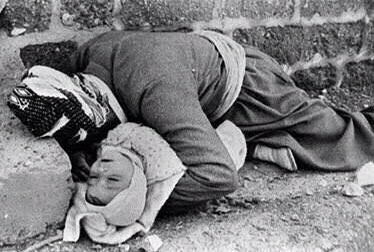
RT @ismail_kupeli
Heute vor genau 35 Jahren wurden 5000 Kurd:innen in #Halabja durch ein Giftgasangriff der irakischen Armee ermordet. Die deutschen Firmen, die für die irakische Giftgasproduktion mitverantwortlich waren, blieben straffrei.

Shermin Arif · @Magic_Cauldron
421 followers · 2564 posts · Server treehouse.technopagans.deCN Tod
35 Jahre seit dem Giftgasangriff auf #Halabja in #Kurdistan. Geschätzt bis zu 5000 Tote. Ganze Familien ermordet. Menschen, die auch heute noch an den Folgen leiden (Krebs, Missbildungen...)
Die Zutaten für das Giftgas kamen aus Deutschland
https://www.spiegel.de/politik/ausland/deutschland-lieferte-chemikalien-an-saddams-irak-und-assads-syrien-a-923347.html
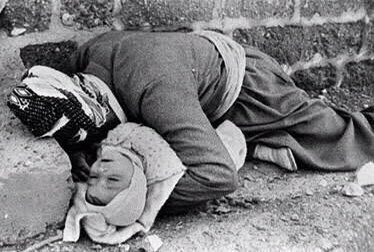
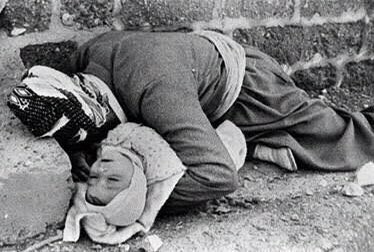
Kaum etwas in meiner Kindheit war so prägend für mich (außer vielleicht das abstrakte Tschernobyl), wie dieser Angriff. Die Bilder der Toten. Das Entsetzen darüber. Der Vater, der im Tod noch schützend sein Kind hält. Ich kann inzwischen die menschliche Natur nachvollziehen, die zu solch inhumanen Dingen fähig ist. Verstehen können werde ich diesen Teil allerdings nie.
Halabja ist unvergessen. Ich sehe die Gesichter in jedem Krieg - und frage mich, ob wir wohl niemals lernen werden.

Jens P:antifa:likeit (er) · @yaenntz
348 followers · 2704 posts · Server don.linxx.net
Hans-Georg Moohten · @moohten
299 followers · 10542 posts · Server mstdn.io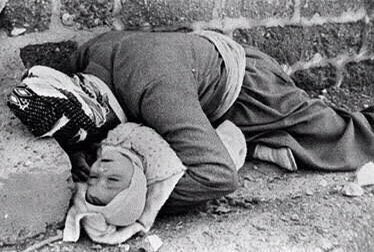
RT @ismail_kupeli
Heute vor genau 35 Jahren wurden 5000 Kurd:innen in #Halabja durch ein Giftgasangriff der irakischen Armee ermordet. Die deutschen Firmen, die für die irakische Giftgasproduktion mitverantwortlich waren, blieben straffrei.
Ismail Küpeli · @ismail_kupeli
1781 followers · 63 posts · Server digitalcourage.social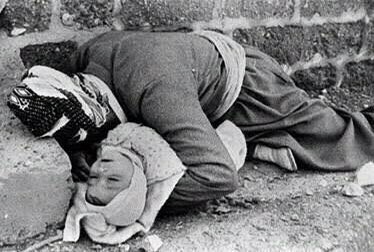
Heute vor genau 35 Jahren wurden 5000 Kurd:innen in #Halabja durch ein Giftgasangriff der irakischen Armee ermordet. Die deutschen Firmen, die für die irakische Giftgasproduktion mitverantwortlich waren, blieben straffrei.
... and behold · @andbhold
250 followers · 922 posts · Server mstdn.ioVor 35 Jahren wurden etwa 5000 Kurd"innen - Männer, Frauen, Kinder - in #Halabja im Irak eiskalt mit Giftgas ermordet.
Dabei auf Saddam zu zeigen ist verlockend, doch etwas zu einfach... Auch deutsche Firmen und der BND hatten die Finger im Spiel.
https://www.medico.de/halabdscha-14658

Arbella Bet-Shlimon · @abshlimon
695 followers · 110 posts · Server spore.social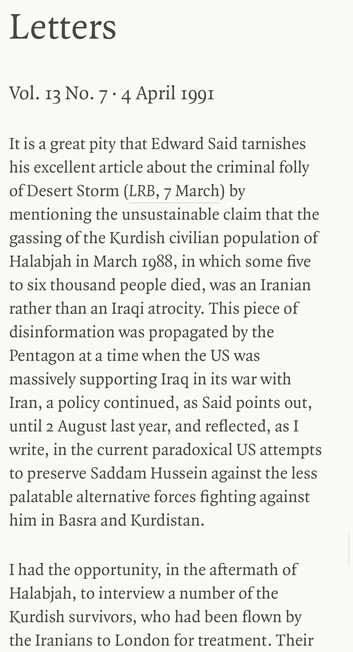
[#Halabja thread 16/16]
I conclude here with a powerful response to Edward Said’s Halabja denial by Steven Rose, a neuroscientist and founder of the British Committee for the Universities of Palestine, also published in the London Review of Books in 1991 (as a response to Said): https://www.lrb.co.uk/the-paper/v13/n05/edward-said/edward-said-an-american-and-an-arab-writes-on-the-eve-of-the-iraqi-soviet-peace-talks
Arbella Bet-Shlimon · @abshlimon
695 followers · 110 posts · Server spore.social
[#Halabja thread 15/16]
Remember the people of Halabja today. Remember the #Kurds, #Assyrians, and #Yazidis who were murdered and displaced during the Anfal #genocide. Spare a thought for others whose oppression is being exploited to justify Western warmaking and continues unabated.
For more on all of the above, see this book by Joost Hiltermann: https://books.google.com/books/about/A_Poisonous_Affair.html?id=5JGldonhk6wC
#halabja #kurds #assyrians #yazidis #genocide
Arbella Bet-Shlimon · @abshlimon
695 followers · 110 posts · Server spore.social[#Halabja thread 14/16]
Those who are caught between genocidal regimes and western imperialists are starved for solidarity. Their plight is either weaponized by warmongers who don’t actually care if they die, or ignored. Or worse, they’re mocked as State Department stooges or imperial propagandists—a smear that originates in easily ignored ideological margins, but permeates into activism, journalism, and academia more than you might think. The people of Halabja—& so many others—deserve better.
Arbella Bet-Shlimon · @abshlimon
695 followers · 110 posts · Server spore.social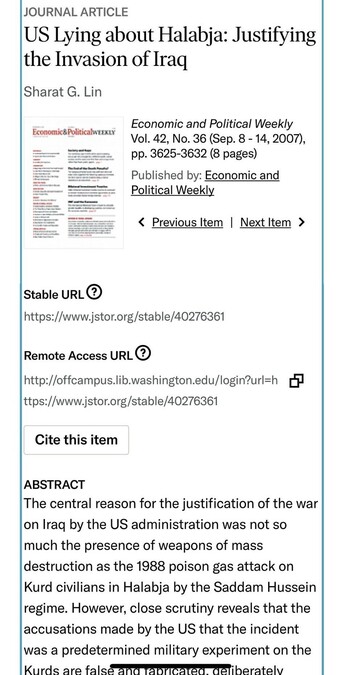
[#Halabja thread 13/16]
Bringing up a young Twitter rando’s thread might seem odd, but its content is salient. The claim that “Halabja was a tragic but defensive move by Iraq” is the more “respectable,” less conspiratorial version of Halabja denialism—one that muddies the waters rather than constructing a dubious alternative theory that Iran did it.
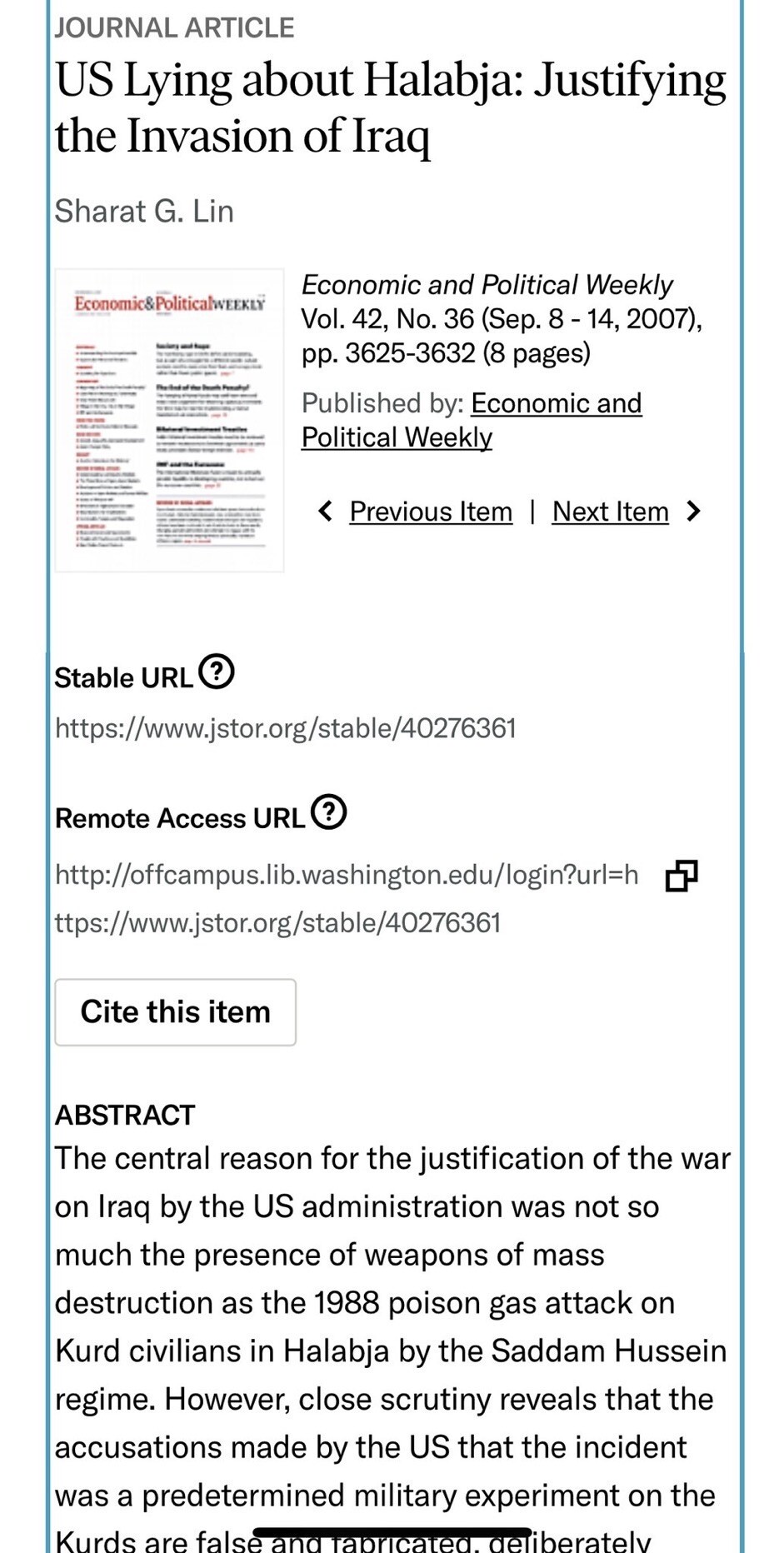
Don’t believe me? Here it is in a peer-reviewed academic journal in 2007: https://www.jstor.org/stable/40276361?seq=1#metadata_info_tab_contents
Arbella Bet-Shlimon · @abshlimon
695 followers · 110 posts · Server spore.social[#Halabja thread 12/16]
The second person deleted the thread after pushback (and they IDed as a minor in their bio at the time so I’ve redacted the screencap), but it hinged on a claim that the Anfal campaigns were justified because they happened amid a defensive war. The liberal application of the concept of “manufactured consent”—so often a starting point for genocide denial—is familiar.
Arbella Bet-Shlimon · @abshlimon
695 followers · 110 posts · Server spore.social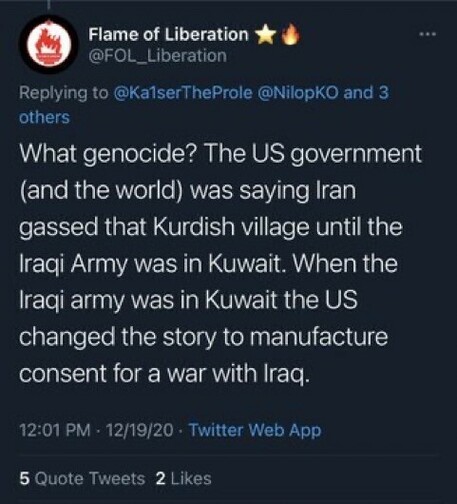
[#Halabja thread 11/16]
Now, as it is, those folks are too opportunistic to know anything about Halabja, so they don’t talk about it (also, since the alternative is usually blaming it on Iran, it doesn’t fit their rigid framework and doesn’t serve them). But once in a while you get takes like this:
Arbella Bet-Shlimon · @abshlimon
695 followers · 110 posts · Server spore.social[#Halabja thread 10/16]
If you don’t know who I mean, consider yourself lucky. They're all over other social media platforms, and it’s impossible to avoid their influence in any antiwar movement or organized left space.
They’d have produced “reports” examining photos of Halabja to prove the rescue workers had staged them. They’d smugly point out that Anfal couldn’t have been a genocide because the Kurds had a high birth rate. They’d bleat that what actually happened is nuanced and unknowable.
Arbella Bet-Shlimon · @abshlimon
695 followers · 110 posts · Server spore.social[#Halabja thread 9/16]
Fortunately, though, this claim was mostly ignored again in 2003 (message board posts like the one at the top of this thread notwithstanding). And today, most antiwar folks continue to acknowledge that Saddam Hussein was behind the attack.
Here’s the thing, though. If today’s media environment had existed in 1991 or 2003, we know exactly who would be alleging that Halabja was a false flag operation to justify the US invasion.
Arbella Bet-Shlimon · @abshlimon
695 followers · 110 posts · Server spore.social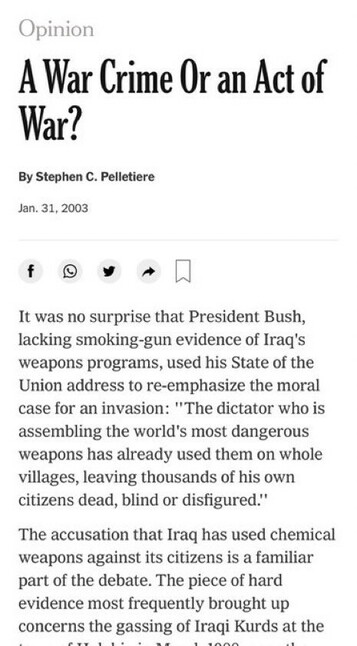
[#Halabja thread 8/16]
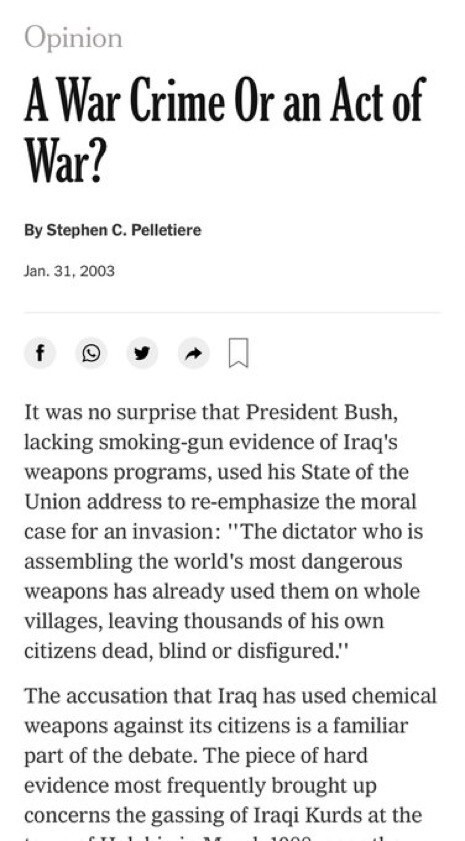
But, never to be outdone in its trash Iraq takes, the New York Times opinion page gave column space in January 2003 to a former #CIA analyst (!), Stephen Pelletiere, to prop up the undead “Iran did Halabja, actually” claim as a purported case against the #IraqWar: https://www.nytimes.com/2003/01/31/opinion/a-war-crime-or-an-act-of-war.html
Arbella Bet-Shlimon · @abshlimon
695 followers · 110 posts · Server spore.social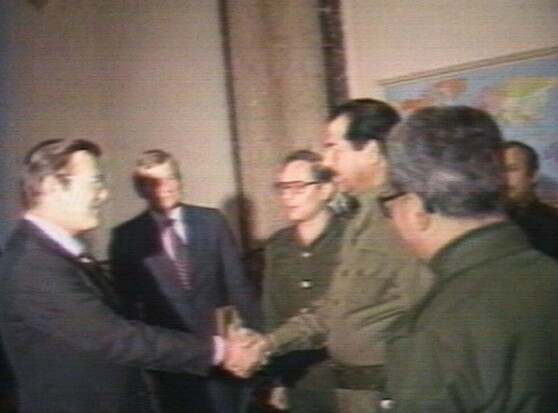
[#Halabja thread 7/16]
Then, it was mostly forgotten again until 2003, when George W. Bush geared up to invade Iraq again, this time to overthrow the regime.
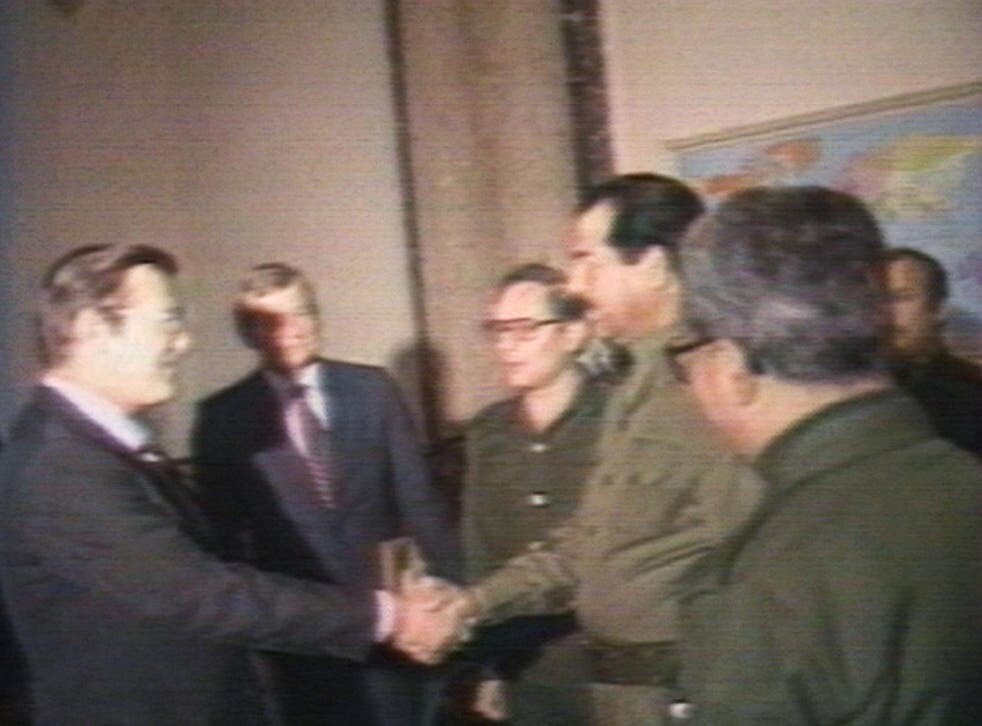
Note: the most common stance of that antiwar movement was that Saddam Hussein was NOT defensible—in fact, we were arguing for the blatant self-serving hypocrisy of the US turnaround *because* the US had sponsored Saddam Hussein’s atrocities. (Remember the infamous footage of Donald Rumsfeld shaking hands with Saddam Hussein?)
Arbella Bet-Shlimon · @abshlimon
695 followers · 110 posts · Server spore.social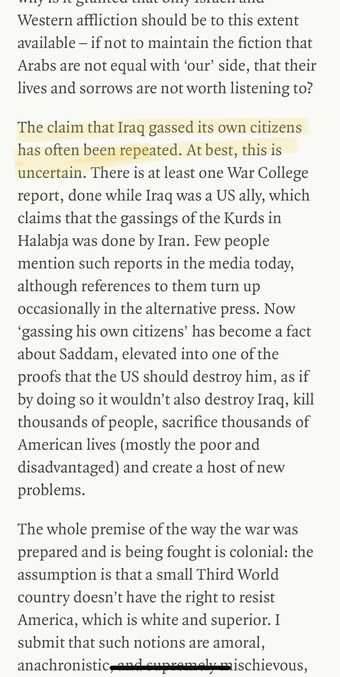
[#Halabja thread 6/16]
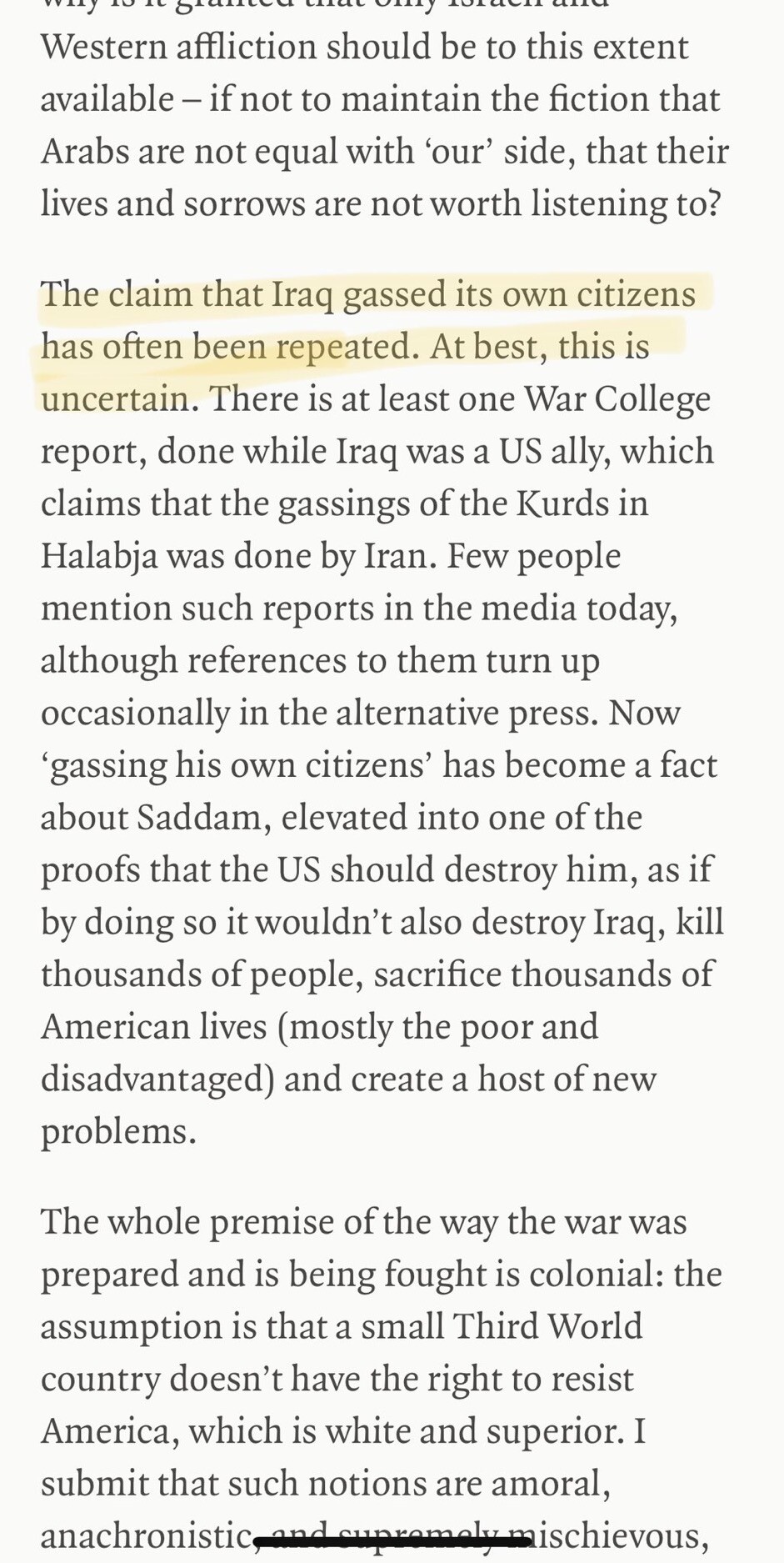
It was revived briefly in 1991, when a few opponents of the first Gulf War brought it up to question US accounts of Iraqi atrocities buttressing that invasion.
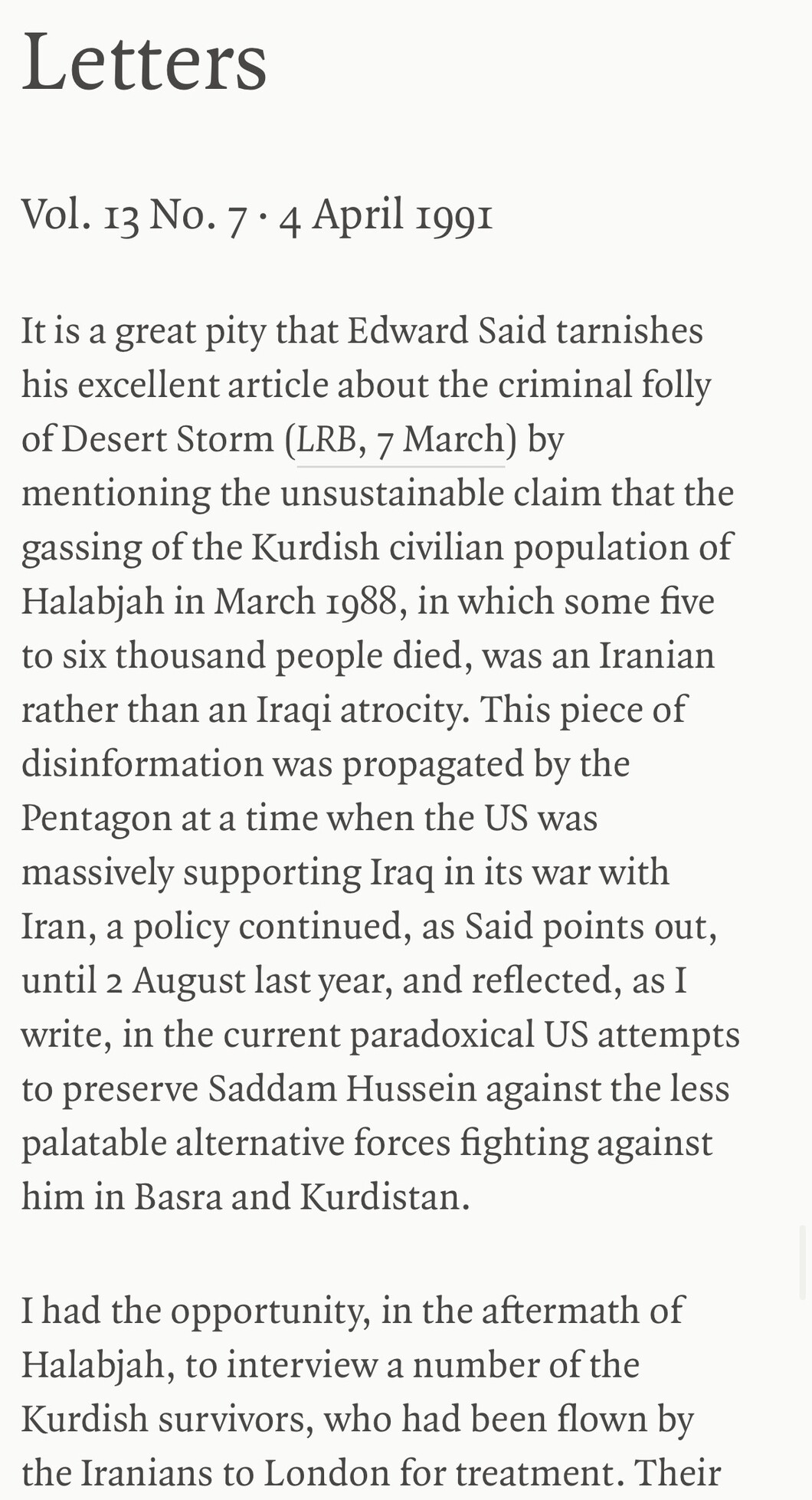
Edward Said, dismayingly, floated a version of the claim (citing a US military source!) in an otherwise strong piece in the London Review of Books: https://www.lrb.co.uk/the-paper/v13/n05/edward-said/edward-said-an-american-and-an-arab-writes-on-the-eve-of-the-iraqi-soviet-peace-talks
Arbella Bet-Shlimon · @abshlimon
695 followers · 110 posts · Server spore.social[#Halabja thread 5/16]
In any case, the claim died out—until Saddam Hussein became a US enemy upon invading #Kuwait in 1990. The US, doing a 180, started using his atrocities to justify a military operation.
From that point on, the claim—which, again, had originated with Iran-hating figures in the Pentagon and, outside the US government, had been confined mostly to the far right—started to appear on the #antiwar left.
Arbella Bet-Shlimon · @abshlimon
695 followers · 110 posts · Server spore.social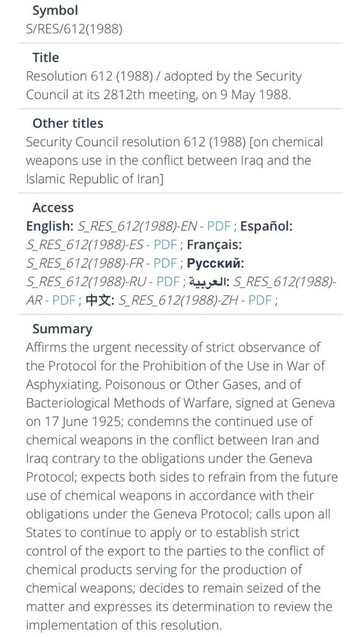
Arbella Bet-Shlimon · @abshlimon
695 followers · 110 posts · Server spore.social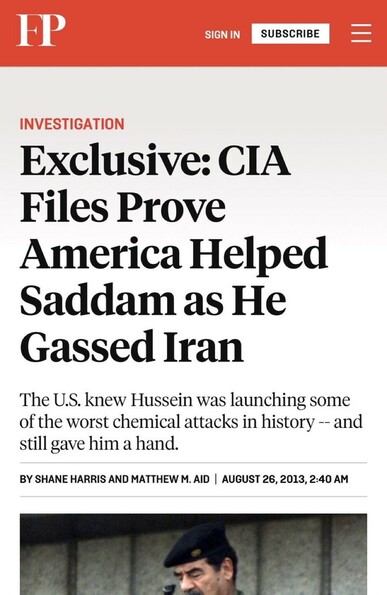

[#Halabja thread 3/16]
Even aside from the lack of evidence, the claim made no sense. Halabja was nearly all Kurdish and (some, not all) Kurdish rebels in Iraq had sided with Iran in the war. Saddam Hussein had already retaliated brutally against Kurds for years.
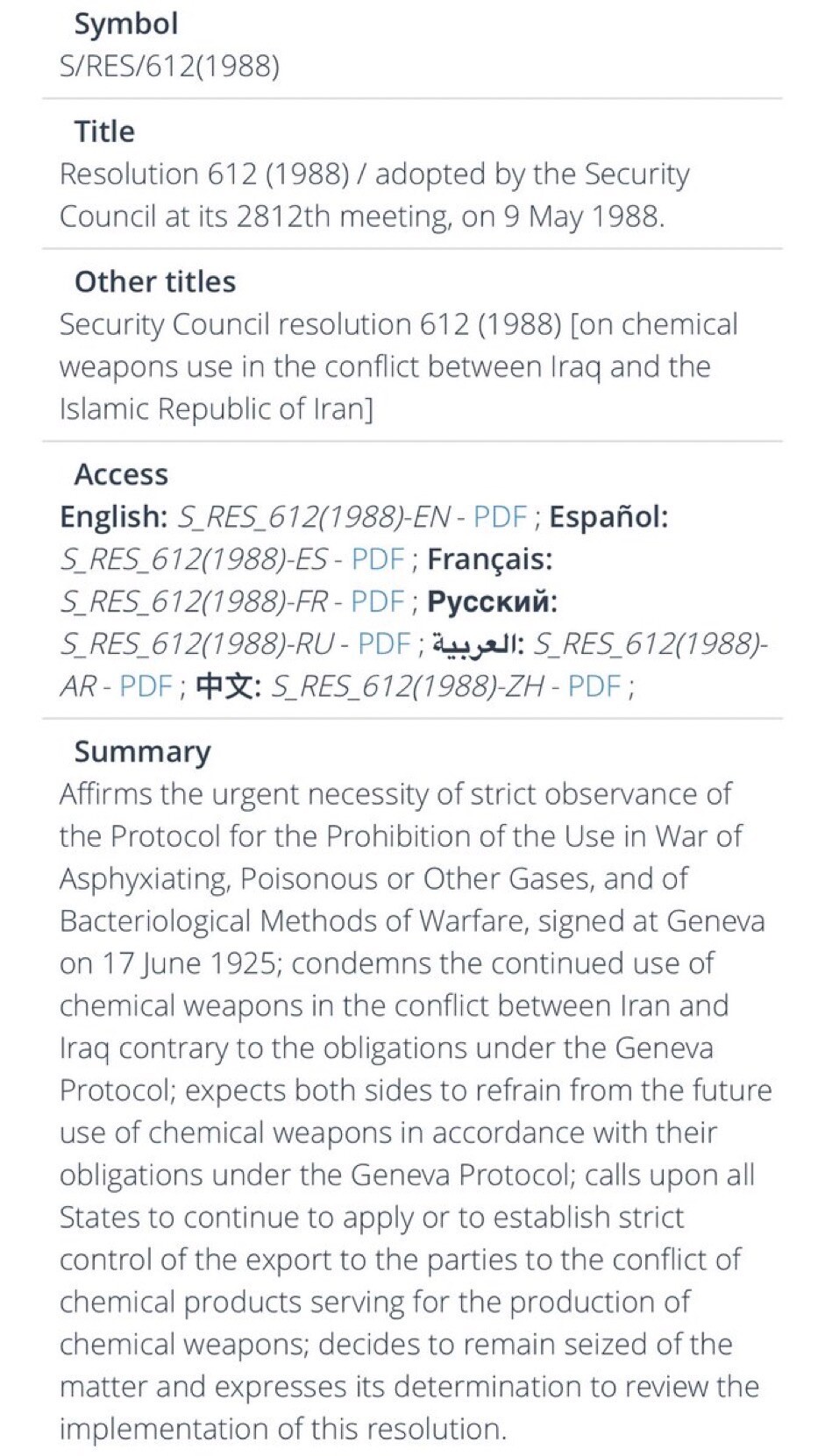
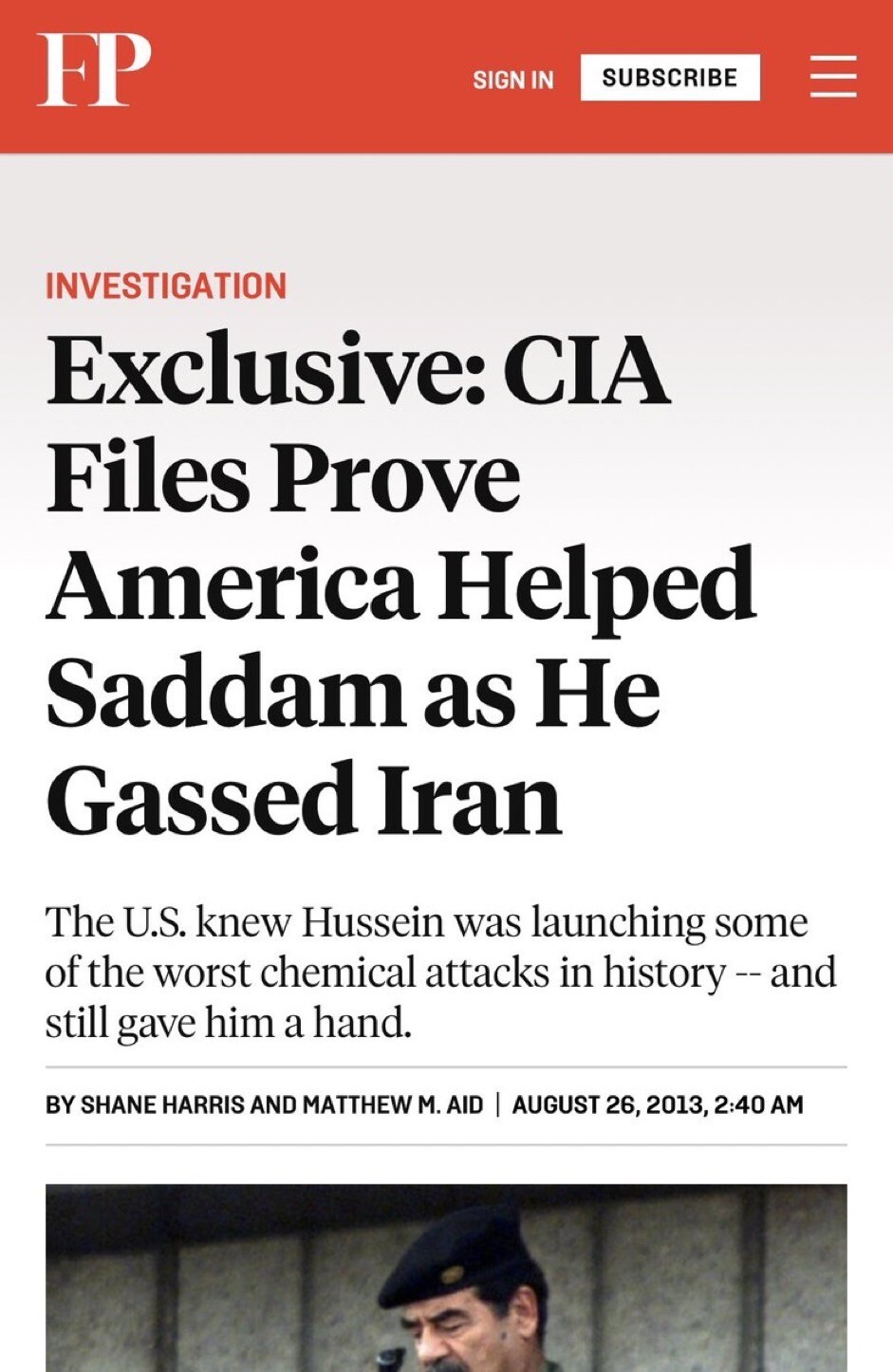
So, why make this dubious claim? Consider the context: Iran was the enemy. The US was giving Iraq coordinates to gas Iranian troops! Of course (some in) the Pentagon wanted to (implicitly) blame the attack on Khomeini.