
Ross Gayler · @RossGayler
122 followers · 988 posts · Server aus.socialHere's a really interesting (long) paper on what a theory of computing based on arbitrary physical substrates might look like: http://arxiv.org/abs/2307.15408
#NewPaper #TheoreticalComputerScience #neuromorphic #CogSci #CognitiveScience #VSA #VectorSymbolicArchitecture #HDC #HyperdimensionalComputing #AnalogComputing
#newpaper #theoreticalcomputerscience #neuromorphic #cogsci #cognitivescience #vsa #vectorsymbolicarchitecture #HDC #hyperdimensionalcomputing #analogcomputing
Ross Gayler · @RossGayler
122 followers · 940 posts · Server aus.social@thezerobit for fielded devices I gotta agree. However, for algorithmic explanation of an approach to computing that might *actually* be well suited to memristors (and other proposed noisy hardware technologies) there's a reasonable amount of activity in the Vector Symbolic Architecture / Hyperdimensional Computing space:
https://duckduckgo.com/?t=h_&q=memristor+%22vector+symbolic+architecture%22+&ia=web
https://duckduckgo.com/?t=h_&q=memristor+hyperdimensional+&ia=web
#memristor #neuromorphic #VSA #VectorSymbolicArchitecture #HDC #HyperdimensionalComputing
#memristor #neuromorphic #vsa #vectorsymbolicarchitecture #HDC #hyperdimensionalcomputing

Wout Bittremieux · @wout
129 followers · 59 posts · Server sigmoid.social
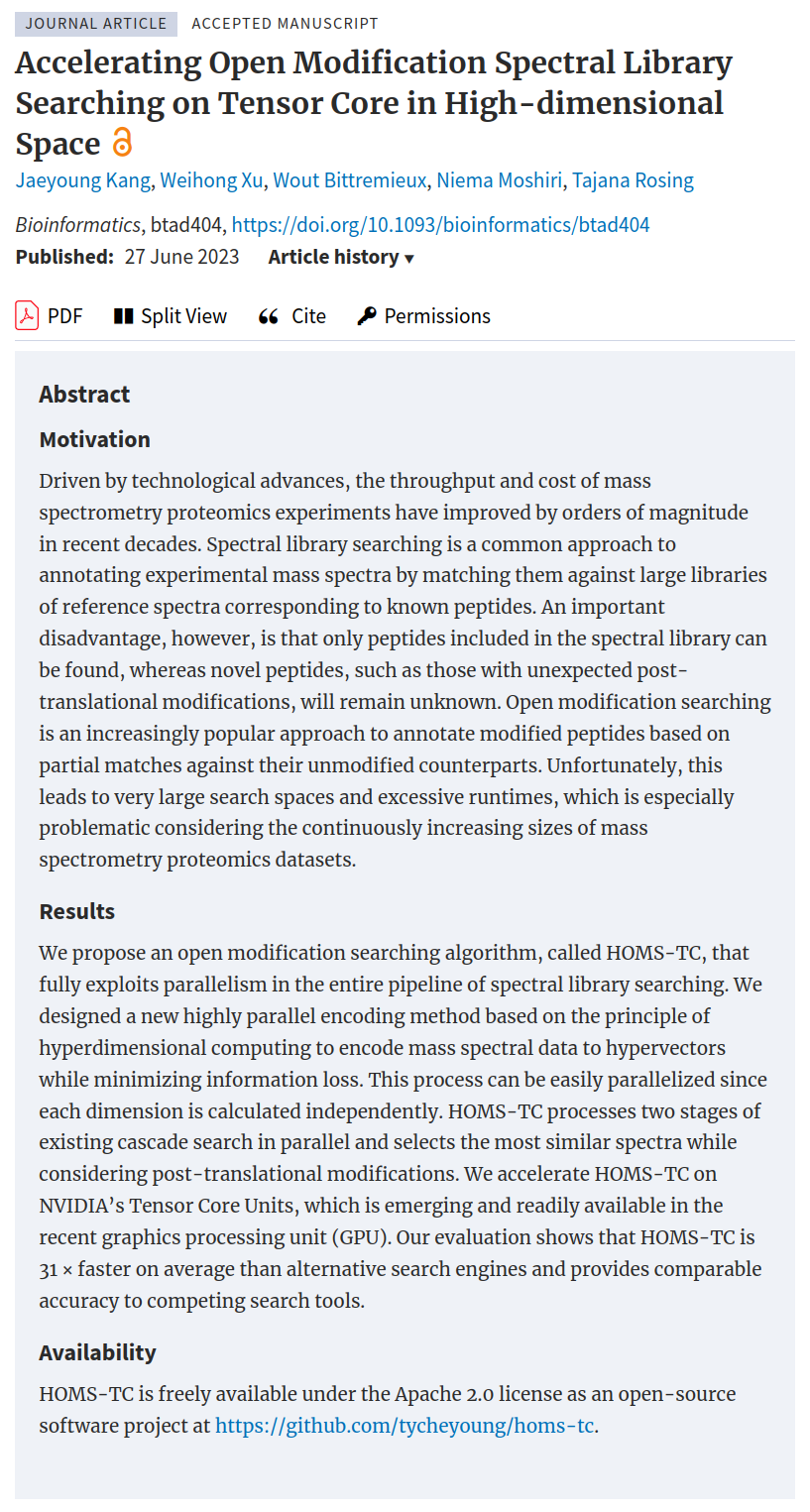
New paper with the Rosing group at UCSD: we use #HyperdimensionalComputing and GPU Tensor Cores to speed up #OpenModificationSearching by orders of magnitude. Search a raw file in a matter of seconds! 🔥
Out now in #Bioinformatics: https://doi.org/10.1093/bioinformatics/btad404
#hyperdimensionalcomputing #openmodificationsearching #bioinformatics
Ross Gayler · @RossGayler
116 followers · 708 posts · Server aus.socialThe videos of the talks from the Midnight Sun Workshop on Vector Symbolic Architectures and Hyperdimensional Computing are now online at:
https://sites.google.com/ltu.se/midnightvsa/abstracts?authuser=0
#VSA #VectorSymbolicArchitecture #HDC #HyperdimensionalComputing #CogSci #CognitiveScience #neuromorphic #UnconventionalComputing
#vsa #vectorsymbolicarchitecture #HDC #hyperdimensionalcomputing #cogsci #cognitivescience #neuromorphic #unconventionalcomputing

Nicole Hennig · @nic221
291 followers · 1308 posts · Server techhub.socialHyperdimensional Computing Reimagines Artificial Intelligence https://www.quantamagazine.org/a-new-approach-to-computation-reimagines-artificial-intelligence-20230413/ #AI #future #HyperdimensionalComputing
#AI #future #hyperdimensionalcomputing
Ross Gayler · @RossGayler
117 followers · 667 posts · Server aus.socialClojure Conj talk by @gigasquid on Vector Symbolic Architectures is up: https://www.youtube.com/watch?v=ByzaFEVlaq
#VSA #VectorSymbolicArchitecture #HDC #HyperdimensionalComputing #clojure
#vsa #vectorsymbolicarchitecture #HDC #hyperdimensionalcomputing #clojure
Ross Gayler · @RossGayler
117 followers · 667 posts · Server aus.socialThanks @hosford42 for reminding me of this half-day tutorial on Vector Symbolic Architectures / Hyperdimensional Computing. The authors have been applying HDC/VSA to place recognition in robotics, but the tutorial coverage is much wider.
https://www.tu-chemnitz.de/etit/proaut/workshops_tutorials/hdc_ki19/index.html
#VSA #VectorSymbolicArchitecture #HDC #HyperdimensionalComputing #CogRob #CognitiveRobotics #CompCogSci #ComputationalCognitiveScience #CogSci #CognitiveScience #MathPsych #MathematicalPsychology
#vsa #vectorsymbolicarchitecture #HDC #hyperdimensionalcomputing #cogrob #CognitiveRobotics #compcogsci #computationalcognitivescience #cogsci #cognitivescience #mathpsych #mathematicalpsychology
Ross Gayler · @RossGayler
114 followers · 563 posts · Server aus.social@hosford42 I'd be interested to see a description of what you've done for reinforcement learning with hyperdimensional computing.
#HDC #HyperdimensionalComputing #VSA #VectorSymbolicArchitecture
#HDC #hyperdimensionalcomputing #vsa #vectorsymbolicarchitecture

Aaron · @hosford42
538 followers · 3779 posts · Server techhub.socialOver the weekend I threw together some #Python #TensorFlow code to use #HyperDimensionalComputing for #ReinforcementLearning. I was surprised to see my naive, first attempt blow away #DeepLearning. I'm hooked.
Where have you been all my life, #HDC?
#python #tensorflow #hyperdimensionalcomputing #reinforcementlearning #deeplearning #HDC
Aaron · @hosford42
538 followers · 3770 posts · Server techhub.socialIs anybody out there aware of, or better yet, familiar with, #HyperDimensionalComputing? I'm eager to learn more about it.
#hyperdimensionalcomputing #machinelearning
Ross Gayler · @RossGayler
112 followers · 543 posts · Server aus.social
Here are two high level articles that mention Vector Symbolic Architecure / HyperDimensional Computing in the more "popular" end of the technical press:
https://ieeexplore.ieee.org/stamp/stamp.jsp?arnumber=10098176
#VSA #VectorSymbolicArchitecture #HDC #HyperdimensionalComputing #CompCogSci #ComputationalCognitiveScience #CogSci #CognitiveScience #MathPsych #MathematicalPsychology
#vsa #vectorsymbolicarchitecture #HDC #hyperdimensionalcomputing #compcogsci #computationalcognitivescience #cogsci #cognitivescience #mathpsych #mathematicalpsychology
Ross Gayler · @RossGayler
112 followers · 529 posts · Server aus.social
High level piece on hyperdimensional computing / Vector Symbolic Architecture in Quanta Magazine:
https://www.quantamagazine.org/a-new-approach-to-computation-reimagines-artificial-intelligence-20230413/
#VSA #VectorSymbolicArchitecture #HDC #HyperdimensionalComputing #CompCogSci #CogSci #CognitiveScience
#vsa #vectorsymbolicarchitecture #HDC #hyperdimensionalcomputing #compcogsci #cogsci #cognitivescience
Ross Gayler · @RossGayler
95 followers · 315 posts · Server aus.socialAntonello Rosato has organised a half-day workshop on Vector Symbolic Architectures / Hyperdimensional Computing, to be held in Antwerp, Belgium, as part of the Design, Automation and Test in Europe Conference (DATE23). The details are on LinkedIn (I'm really sorry about that):
https://www.linkedin.com/posts/rossgayler_log-in-to-easychair-activity-7019452856017539072-69GB?utm_source=share&utm_medium=member_desktop
#VSA #VectorSymbolicArchitecture #HDC #HyperdimensionalComputing
#vsa #vectorsymbolicarchitecture #HDC #hyperdimensionalcomputing
Ross Gayler · @RossGayler
95 followers · 315 posts · Server aus.socialBoosting for my followers - see original post in the thread above.
The BBS target article on the Language of Thought Hypothesis states:
"We outline six core properties of
LoTs: (i) discrete constituents; (ii) role-filler independence; (iii) predicate-argument
structure; (iv) logical operators; (v) inferential promiscuity; and (vi) abstract content."
It's interesting to think about the extent to which those properties are directly enabled by neural representations using Vector Symbolic Architectures / Hyperdimensional Computing. It hadn't occurred to me to draw a line between LoT and VSA/HDC.
#CogSci #CognitiveScience #CompCogSci #ComputationalCognitiveScience #VSA #VectorSymbolicArchitecture #HDC #HyperdimensionalComputing
#cogsci #cognitivescience #compcogsci #computationalcognitivescience #vsa #vectorsymbolicarchitecture #HDC #hyperdimensionalcomputing
Ross Gayler · @RossGayler
95 followers · 315 posts · Server aus.socialA blog post on basic Vector Symbolic Architecture / Hyperdimensional Computing operations implemented in Clojure (a dialect of LISP running on the JVM), written by Carin Meier (a star in the Clojure firmament).
http://gigasquid.github.io/blog/2022/12/31/vector-symbolic-architectures-in-clojure/
#VectorSymbolicArchitecture #VSA #HyperdimensionalComputing #HDC #cogsci #clojure
#vectorsymbolicarchitecture #vsa #hyperdimensionalcomputing #HDC #cogsci #clojure
Ross Gayler · @RossGayler
85 followers · 191 posts · Server aus.socialLulea Technical University (Sweden) announces two open positions ultimately focusing on research on hyperdimensional computing and vector-symbolic architectures. The positions are connected to the recently approved grant by Swedish Research Council "Vector-symbolic architectures as an algebraic programming language for neuromorphic computers”.
The application deadline is January 31st, 2023
Position 1. Senior lecturer: https://lnkd.in/gu5zf69T
Position 2. Researcher: https://lnkd.in/giSuqkFi
Should you have any questions please write to Evgeny Osipov (Evgeny.Osipov@ltu.se).
#VSA #VectorSymbolicArchitecture #HDC #HyperdimensionalComputing #CogSci #CognitiveScience #CogRob #CognitiveRobotics #MathPsych #CompCogSci #CompSci #ComputerScience #neuromorphic
#vsa #vectorsymbolicarchitecture #HDC #hyperdimensionalcomputing #cogsci #cognitivescience #cogrob #CognitiveRobotics #mathpsych #compcogsci #compsci #computerscience #neuromorphic
Ross Gayler · @RossGayler
95 followers · 315 posts · Server aus.social
Lulea Technical University (Sweden) announces two open positions ultimately focusing on research on hyperdimensional computing and vector-symbolic architectures. The positions are connected to the recently approved grant by Swedish Research Council "Vector-symbolic architectures as an algebraic programming language for neuromorphic computers”.
The application deadline is January 31st, 2023
Position 1. Senior lecturer: https://lnkd.in/gu5zf69T
Position 2. Researcher: https://lnkd.in/giSuqkFi
Should you have any questions please write to Evgeny Osipov (Evgeny.Osipov@ltu.se).
#VSA #VectorSymbolicArchitecture #HDC #HyperdimensionalComputing #CogSci #CognitiveScience #CogRob #CognitiveRobotics #MathPsych #CompCogSci #CompSci #ComputerScience #neuromorphic
#job
#vsa #vectorsymbolicarchitecture #HDC #hyperdimensionalcomputing #cogsci #cognitivescience #cogrob #CognitiveRobotics #mathpsych #compcogsci #compsci #computerscience #neuromorphic #job
Ross Gayler · @RossGayler
95 followers · 315 posts · Server aus.social
Abstract:
Motivated by recent innovations in biologically inspired neuromorphic hardware, this article presents a novel unsupervised machine learning algorithm named Hyperseed that draws on the principles of vector symbolic architectures (VSAs) for fast learning of a topology preserving feature map of unlabeled data. It relies on two major operations of VSA, binding and bundling. The algorithmic part of Hyperseed is expressed within the Fourier holographic reduced representations (FHRR) model, which is specifically suited for implementation on spiking neuromorphic hardware. The two primary contributions of the Hyperseed algorithm are few-shot learning and a learning rule based on single vector operation. These properties are empirically evaluated on synthetic datasets and on illustrative benchmark use cases, IRIS classification, and a language identification task using the n -gram statistics. The results of these experiments confirm the capabilities of Hyperseed and its applications in neuromorphic hardware.
https://ieeexplore.ieee.org/abstract/document/9953974
#VSA #VectorSymbolicArchitecture #HDC #HyperdimensionalComputing #CogSci #CogRob #MathPsych
#vsa #vectorsymbolicarchitecture #HDC #hyperdimensionalcomputing #cogsci #cogrob #mathpsych
Ross Gayler · @RossGayler
81 followers · 132 posts · Server aus.social@matspike Focusing on your final couple of points: linguistics needs structural representation & PDEs (continuous maths models) offer nothing for structure - You might want to take a look at Hyperdimensional Computing (HDC) / Vector Symbolic Architectures (VSA), which are all about how to represent and manipulate composite structures (trees, graphs, etc.) by simple arithmetic on high dimensional vector spaces (as a model of, say, the firing rates of a large group of neurons). Mostly it's algebraic, but PDEs are optional if you wanted to model the dynamics of a VSA/HDC system.
Early VSA paper referring to the Jackendoff example you use: https://arxiv.org/abs/cs/0412059
Me droning on about VSA as analogue computing for discrete structures: https://archive.org/details/Redwood_Center_2013_06_14_Ross_Gayler
A recent survey of the topic: https://arxiv.org/abs/2111.06077
#VSA #HDC
#VectorSymbolicArchitecture
#HyperdimensionalComputing
#vsa #HDC #vectorsymbolicarchitecture #hyperdimensionalcomputing
Ross Gayler · @RossGayler
80 followers · 117 posts · Server aus.socialEditorial of a special issue on Hyperdimensional omputing (Vector Symbolic Architectures)
https://www.frontiersin.org/articles/10.3389/fnins.2022.1102568/full
#HyperdimensionalComputing #HDC #VectorSymbolicArchitecture #VSA #CogSci #neuromorphic
#hyperdimensionalcomputing #HDC #vectorsymbolicarchitecture #vsa #cogsci #neuromorphic