Julien Girard · @juliengirard
293 followers · 141 posts · Server astrodon.social
A lot of #SETIshorts videos about #JWST are coming out on the @SETIInstitute YT. Many of these interviews were captured by @AllPlanets during the "First Science Results from JWST" #JWSTFirstScience conference back in December 2022 @stsci @spacetelescope https://www.youtube.com/@SETIInstitute
---
RT @SETIInstitute
VIDEO: https://buff.ly/3DdAMI4
#SETIShorts: Can JWST Take Pictures of Exoplanets ft. Julien Girard
We caught up with J…
https://twitter.com/SETIInstitute/status/1618764727932395520
#setishorts #jwst #jwstfirstscience

Aussiemandias · @Aussiemandias
138 followers · 256 posts · Server mastodon.socialNathalie Ouellette of
@iExoplanets
, Sean Linden from
@CNS_UMass
, and Divakara Mayya from
@inaoe_mx
explain how (and why) we’re using #NASAWebb to understand star formation hidden in the dust of distant merging galaxies. #JWSTFirstScience
https://twitter.com/i/status/1603786782910423042
Julien Girard · @juliengirard
262 followers · 99 posts · Server astrodon.socialRT @spacetelescope
@uarizona What are spectra and why are they so exciting? Kaitlin Rasmussen from @UW, Yoni Brande from @KUPhysicsAstro, and Brittany Miles from @uarizona explain how we’re using #NASAWebb spectroscopy to understand exoplanets. #JWSTFirstScience

StellarStoic · @StellarStoic
1 followers · 104 posts · Server mastodon.socialRT @SpaceTelescope@twitter.com
@uarizona@twitter.com What are spectra and why are they so exciting? Kaitlin Rasmussen from @UW@twitter.com, Yoni Brande from @KUPhysicsAstro@twitter.com, and Brittany Miles from @uarizona@twitter.com explain how we’re using #NASAWebb spectroscopy to understand exoplanets. #JWSTFirstScience
🐦🔗: https://twitter.com/SpaceTelescope/status/1603450358923247641

Space Telescope Science Inst. · @spacetelescope
1616 followers · 34 posts · Server astrodon.social
“It is so thrilling to see what we got! Everything we did was worth it.” #NASAWebb Senior Project Scientist and Nobel Prize laureate John Mather from NASA Goddard sums up the excitement of #JWSTFirstScience. What’s in store for the future? “If it’s not impossible, let’s do it!”
#NASAWebb #jwstfirstscience #STScI #jwst #space #astronomy
Julien Girard · @juliengirard
262 followers · 92 posts · Server astrodon.social
RT @AllPlanets
I also interviewed @djulik and @AstroRickman about direct imaging of exoplanets, Olivia Lim about the first result on Trappist-1, Michael Kelley about mainbelt comets and @grobertsborsani about a new population of galaxies. This was fascinating #JWSTFirstScience
Julien Girard · @juliengirard
262 followers · 92 posts · Server astrodon.social
RT @spacetelescope
Brittany Miles from @uarizona is explaining how she’s using #NASAWebb spectroscopy to study the atmospheric chemistry of brown dwarfs. What’s so interesting about brown dwarfs? ➡️ https://webbtelescope.pub/3FpEwGF
#JWSTFirstScience

Putin delenda est · @banie01
124 followers · 820 posts · Server mas.to
This is incredible!
A glimpse into the possibility of life elsewhere in our universe
#NASA #JWSTFirstScience
#JWST
https://www.nature.com/articles/d41586-022-04452-3
Alexandra Witze · @alexwitze
1493 followers · 78 posts · Server sciencemastodon.com
JWST data on TRAPPIST-1 is here
This is not a drill
JWST data on TRAPPIST-1 is here
By me, from #JWSTFirstScience symposium in Baltimore this week https://www.nature.com/articles/d41586-022-04452-3
Space Telescope Science Inst. · @spacetelescope
1598 followers · 30 posts · Server astrodon.social
Brittany Miles from the University of Arizona is explaining how she’s using #NASAWebb spectroscopy to study the atmospheric chemistry of brown dwarfs. What’s so interesting about brown dwarfs? https://webbtelescope.org/contents/articles/what-makes-brown-dwarfs-unique
#JWSTFirstScience #JWST #STScI #NASAWebb
#NASAWebb #jwstfirstscience #jwst #STScI
Space Telescope Science Inst. · @spacetelescope
1590 followers · 28 posts · Server astrodon.social
Geronimo Villanueva from NASA’s Goddard Space Flight Center is explaining how we can use the James Webb Space Telescope’s sensitive infrared spectroscopic capabilities to measure the abundance of key gases—like water, carbon dioxide, and methane—on Mars and other planets and moons in our solar system. #JWSTFirstScience #JWST #STScI #NASAWebb
#jwstfirstscience #jwst #STScI #NASAWebb
Space Telescope Science Inst. · @spacetelescope
1589 followers · 27 posts · Server astrodon.social
Imke de Pater from UC Berkeley is explaining her team’s work using the James Webb Space Telescope observations to build a more detailed understanding of Jupiter’s atmosphere. #JWSTFirstScience #STScI #NASAWebb #JWST
#jwstfirstscience #STScI #NASAWebb #jwst
Space Telescope Science Inst. · @spacetelescope
1589 followers · 26 posts · Server astrodon.social
Ryan Lau from NOIRLab is using the James Webb Space Telescope to study the colliding winds that formed the brilliant rings of carbon-rich dust ejected every 7.93 years by the binary star system WR 140. Check out the preview Ryan gave us back in October: webbtelescope.pub/3S3D8xO #JWSTFirstScience #NOIRLab #JWST #NASAWebb #STScI
#jwstfirstscience #noirlab #jwst #NASAWebb #STScI
Space Telescope Science Inst. · @spacetelescope
1587 followers · 25 posts · Server astrodon.social
Yao-Lun Yang from the RIKEN Cluster for Pioneering Research in Japan shared how he’s using the James Webb Space Telescope to study organic ices like methane and ethanol found in disks of material where stars and planets are forming. The ices are important in planet formation–the chemistry happens on the surfaces of the ice grains!
#JWSTFirstScience #NASAWebb #STScI #JWST
#jwstfirstscience #NASAWebb #STScI #jwst
Alexandra Witze · @alexwitze
1457 followers · 75 posts · Server sciencemastodon.com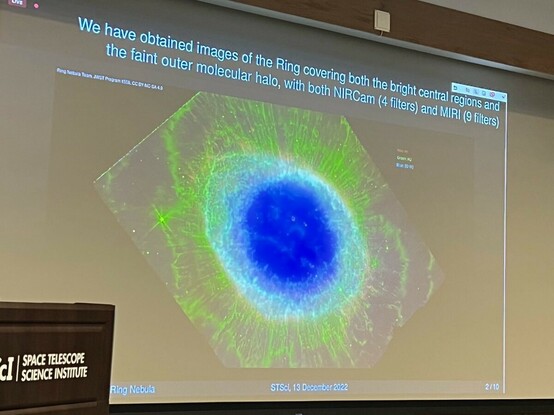
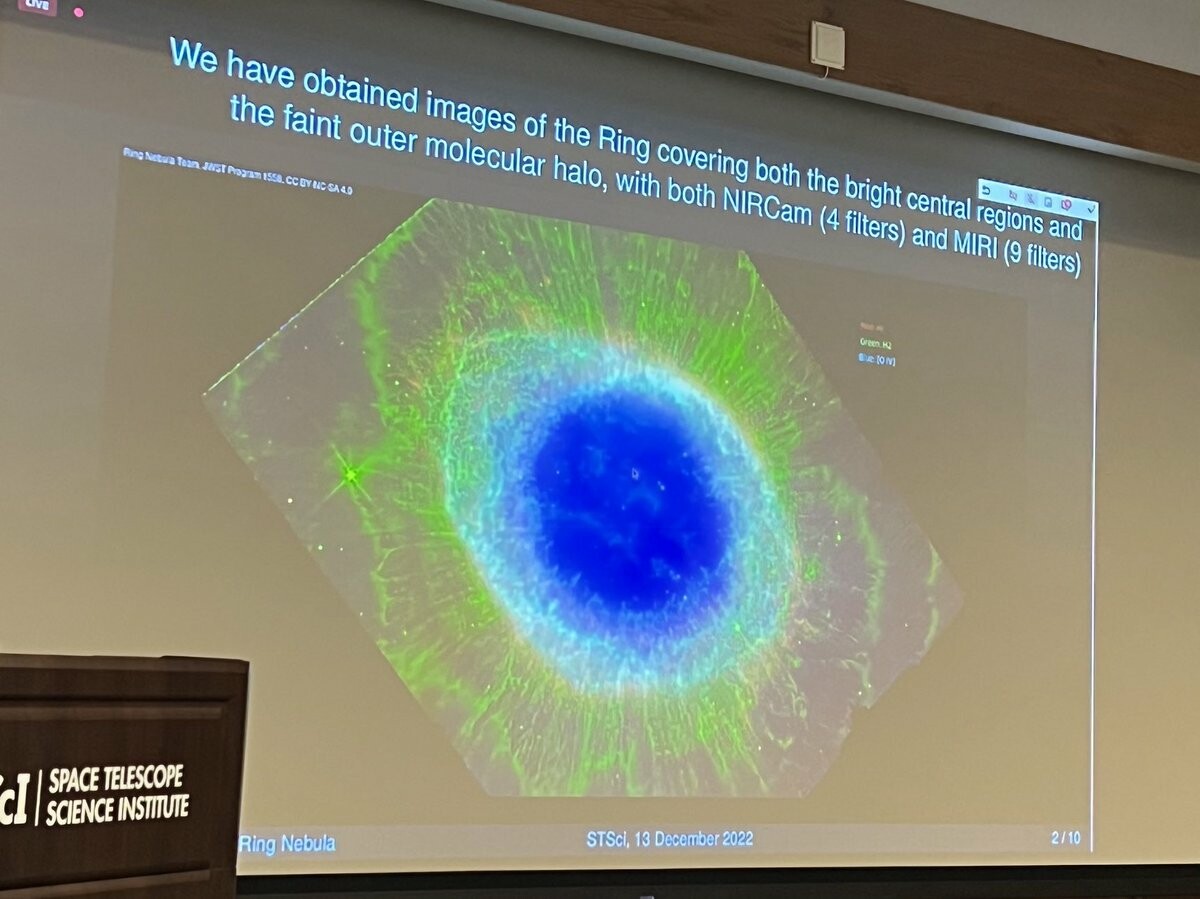
What does the Ring Nebula look like through JWST? Super-pretty! Presented by Roger Wesson at #JWSTFirstScience symposium today in Baltimore
Julien Girard · @juliengirard
262 followers · 87 posts · Server astrodon.social
Enjoying this conference so much :)
---
RT @spacetelescope
Welcome to Day 2 of the #JWSTFirstScience Conference here at the Space Telescope Science Institute!
First up: What we’re learning about star formation and characteristics of nearby populations of stars from #NASAWebb.
https://twitter.com/SpaceTelescope/status/1602663676099567616
Chris Lombardi · @ChrisAintMarchin
271 followers · 2373 posts · Server mastodon.social
RT @astraughnomer@twitter.com
A big conclusion from early #jwst data…galaxies formed earlier & faster than we thought! Via the GLASS program #jwstfirstscience
🐦🔗: https://twitter.com/astraughnomer/status/1602381664046485504
Space Telescope Science Inst. · @spacetelescope
1565 followers · 24 posts · Server astrodon.social
With the help of gravitational lenses—nature’s magnifying glasses—#NASAWebb has captured images and spectra of exceptionally faint galaxies. Guido Roberts-Borsani from #UCLA explains how we’re using Webb to understand ancient galaxies that burned off the cosmic fog of the Dark Ages. #JWSTFirstScience #JWST #STScI
#NASAWebb #ucla #jwstfirstscience #jwst #STScI
Space Telescope Science Inst. · @spacetelescope
1565 followers · 23 posts · Server astrodon.social
Adam Carnall of Edinburgh's Royal Observatory just revealed some surprising results: #NASAWebb is finding a bunch of “massive quiescent galaxies at high redshift” i.e., big galaxies that seem to have finished most of their star-formation within the first billion years of the universe! #JWSTFirstScience #STScI #JWST
#NASAWebb #jwstfirstscience #STScI #jwst
Space Telescope Science Inst. · @spacetelescope
1551 followers · 22 posts · Server astrodon.social




Macarena Garcia Marin, James Webb Space Telescope Instrument Scientist/Deputy Project Scientist in the Webb Mission Office at STScI, is briefing us on Webb’s Mid-Infrared Instrument (MIRI): “We are seeing unsurpassed sensitivity and resolution. It’s really excellent quality!” #NASAWebb #STScI #JWSTFirstScience #ESA #JWST
#NASAWebb #STScI #jwstfirstscience #esa #jwst