
Space Hobo · @spacehobo
406 followers · 2268 posts · Server teh.entar.netHere's a video of the #LINC team signing that panel visible in the background of the video: https://youtu.be/dg7-GxUfn_M
Space Hobo · @spacehobo
406 followers · 2266 posts · Server teh.entar.netHere's a recent local news segment from someone visiting the museum where the #DigiBarn #LINC was last year, apparently. If you go to the museum Web site the #pdp12 in this shot seems to be on a general floor exhibit. The piece talks about how Wilkes got out of computers to become an attorney.
https://youtu.be/VymT3KnSvAM?t=7
Space Hobo · @spacehobo
406 followers · 2266 posts · Server teh.entar.net
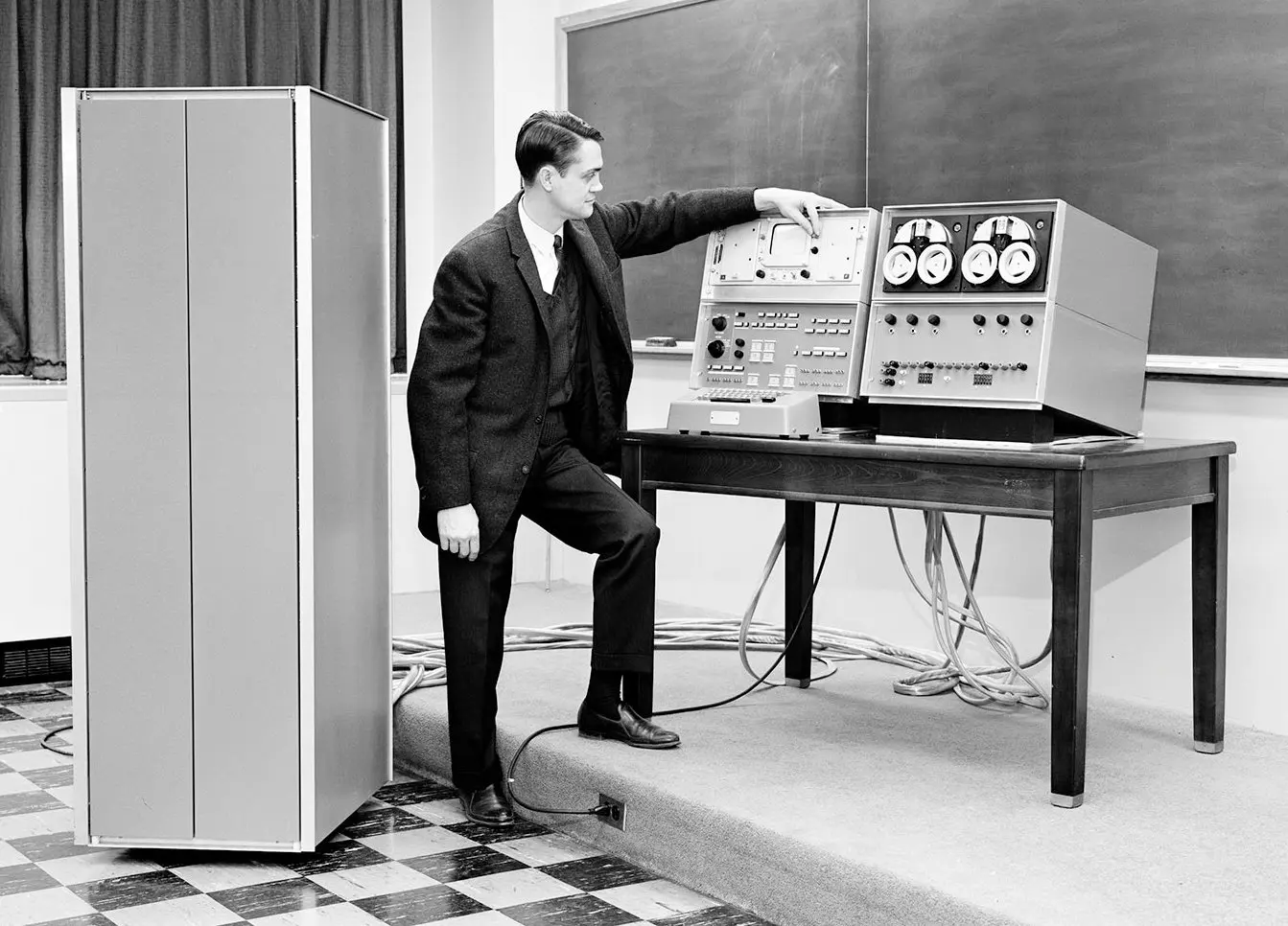
One thing this photo makes clear is how low-powered the #LINC was. You can clearly see at the bottom that it's fed off of one 15A/115V 60Hz US wall outlet. The power goes to the scope (which was very dim, if the DigiBarn videos are any guide) and the #LINCTape drives, and then big cable bundles come off the back to carry power and logic levels to the tall cabinet that held the CPU and #core memory.
This makes sense, as it was designed to be one piece of kit in a lab full of other equipment, all running off of ordinary US mains power. If they'd required 220V or three-phase (as many #dec machines did), that would have ruled the device out for many institutions.
But this is how it was possible to run a LINC in a residential home that had pre-war electrical setups. You could theoretically have powered this off a light socket.
Here's the 1964 sales brochure from #dec (who ended up building the things and selling them for a while).
Space Hobo · @spacehobo
406 followers · 2266 posts · Server teh.entar.net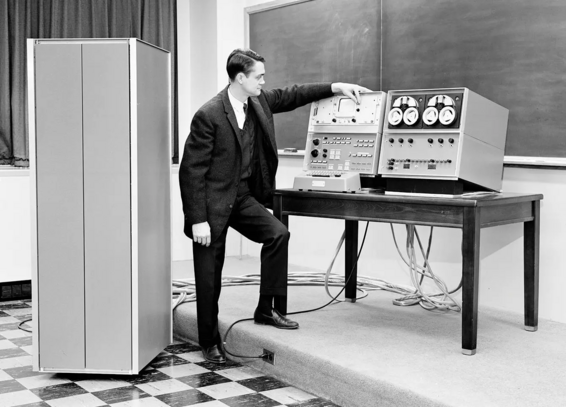
There is one good photo of Wes Clark with a #LINC; but instead of using it, he's just posing with it like some sort of anonymous model. He always described this photo as his "#BrooksBrothers pose", referring to the popular menswear company in the US.
Space Hobo · @spacehobo
406 followers · 2266 posts · Server teh.entar.netGentle update: I originally said this was the earliest LINC photo, which on review is highly incorrect.
I had conflated some stuff about how Wilkes worked on the original OS (more of a simple assembler, really) on a #LINC emulator she wrote on the TX-2. She spent a lot of time haranguing Wes and the others to pin down behaviours of the hardware so she could get it finished, but they were redesigning regularly due to the tight constraints and new flipchips coming out at #dec.
She worked with all the biomedical researchers they shipped the things to, teaching them how to get software written that worked with their experiments. Apparently that was so exhausting that she took a year off to travel the world, and in 1965 she got back to the US and found LINC had spun off from MIT and was based in St. Louis. She was still in sort of "gap year" mindset and said she'd work on the machine but didn't want to commit to any particular city. So they shipped one of the existing units to her father's home in Baltimore.
The OS she worked on there was LAP 6 (LINC Assembly Program version 6), which was vastly superior to the earlier versions. It had a full-screen text editor that took advantage of the RAM expansion modules that LINC were shipping at the time, and really made the machine more generally useful.
The OS that shipped with the #pdp12 from #dec was called "LAP6DIAL"
Space Hobo · @spacehobo
396 followers · 2167 posts · Server teh.entar.net@tastytronic Oh yes, and it's from the Minneapolis campus, but it's rather fitting that this 1990 oral history of the #LINC is hosted at UMN: https://conservancy.umn.edu/handle/11299/107217
Space Hobo · @spacehobo
396 followers · 2165 posts · Server teh.entar.netOK, so where did all of this #LINC and #pdp8 stuff from this whoooole thread end up? Well, Dick Clayton from #dec explains in this short interjection at the DigiBarn event:
https://youtu.be/xT_5PcrVI9Q?t=5810
Basically Digital made a weird hybrid LINC/pdp8 system called the LINC-8, but it wasn't that great. So while he was on jury duty, he sketched out the Right Way to do it so that the system could switch between "8 mode" and "LINC mode" *in software*. The result was the #pdp12, which sold more units than all the previous LINC systems combined.
And that takes us to tonight's thread from @tastytronic, where the #umdpdp12 has just had its first successful verification tests of some of its 60-year-old flipchip cards: https://teh.entar.net/@tastytronic/109644812161500698
#linc #pdp8 #dec #pdp12 #umdpdp12
Space Hobo · @spacehobo
396 followers · 2165 posts · Server teh.entar.netWhile I'm posting links to media, here's a great demo of someone working on the #LINC at the DigiBarn event. You can see all the parts in operation: #LINCTapes, the chime bell, the scope and text editor, and even a puckish appearance by Wes Clark to playfully chide someone into improving his code.
https://youtu.be/atJUnQN65dE
I'm really grateful that people took video of this event, because it's kind of the last time all of the LINC folks were together in one room before many of them passed on.
Space Hobo · @spacehobo
396 followers · 2165 posts · Server teh.entar.net
OK, so that's great, but what's this LINC?
Here's a talk by Wes Clark on the TX-0, TX-2, but mostly about LINC: https://youtu.be/l9YBZo30Ses?list=TLPQMDYwMTIwMjNntcAHDint6g
Everyone at Lincoln Labs built this amazing computer in the TX-2, but they found a LOT of people kept wanting to use the TX-0. One of those people was Ken Olsen, who left to found #dec, and you can see how my theories about the history of the PDP machines fits. Olsen wanted to "churn out computers like television sets" (which DEC eventually did with the PDP8), but at first the board forced him to make lab bench equipment.
From there, DEC made modular electronics boards called "flip chips" (no relation to the term we use today: that's a theme with early DEC stuff. Ask me about "microcoded" instructions in the PDP-8 instruction set...). It was pretty clear this was similar to the modules the TX-0 and TX-2 used, and the goal was a computer, and in 1959 the PDP-1 was made with these modules.
But Wes had moved on a little, and thought about the TX-0 and how some folks preferred it. MIT had purchasing rules for new computers that required a board of bureaucrats to approve any new computer purchase. But he noticed that you could buy anything you liked so long as it cost less than the total amortised cost of one full salary for office admin staff. So he wondered how much computer he could build for this magic number. What could sneak under the RADAR?
So using lessons from the TX-0 (people will work around a limited instruction set) and the TX-2 (fast tape drives will hide a lot of limitations in a computer), he designed the #LINC as a laboratory instrumentation automation and data-collection computer.
This was a system with a 12-bit architecture, a two-bit opcode with 10-bit operand (yes: 4 instructions, but *so* many side-effects!), a whole bunch of analogue integration ports (to plug into your lab gear), a keyboard driving the CRT-based console, and 1kW of core memory taking up most of the equipment. All built with DEC flip-chips.
And yes, that tape drive was what we now know as #LINCTape. It's a scaled-down version of the TX-2 tape drive, with reels you can fit in an overcoat pocket.
The terminology for this machine has everything pushed down a level from what we expect. What the docs refer to as "registers" are nearly always locations in core (the accumulator is always called just that). And often operations we think of as happening in main memory are pushed to the tape. After all, it was fast!

BlueOwl · @blueowl
38 followers · 289 posts · Server techhub.social
@gualdo Voice recognition devices based on remote #AI, such as #Amazon #Echo #Alexa or #Google #assistant are problematic for #privacy
The #LINC, research center of the French #privacy watchdog, is working on a voice assistant that operates locally without sending data, compliant with the #GDPR.
The results are encouraging, more info (in French): https://linc.cnil.fr/fr/preuve-de-concept-dun-assistant-vocal-respectueux-de-la-vie-privee-des-utilisateurs
#AI #amazon #echo #alexa #google #assistant #privacy #linc #gdpr

gualdo :mastodon: :unverified: · @gualdo
140 followers · 144 posts · Server mastodon.uno
I dispositivi di riconoscimento vocale basati su #AI remota, come #Amazon #Echo #Alexa o #Google #assistant, sono problematici per la #privacy
Il #LINC, centro di ricerca del #garante privacy francese, sta lavorando a un assistente vocale che opera in locale senza invio di dati, conforme al #GDPR.
I risultati sono incoraggianti: è una buona notizia.
Le info sono qui: https://linc.cnil.fr/fr/preuve-de-concept-dun-assistant-vocal-respectueux-de-la-vie-privee-des-utilisateurs
#digitalrights #sorveglianza #surveillance #surveillancecapitalism
#CNIL
#garanteprivacy
#ai #amazon #echo #alexa #google #assistant #privacy #linc #garante #digitalrights #sorveglianza #surveillance #surveillancecapitalism #cnil #Garanteprivacy #gdpr

Daniel Olcay Jeneral · @doj
4 followers · 8 posts · Server tkz.one
Celebrando el día de las Librerías Independientes en Arica!!!
Junto a mi esposa y escritora Maru Delgado, creamos Casa Katari y seguiremos divulgando la literatura.
#diadelaslibrerias #elijelibrerias #librerias #libroslibroslibros #libreriasdechile #diadelaslibrerias #bookstagramchile #aquiselee #libroschile #linc #literatura #autorchileno #arica #escritor
#diadelaslibrerias #elijelibrerias #librerias #libroslibroslibros #libreriasdechile #bookstagramchile #aquiselee #libroschile #linc #literatura #autorchileno #arica #escritor

Audrey Plessis :sunny: · @CapCdi
396 followers · 785 posts · Server framapiaf.org
[#vidéosurveillance] Un dossier du #Linc (#CNIL) publié le 19/11/2021,sur le développement de la vidéosurveillance dans les villages.
➡️ https://linc.cnil.fr/fr/les-cameras-au-village
#Surveillance #DonneesPersonnelles #RGPD #ViePrivee #Videoprotection
#videoprotection #vieprivee #rgpd #donneespersonnelles #surveillance #cnil #linc #vidéosurveillance

nuagezero · @nuagezero
279 followers · 2230 posts · Server mamot.frScènes de la vie numérique : l’accès aux services publics à l’épreuve de la dématérialisation
Dans le cadre de la parution de son Cahier IP8 « Scènes de la vie numérique », le LINC a organisé le 13 avril dernier, en partenariat avec Etalab, une table-ronde sur le rapport pluriel des individus à la vie privée et à l’exercice de leurs droits.
#cnil #linc #vieprivée #numérique #servicepublic #administration
#cnil #linc #vieprivée #numérique #servicepublic #administration
Audrey Plessis :sunny: · @CapCdi
396 followers · 785 posts · Server framapiaf.org



Vers une personnalisation des #tarifs dans les #magasins physiques ? via le Laboratoire d'innovation numérique de la @CNIL@mastodon.etalab.gouv.fr (LINC) >https://linc.cnil.fr/quel-prix-payer-pour-des-tarifs-dynamiques-en-magasin
#CNIL #LINC #DonneesPersonnelles #Datas #prix https://framapiaf.org/media/t-aNNsABUIxqkgm5ivg
#tarifs #magasins #cnil #linc #donneespersonnelles #datas #prix