
David Meyer · @dmm
186 followers · 339 posts · Server mathstodon.xyz
Here's a curious property of the natural numbers: the last digit of n^5 is n itself. This holds for every natural number n.
There is a pretty easy proof by induction, if you believe in induction. You can also prove it using Fermat's little theorem, namely, that a^p ≡ a mod p.
Aside: neither Hume nor Popper believed that induction was a valid form of reasoning, which leads to interesting ideas about what we call "causality".

Pustam Raut🇳🇵(पुस्तम राउत) · @pustam_egr
38 followers · 120 posts · Server mathstodon.xyz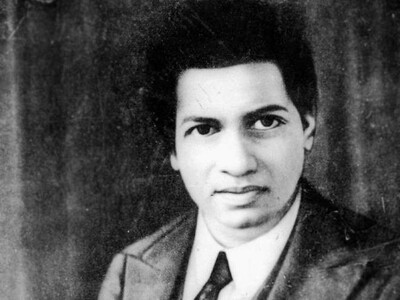

How could adding positive integers equal a negative fraction?🤔 🔗 https://www.cantorsparadise.com/the-ramanujan-summation-1-2-3-1-12-a8cc23dea793
Ramanujan's summation: \(1+2+3+\cdots=-\dfrac{1}{12}\)
#RamanujanSummation #Ramanujan #Summation #CantorsParadise #InfiniteSum #NaturalNumbers #NegativeFraction #Fraction #NegativeNumber
#negativenumber #fraction #negativefraction #naturalnumbers #infinitesum #cantorsparadise #summation #ramanujan #ramanujansummation
Pustam Raut🇳🇵(पुस्तम राउत) · @pustam_egr
38 followers · 119 posts · Server mathstodon.xyzHow could adding positive integers equal a negative fraction?🤔🔗https://www.cantorsparadise.com/the-ramanujan-summation-1-2-3-1-12-a8cc23dea793\
Ramanujan's summation:
\[1+2+3+\cdots=-\dfrac{1}{12}\]
#RamanujanSummation #Ramanujan #Summation #CantorsParadise #InfiniteSum #NaturalNumbers #NegativeFraction #Fraction #NegativeNumber
#negativenumber #fraction #negativefraction #naturalnumbers #infinitesum #cantorsparadise #summation #ramanujan #ramanujansummation