happyborg · @happyborg
431 followers · 3447 posts · Server fosstodon.org
Async Rust is a Bad Language
Very good intro and thought provoking article on #concurrency and #parallelism, and their use in #Rust.
It champions #TonyHoare's #CSP model of concurrency which takes me back. Back to the time I failed to get funding for a start-up to build an #Occam compiler targeting i386. Which was largely a ploy to get the UK government to buy me some neat kit 🤷♂️
Anyway, here's the article:
https://bitbashing.io/async-rust.html
#concurrency #parallelism #rust #TonyHoare #csp #occam #rustlang #async

nil · @nil
23 followers · 30 posts · Server functional.cafePi calculus is simply animism for engineers. #hottake #concurrency #reductionism #processtheultimate #csp #occam
#hottake #concurrency #reductionism #processtheultimate #csp #occam
nil · @nil
3 followers · 6 posts · Server functional.cafe
#occam #csp #transputer
Title: a tutorial introduction to OCCAM programming
Author: Dick Pountain and David May

nil · @nil
0 followers · 2 posts · Server functional.cafe
Marcin Paprzycki · @marcinpaprzycki
6 followers · 103 posts · Server masto.aiProposing several variants of #OCCAM, a minimalistic #programminglanguage in which a program consists only of processes and channels in: “Channel-Less Process Communication” by T. Plachetka. @FedCSIS
2022, ACSIS Vol. 30 p. 515–519; http://tinyurl.com/5t3576wd
Vivienne Dunstan · @vivdunstan
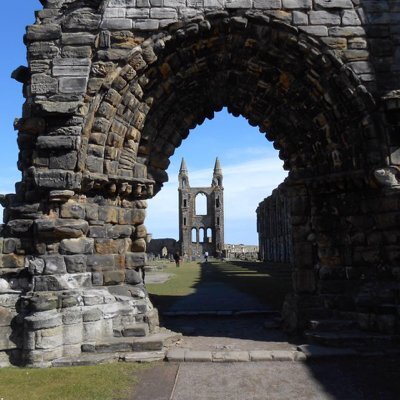
651 followers · 487 posts · Server mastodon.scotMe to my husband just now: “It’s like an Occam folding editor!” as I try to explain cut/spoiler sections in DreamWidth blog posts. That won’t make any sense except to fellow computer scientists possibly of a certain vintage. But sharing for them! I can still vividly remember coding Occam in the Edge basement Sun lab on the Scores in St Andrews in the early 1990s.
#Occam #ProgrammingLanguages #ComputerScience #StAndrews #FoldingEditors #Dreamwidth
#dreamwidth #foldingeditors #standrews #computerscience #programminglanguages #occam

Tom Stepleton · @stepleton
118 followers · 40 posts · Server oldbytes.space
At last, my #transputer project is ready to share!
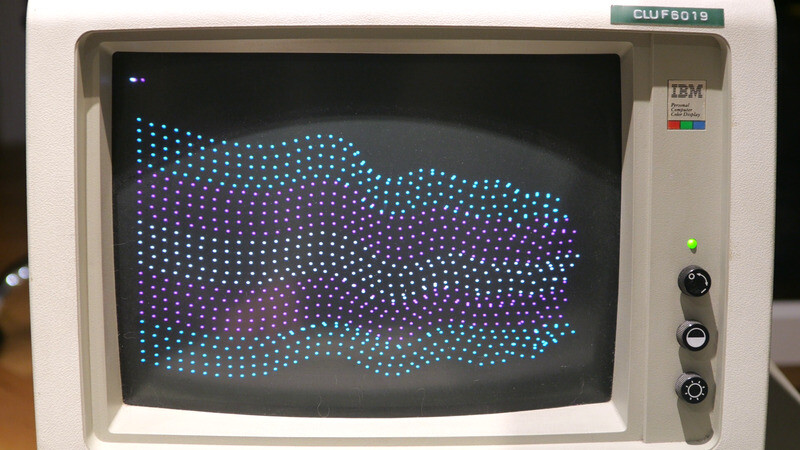
I've written a program in the #occam language that uses a network of seven transputers ('80s/'90s UK CPUs for parallel processing) to simulate a flying flag --- much faster than the IBM PC/AT 286 host computer could do it, I think! (So #doscember too!)
I've also written a long writeup on how it works, with background on transputing and occam.
This was a really enjoyable project, so I hope it makes for fun reading!
YouTube teaser: https://www.youtube.com/watch?v=ZY-cUEJT1XQ
Writeup@GitHub: https://github.com/stepleton/flag/blob/main/README.md
Tom Stepleton · @stepleton
118 followers · 40 posts · Server oldbytes.spaceAt last, my #transputer project is ready to share!
I've written a program in the #occam language that uses a network of seven transputers ('80s/'90s UK CPUs for parallel processing) to simulate a flying flag --- much faster than the IBM PC/AT 286 host computer could do it, I think!
I've also written a long writeup on how it works, with background on transputing and occam.
This was a really enjoyable project, so I hope it makes for fun reading!
YouTube teaser: https://www.youtube.com/watch?v=ZY-cUEJT1XQ
Writeup@GitHub: https://github.com/stepleton/flag/blob/main/README.md
James Smith · @djalbat
1 followers · 1 posts · Server mathstodon.xyzHello,
I am working on an automated domain of reasoning called Occam. Here are some links:
https://occam.science
https://openmathematics.org
Partial lift off will happen in the coming months. One of the reasons I am here is to announce that. However, there are perhaps two or three years to go before things are ready for a wider audience.
#openmathematics #occam #introduction
Tom Stepleton · @stepleton
78 followers · 18 posts · Server oldbytes.spaceAt least with #occam and the rest of the tools from #INMOS, transputers are also programmed in the "bee" way rather than the "hive" way. What makes occam and transputers special is that they were built to be bees from the start! The computer and software architectures that underlie most cloud systems evolved from settings where there was only ever one computer: sometimes a large, expensive minicomputer that hosted multiple users, other times a desktop PC that was kept running overnight to do various server-like duties. The facilities that let multiple computers work together were added _post hoc_, and it shows. Local threads of one program share data in a way that differs from how separate programs on the same machine share data, which is different to how programs on separate computers share data --- and so on. Some programmers' aids like libraries and frameworks try to hide this complexity, but you can always feel the ancient rivets and seams underneath the shiny new wallpaper. (2/3)

The Old C Dog · @badlydrawn
12 followers · 36 posts · Server infosec.exchange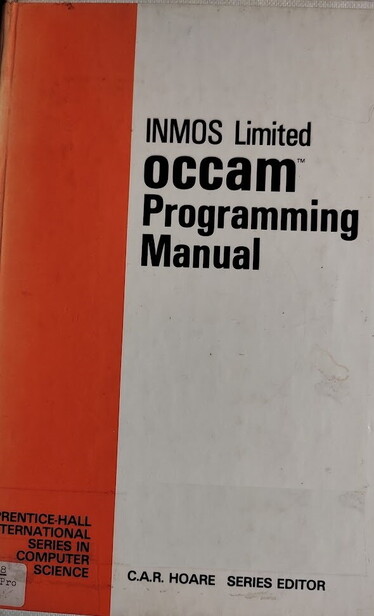
My daughter is visiting for the weekend and has this book from her college library.
In the mid 80s there was a CPU called the transputer.
It was designed to be ubiquitous (like the transistor I guess) and had some interesting ideas around parallelism, but it didn't really catch on.
The transputer was programmed in Occam which seems to be quite low level. There's very little in the way of types (words and arrays of words), but the concept of channels is built in.
I found myself wondering if Occam influenced Erlang, but they seem to have been invented around the same time.
#programminglanguages #programming #occam #transputer
The Old C Dog · @badlydrawn
29 followers · 74 posts · Server infosec.exchangeMy daughter is visiting for the weekend and has this book from her college library.
In the mid 80s there was a CPU called the transputer.
It was designed to be ubiquitous (like the transistor I guess) and had some interesting ideas around parallelism, but it didn't really catch on.
The transputer was programmed in Occam which seems to be quite low level. There's very little in the way of types (words and arrays of words), but the concept of channels is built in.
I found myself wondering if Occam influenced Erlang, but they seem to have been invented around the same time.
#programminglanguages #programming #occam #transputer