
OverHere Consulting · @OverHereConsulting
25 followers · 21 posts · Server iaccessibility.socialBoth events on Thursday and Friday this last week went amazing! Thank you to everybody that made time to come out and celebrate 10 years with us! #OHC #Blind #10Years #SmallBusiness
#ohc #blind #10years #smallbusiness

Ariadne · @ariadne
900 followers · 129 posts · Server kolektiva.social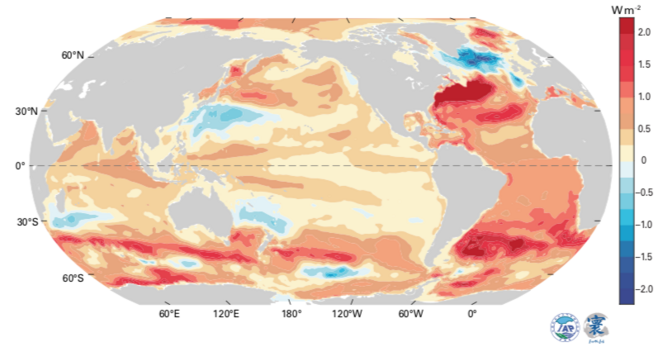
Another important graphic on #OceanWarming from the #WMO annual report (link to full report here https://kolektiva.social/@ariadne/110305388737917179
)
The upper 2000 m of the ocean continued to warm in 2022, and it is expected that it will continue to warm in the future, causing changes that are irreversible on centennial to millennial time scales. #OHC (Ocean Heat Content) in 2022 was the highest on record, exceeding the 2021 value by 17 ± 9 ZJ. All data sets agree that #ocean warming rates were particularly high in the past two decades - the rate of ocean warming for 0–2000 m was 0.7 ± 0.1 W m–2 from 1971 to 2022, but 1.2 ± 0.2 W m–2 from 2006 to 2022. Deep ocean warming below a depth of 2 000 m is estimated to have been 0.0725 ± 0.1 W m–2 from 1992 to 2022.
Although global mean OHC has increased strongly, the rate of ocean warming has not been the same everywhere. The strongest warming in the upper 2000 m occurred in the Southern Ocean, North Atlantic and South Atlantic, where warming locally exceeded 2 W m−2. The Southern Ocean is the largest reservoir of heat, accounting for around 36% of the global OHC increase in the upper 2 000 m since 1958. This strong warming is associated with the absorption of #anthropogenic heat by the cold upwelling waters which is then exported to the northern edge of the #Antarctic Circumpolar Current by the background overturning circulation.
Some limited regions are losing heat and are cooling, including the subpolar Atlantic Ocean extending from near the surface down to >800 m depth (also the only area to show centennial cooling at the surface). The contrasting pattern of cooling (50°N–70°N) and warming (20°N–50°N) in the North Atlantic is associated with a slowing of the Atlantic Meridional Overturning Circulation #AMOC and local interactions between the air and sea.
#ClimateCrisis #Climate #Klima #KlimaKrise #GlobalWarming #Erderwärmung
#oceanwarming #wmo #ohc #ocean #anthropogenic #antarctic #amoc #ClimateCrisis #climate #klima #klimakrise #globalwarming #erderwarmung
Ariadne · @ariadne
899 followers · 127 posts · Server kolektiva.social
More from the #WMO annual climate report - the #oceans store 90% of accumulated heat on #Earth. Another disturbing graph.
OCEAN HEAT CONTENT #OHC -
The upper 2 000 m of the #ocean continued to warm in 2022, and it is expected that it will continue to warm in the future, causing changes that are irreversible on centennial to millennial time scales.
Increasing human emissions of #CO2 and other #greenhouse gases #GHG cause a positive radiative imbalance at the top of the atmosphere leading to an accumulation of energy in the form of heat in the Earth system that is driving global warming. Around 90% of the accumulated heat is stored in the ocean, leading to ocean warming. Ocean heat content (OHC) is an indicator that measures the accumulated heat. A positive energy imbalance signals that the climate is still responding to the current forcing and that more warming will occur even if the forcing does not increase further.13 In a recent report the #IPCC concluded that “It is virtually certain that the global upper ocean (0–700 m) has warmed since the 1970s and extremely likely that human influence is the main driver."
link to the full #WMO report is here - https://kolektiva.social/@ariadne/110305388737917179
#wmo #oceans #earth #ohc #ocean #co2 #greenhouse #ghg #ipcc #climate #ClimateCrisis #klima #klimakrise
O=C=O · @tuxom
1842 followers · 8902 posts · Server mastodon.social
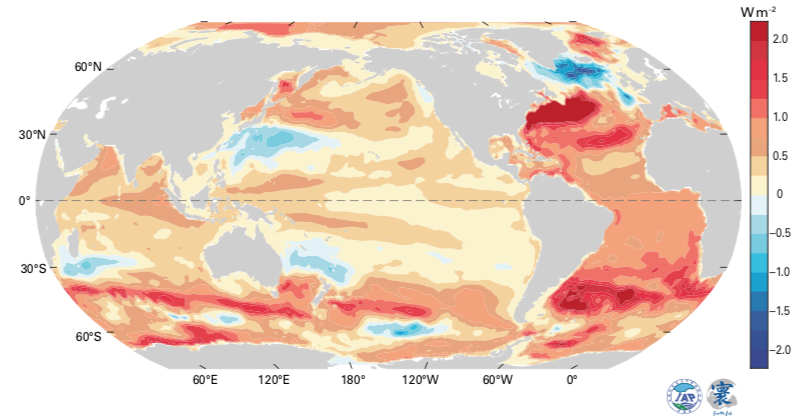


Another Record: Ocean Warming Continues through 2021despite La Niña Conditions
The increased concentration of #GreenhouseGas'es in the atmosphere from human activities traps heat within the #climate system and increases #ocean heat content (#OHC). Here, we provide the first analysis of recent OHC changes through 2021 from two international groups.
PDF (#OpenAccess):
https://link.springer.com/content/pdf/10.1007/s00376-022-1461-3.pdf
#greenhousegas #climate #ocean #ohc #openaccess #climatescience