
Daniel Fischer · @cosmos4u
1478 followers · 2874 posts · Server scicomm.xyzExtreme #evaporation of #planets in hot thermally unstable #protoplanetary discs - the case of FU Ori: https://academic.oup.com/mnras/article/523/1/385/7161140 -> Flaring star could be down to young planet’s disc inferno: https://le.ac.uk/news/2023/june/planetary-disc-inferno
#protoplanetary #planets #evaporation
Daniel Fischer · @cosmos4u
1324 followers · 2186 posts · Server scicomm.xyz
A rich hydrocarbon chemistry and high C to O ratio in the inner disk around a very low-mass star / JWST/MIRI Spectroscopy of the Disk of the Young Eruptive Star EX Lup in Quiescence / MINDS - the detection of 13CO2 with JWST-MIRI indicates abundant CO2 in a #protoplanetary disk: https://arxiv.org/abs/2304.05954 / https://arxiv.org/abs/2301.08770 / https://arxiv.org/abs/2212.08047 -> #JWST peeks into the birthplaces of #exoplanets - a rich and diverse chemistry: https://www.mpia.de/news/science/2023-05-jwst-minds
#exoplanets #jwst #protoplanetary
Daniel Fischer · @cosmos4u
1079 followers · 1139 posts · Server scicomm.xyzDiscovery of Line Pressure Broadening and Direct Constraint on Gas Surface Density in a #Protoplanetary Disk: https://iopscience.iop.org/article/10.3847/2041-8213/ac903a -> Model-Independent Method to Weigh Protoplanetary Disks: https://www.nao.ac.jp/en/news/science/2023/20230111-dos.html
Daniel Fischer · @cosmos4u
1069 followers · 1098 posts · Server scicomm.xyzEmergence of vortices at the edges of planet-driven gaps in #protoplanetary discs: https://academic.oup.com/mnras/article/519/1/208/6889526?login=false -> Astronomers use ‘little hurricanes’ to weigh and date planets around young stars: https://www.cam.ac.uk/research/news/astronomers-use-little-hurricanes-to-weigh-and-date-planets-around-young-stars

Scientific Frontline · @sflorg
953 followers · 2069 posts · Server mastodon.social
Pancake-like clouds of #gases, dust and ice surrounding young #stars – known as #protoplanetary discs - are where the process of #planet formation begins. Through a process known as core accretion, #gravity causes particles in the disc to stick to each other, eventually forming larger solid bodies such as #asteroids or #planets
#Astronomy #SpaceScience #sflorg
https://www.sflorg.com/2023/01/astr01062301.html
#gases #stars #protoplanetary #planet #gravity #asteroids #planets #astronomy #spacescience #sflorg

Hossam Aly · @AstroHoss
183 followers · 47 posts · Server astrodon.socialAlright #Astrodon I migrated here a couple of days ago and the time for introduction is nigh overdue.
I'm an astrophysicist, currently postdoc at #ZAH in #Heidelberg. I spend most of time thinking about planet formation and the evolution of gas and dust in #Protoplanetary discs. Particularly the ones that are a bit wonky, i.e, warped and misaligned. The wonky ones have a lot of interesting physics! We should all care about the wonky ones!
#Astrodon #ZAH #heidelberg #protoplanetary

Jean-François Gonzalez · @jfg_astro
164 followers · 124 posts · Server astrodon.socialHey #Astrodon I think it's time for an #introduction.
I'm an Associate Professor of #astrophysics at the Centre de Recherche Astrophysique de #Lyon, #France (affiliated with #UniversitéLyon1, #ENSdeLyon, #CNRS). I work on the first stages of #planet formation, more specifically the evolution of gas and dust in #protoplanetary #disks with numerical simulations. I also compute synthetic observations from them.
#Astrodon #introduction #astrophysics #Lyon #france #UniversitéLyon1 #ENSdeLyon #CNRS #planet #protoplanetary #disks

Gustavo · @astromecanik
209 followers · 536 posts · Server mastodon.online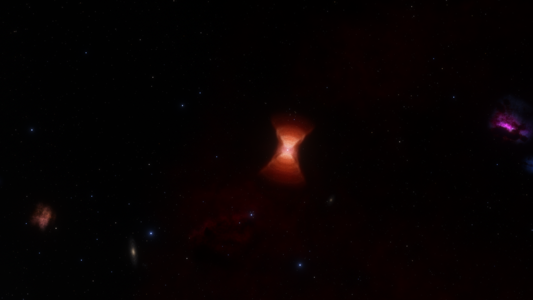
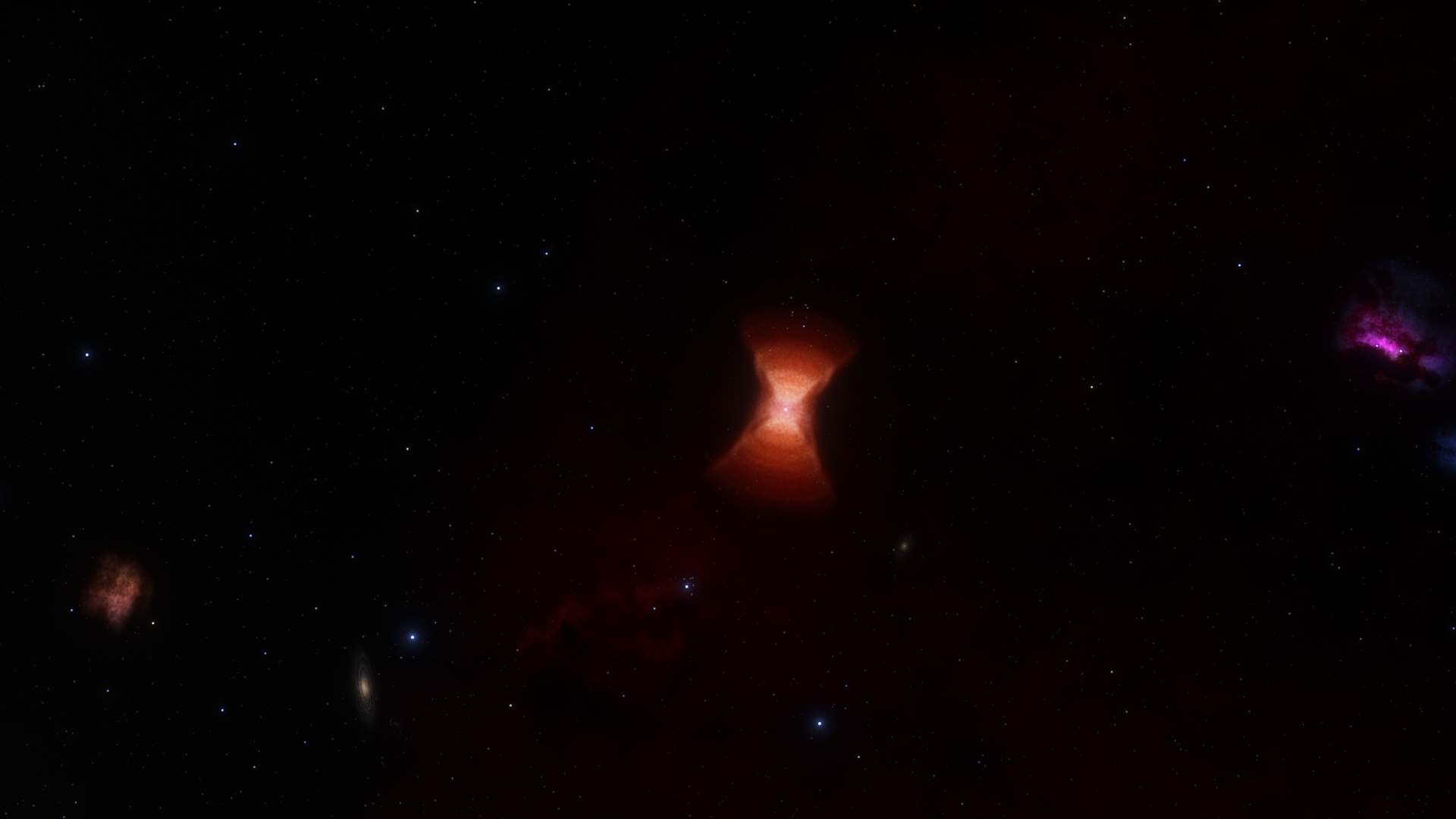
This has to be one of the coolest space objects I've seen in a while. While exploring around in #SpaceEngine, I came across this odd looking object. I though it was an artifact or glitch due to the procedural generation used by the software in some unmapped areas of the galaxy, but no, this exists! It's called the Red Rectangle #Nebula (HD 44179), a #protoplanetary nebula located in constellation Monoceros. It's around 710 ± 100 pc away. #Hubble actually imaged it:
https://www.nasa.gov/image-feature/goddard/2016/hubble-frames-a-unique-red-rectangle
#hubble #protoplanetary #nebula #spaceengine