
· @Hash
108 followers · 2960 posts · Server sfba.social@realTuckFrumper
Judiciary is all about wielding power. Not serving majority
#shadowdocket
Why approval rating is worse than crap

Gladwyn d’Souza · @godsouza
129 followers · 1719 posts · Server sfba.socialhttps://overcast.fm/+5wvnQfFKI
the #court does not expect us to agree with the #principles that are espoused in these #decisions, but they expect us to agree that these are principled decisions. And on the #shadowdocket, when most of these #rulings have no #explanation whatsoever, that really, really complicates the story, especially when, as we've seen over the last five or six years, the #pattern looks far more #nefarious.
#ShelbyCounty #VotingRightsAct
#PurchasedJustice #PlantationCourt #corruptconservativescotus
#CorruptEqualsConservative
#court #principles #decisions #shadowdocket #rulings #explanation #pattern #nefarious #shelbycounty #votingrightsact #purchasedjustice #plantationcourt #corruptconservativescotus #corruptequalsconservative

Annhattan · @annhattan
119 followers · 668 posts · Server mstdn.social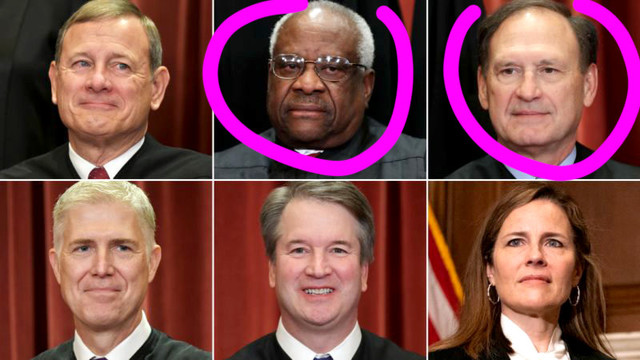
The #SCOTUS justices that led the Roe vs Wade overturn are regularly bribed by #billionaires. As you drive across state lines for your #abortion reflect on that. And even imagine for a moment if it were #KetanjiBrownJackson that accepted a #private jet ride to a #luxury $1k/nite fishing vacation in remote #Alaska.
#DeepState #DarkMoney #right #CorruptSCOTUS #corruption #ExposetheTruth #ShadowDocket #StenchontheBench #Republicans #HarlanCrow #PaulSinger #LeonardLeo
#LeonardLeo #paulsinger #harlancrow #republicans #stenchonthebench #shadowdocket #exposethetruth #Corruption #corruptscotus #right #darkmoney #deepstate #Alaska #luxury #private #ketanjibrownjackson #abortion #billionaires #SCOTUS

wondrng1 · @wondrng1
63 followers · 1190 posts · Server masto.aiVladeck to Ward: “The court has always said that its legitimacy derives to a large degree from its ability to provide principled justifications for its decision-making [& not be] partisans in robes. Bur when you don’t have principles — or at least when the principles are not articulated [in #ShadowDocket] — it really does nothing to disabuse those who are convinced that the justices are political actors.”
https://www.politico.com/news/2023/05/19/supreme-court-stephen-vladeck-interview-00096719
Jason Perseus · @JasonPerseus
518 followers · 1491 posts · Server mas.to“Finally, as the decision to publish the order in Hawkins while not publishing the orders in James, LWV, SEIU, and Waity demonstrates, the Wisconsin Supreme Court’s practices on its shadow docket are ad hoc. That inconsistency is not limited to publication only; the court also sometimes provides written reasoning and sometimes does not. This, in turn, can lead to questions about the quality of the court’s decisions from case to case.”
18/18
#shadowdocket #supremecourt #lawfedi #law
Jason Perseus · @JasonPerseus
518 followers · 1489 posts · Server mas.to“Third, the upshot of the substantive changes the court made to the standards for temporary relief pending appeal in LWV, SEIU, and Waity is that the availability of temporary relief pending appeal now appears to hinge almost entirely on the merits—and each individual justice’s prediction about how she will vote on the merits without the benefit of full briefing and argument— rather than the weighing of the equities under the other three Gudenschwager factors.”
17/*
Jason Perseus · @JasonPerseus
518 followers · 1490 posts · Server mas.to“Then, in a third unpublished order in Waity v. LeMaiheu, the court chided the trial court for “completely fail[ing] to understand” and “never consider[ing]” the changes to the stay-pending-appeal standard that were announced in the unpublished LWV and SEIU orders.”
14/*
#shadowdocket #supremecourt #lawfedi #law
Jason Perseus · @JasonPerseus
518 followers · 1490 posts · Server mas.to“In two unpublished orders staying lower court decisions that invalidated laws passed during an ‘extraordinary session’ of the state legislature in late 2018, League of Women Voters v. Evers (LWV)96 and Service Employees International Union, Local No. 1 v. Vos (SEIU), the court substantially rewrote the analysis . . .”
13/*
#shadowdocket #supremecourt #lawfedi #law
Jason Perseus · @JasonPerseus
518 followers · 1484 posts · Server mas.to“the availability of temporary relief pending appeal in Wisconsin hinged on the factors set forth in State v. Gudenschwager, which required a movant show:
(1) a strong likelihood of success on the merits of the appeal;
(2) irreparable injury to the movant if relief was not granted;
(3) no substantial harm to other interested parties if relief is granted; and
(4) no harm to the public interest from granting relief.”
12/*
#shadowdocket #supremecourt #lawfedi #law
Jason Perseus · @JasonPerseus
518 followers · 1483 posts · Server mas.to“But that is not the only time in recent years when the court substantially altered Wisconsin law on its shadow docket.
In a series of three unpublished orders beginning in 2019, the Wisconsin Supreme Court changed the analysis lower courts must conduct in deciding whether to grant temporary relief pending appeal.”
11/*
#shadowdocket #supremecourt #lawfedi #law
Jason Perseus · @JasonPerseus
518 followers · 1486 posts · Server mas.to“After all, Hawkins was published. When courts make precedential rulings, they publish those decisions in official reporters, thus signaling to litigants, lower courts, and the public that those conclusions are binding on lower courts and will be treated as stare decisis by the court that decided them. In this respect, Hawkins is an example of how, if a court is going to change the law on the shadow docket, it should make that change.”
10/*
#shadowdocket #supremecourt #lawfedi #law
Jason Perseus · @JasonPerseus
518 followers · 1486 posts · Server mas.to“One example is in Hawkins, where the court—in a rare published order—voiced a concern similar to the so-called Purcell principle . . ..
The court has since cited Hawkins as support for the denial of injunctive relief challenging certain Wisconsin election procedures after elections were already underway. This demonstrates that the court considered Hawkins precedential, but that should not be surprising or particularly troubling.”
9/*
#shadowdocket #supremecourt #lawfedi #law
Jason Perseus · @JasonPerseus
518 followers · 1480 posts · Server mas.to“Relatedly, the role of orders in the development of the law and their precedential value is unclear. . . .
[O]ne would expect these shadow docket orders to simply apply existing law and to not have much precedential value. But the court has announced new principles of law in such orders, and then treated those newly announced rules as binding in subsequent cases.”
8/*
#shadowdocket #supremecourt #lawfedi #law
Jason Perseus · @JasonPerseus
518 followers · 1484 posts · Server mas.to“Moreover, with only a few notable exceptions, the court’s orders are not published in the Wisconsin or North Western Reporters and are not available on Westlaw or Lexis. This is true even when orders contain substantive legal analysis and when one or more justices file a concurring or dissenting opinion, . . .”
7/*
#shadowdocket #supremecourt #lawfedi #law
Jason Perseus · @JasonPerseus
518 followers · 1484 posts · Server mas.to“Although the court’s orders deciding motions in each of these categories are technically public, they are nearly impossible to access. That is because, unlike the U.S. Supreme Court, the Wisconsin Supreme Court does not publish a comprehensive orders list on its website, and copies of individual orders in a given case are available only by requesting them through the clerk’s office.”
6/*
#shadowdocket #supremecourt #lawfedi #law
Jason Perseus · @JasonPerseus
518 followers · 1477 posts · Server mas.to(2) requests for the court to exercise its appellate jurisdiction to review lower court decisions, or to exercise its original jurisdiction; and
(3) motions for temporary relief from lower court decisions, including for stays or temporary injunctions.
Before ruling on any of these motions, the court receives only limited briefing—usually just a motion and opposition— and never holds oral argument.”
5/*
#shadowdocket #supremecourt #lawfedi #law
Jason Perseus · @JasonPerseus
518 followers · 1476 posts · Server mas.to“The Wisconsin Supreme Court handles motions and other emergency applications differently than the forty to sixty merits decisions it issues each year. Most of these motions and emergency applications fall into three broad categories:
(1) the usually mundane day-to-day requests for extensions of time to file briefs, leave to file amicus briefs, or those relating to the scheduling of court proceedings; . . .”
4/*
#shadowdocket #supremecourt #lawfedi #law
Jason Perseus · @JasonPerseus
518 followers · 1480 posts · Server mas.to“This lack of transparency raises questions about the precedential value of state shadow docket decisions, the consistency of judicial decision-making, and the public perception of the legitimacy of state courts’ decisions.”
3/*
#shadowdocket #supremecourt #lawfedi #law
Gladwyn d’Souza · @godsouza
98 followers · 1040 posts · Server sfba.socialWhy the #SettlerMindset #pollutes with the one paragraph #ShadowDocket: After parsing adjacent and including through Random, Webster, and Oxford, the #RonDantis #bannedcurriculum graduates on SCROTUS rewrite the #CWA to adjoining (page 20 https://www.supremecourt.gov/opinions/22pdf/21-454_4g15.pdf ) to which Kagan says narrows: The majority could use every letter of the alphabet, and graduate to quadratic equations, and still not solve its essential problem (page 4).
#settlermindset #pollutes #shadowdocket #rondantis #bannedcurriculum #cwa

gwfoto · @gwfoto
904 followers · 3500 posts · Server newsie.social

No shadow docket decision brought more public attention to the Supreme Court’s growing reliance on unsigned, unexplained orders, or provoked more public outrage, than the single long paragraph that the court handed down at 11:58 p.m. on Sept. 1, 2021.
“Texas Heartbeat Act,” a state law banning virtually all abortions after the sixth week of pregnancy, which had gone into effect 23 hours earlier. Indeed, almost 10 months
#SCOTUS #abortionrights #shadowdocket
https://slate.com/news-and-politics/2023/05/supreme-court-shadow-docket-alito-fight.html
#SCOTUS #abortionrights #shadowdocket