
Anirudh Wodeyar · @awodeyar
325 followers · 90 posts · Server qoto.org
Our new paper (https://biorxiv.org/content/10.1101/2023.04.17.537191v1) using thalamic data (!) explores how epileptic spikes block sleep spindle production during non-REM sleep. Discover the impact of epilepsy on sleep-dependent memory consolidation! #tootprint #epilepsy #neuroscience
#tootprint #epilepsy #neuroscience

Albert Cardona · @Rierol
170 followers · 1367 posts · Server mastodont.cat
Quan vàrem pujar la prepublicació al servidor de bioRxiv, vaig preparar aquest #tootprint en anglès per a ressaltar alguns dels aspectes per a mi més interessants, resultat de mapar i analitzar el cervell sencer de la larva de la mosca del vinagre, #Drosophila: https://mathstodon.xyz/@albertcardona/109422190525090990
La prepublicació és d'accés lliure a tothom: https://www.biorxiv.org/content/10.1101/2022.11.28.516756v1
Si voleu el PDF de l'article tal i com s'ha publicat, us el passo encantat.
#tootprint #drosophila #cadadiaciencia #ciencia #neurobiologia

Albert Cardona · @albertcardona
1649 followers · 1599 posts · Server mathstodon.xyz
Today the peer-reviewed version of our preprint is out:
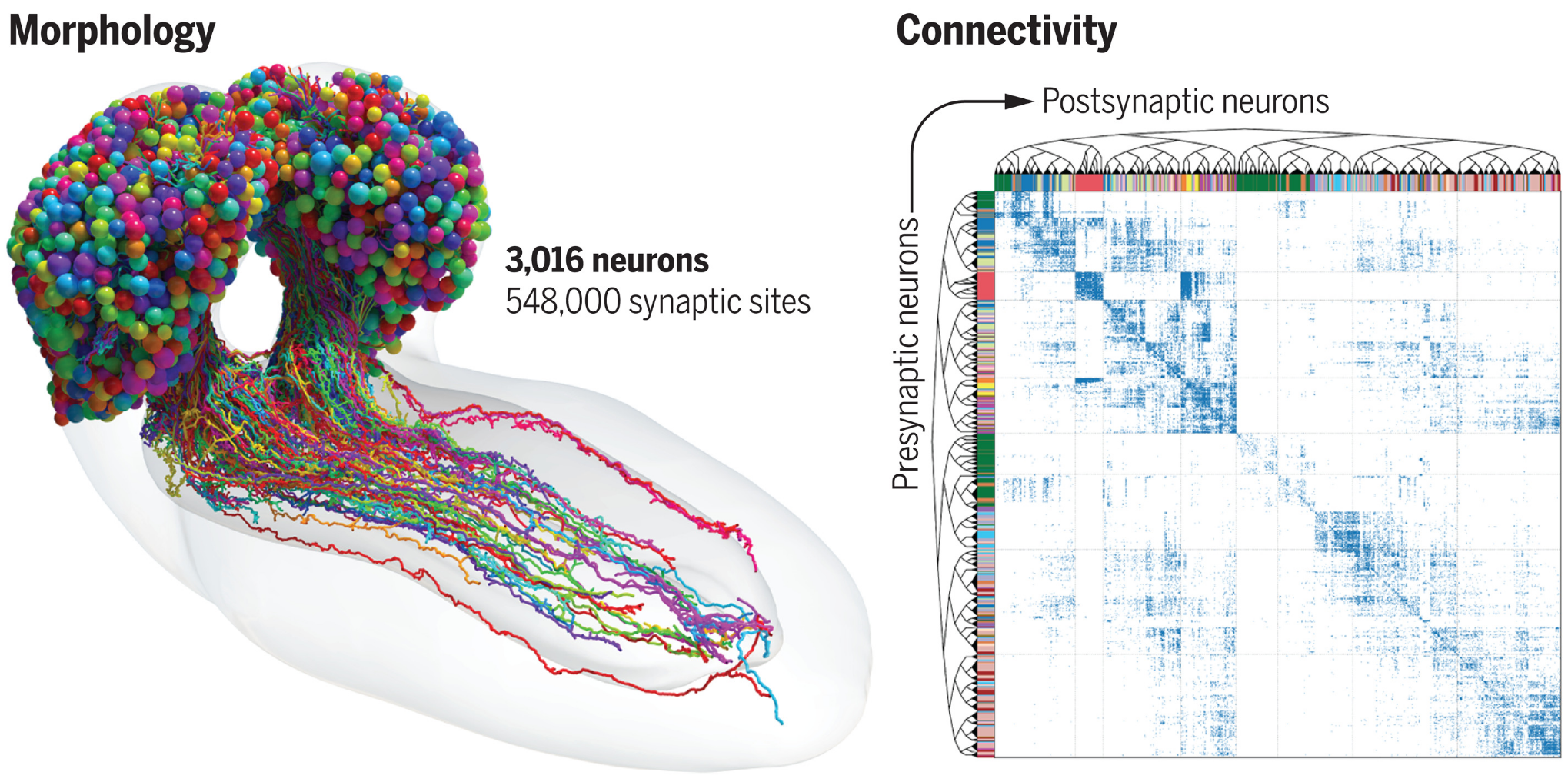
"The #connectome of an insect brain"
https://www.science.org/doi/10.1126/science.add9330
Congrats to co-first authors Michael Winding and Benjamin Pedigo, and to all our lab members and collaborators who made this work possible over the years. A journey that started over 10 years ago–and yet this is but a new beginning. So much more to come.
See my #tootprint on the preprint from back in the Autumn: https://mathstodon.xyz/@albertcardona/109422190525090990
The data is available both as supplements and directly via #CATMAID thanks to hosting by the #VirtualFlyBrain:
https://l1em.catmaid.virtualflybrain.org/?pid=1&zp=108250&yp=82961.59999999999&xp=54210.799999999996&tool=tracingtool&sid0=1&s0=2.4999999999999996&help=true&layout=h(XY,%20%7B%20type:%20%22neuron-search%22,%20id:%20%22neuron-search-1%22,%20options:%20%7B%22annotation-name%22:%20%22papers%22%7D%7D,%200.6)
(The "Winding, Pedigo et al. 2023" annotation listing all included neurons will appear very soon in an upcoming update.)
#drosophilalarva #drosophila #connectomics #neuroscience #VirtualFlyBrain #catmaid #tootprint #connectome

Leon Lotter · @LeonDLotter
623 followers · 70 posts · Server neuromatch.social@kas
Good point concerning the restriction to Mastodon of, e.g., #TootPrint. I agree, a platform-independent tag would be better! Will not go with "toot" and "masto" in the future :)
Leon Lotter · @LeonDLotter
623 followers · 70 posts · Server neuromatch.socialHi #science #research #mastodon community! A few days ago, a post of mine recieved a lot of attention. Thanks for the engagement and the very interesting suggestions! https://neuromatch.social/@LeonDLotter/109632615134117119
On #Twitter, I loved the common practice of writing threads explaining new #preprints and #papers in an understandable way.
I uttered my concern that through the chronological timeline here people might miss interesting science. A solution would be to agree on names for hashtags and/or a.gup.pe groups to ease tracking these "paper threads".
Following tags were named more then once: #newPaper #paperThread #preprint #researchPaper #mastoPrint #tootPrint.
Also, there was #tootorial, but that might be a slightly different category?
I heard people like participation - so let's do a poll! What's your favourite tag for threads explaining research articles? 📊 Multiple choices possible!
#twitterMigration #scienceTwitter #scientist @academicchatter @neuroscience @cognition @psychology @phdstudents
#science #research #mastodon #twitter #preprints #papers #newpaper #paperthread #preprint #researchpaper #mastoprint #tootprint #tootorial #twittermigration #sciencetwitter #scientist
Anirudh Wodeyar · @awodeyar
309 followers · 57 posts · Server qoto.orgThe big message we wanted to convey is that depending on what is intended for the phase to track (do you want it to act like a clock or do you want it to tell you when the peak/trough is reached?) you might want to consider alternative methods and use uncertainty metrics.
I focused in this #tootprint on one situation when the phase can become quite ambiguous - amplitude modulation, but in the paper we consider other cases as well including non-sinusoidal oscillations which lead to other considerations - do check it out! - https://doi.org/10.1101/2023.01.05.522914
Anirudh Wodeyar · @awodeyar
309 followers · 49 posts · Server qoto.orgExcited to share a paper we've been stewing for a while looking into ambiguity in defining phase for brain rhythms and how one can use metrics of uncertainty to identify moments when phase is less ambiguous.
https://doi.org/10.1101/2023.01.05.522914
#neuroscience #brain #tootprint #preprint
#neuroscience #preprint #brain #tootprint

Lorenzo Posani · @lorenzo
129 followers · 26 posts · Server neuromatch.social
Therefore, given a bunch of training data, there is a clear trade-off between selecting a few "good" training points and including more, but of lower overall quality. We provide some heuristics to select the optimal subset of data given a model and a prediction problem.
/end of my first #tootprint #masthread #preprint 😁
#tootprint #masthread #preprint
Leon Lotter · @LeonDLotter
471 followers · 9 posts · Server neuromatch.socialOn #scienceTwitter, my favourite thing were reading and, on rare occasions, writing "paper/preprint threads". From the researchers I followed and through the #Twitter algorithm, this became my most important source for new #research.
While people start to do the same on #Mastodon, I have the feeling that I miss important work bc no algorithm "saves" it for me if I don't watch my timeline constantly.
Two simple solutions would be: a commonly accepted hashtag that everybody uses when writing "paper threads" or a [...] @ a.gup.pe group with a similar adaptation rate.
#Question 1: is there already a mechanism for this that I missed?
#Question 2: What hashtag or group name?
I saw #TootPrint before. Maybe #PaperInAToot? #PaperInAPost? #PaperInAThread? #PaperPost? #MastoPrint?
Suggestions and boosts, please, we need reach for this! 🤓
#TwitterMigration #Science #Scientist @phdstudents @academicchatter @neuroscience @cognition
#sciencetwitter #twitter #research #mastodon #question #tootprint #paperinatoot #paperinapost #paperinathread #paperpost #mastoprint #twittermigration #science #scientist

Ari Benjamin · @aribenjamin
274 followers · 1 posts · Server neuromatch.social



Time for a #tootprint to celebrate a publication! I want to share a simple demo of the paper's main concept here — five-lines-of-Python simple.
Back in the '80s, researchers Luisa Mayer and Velma Dobson (among others) found that babies and young children slowly get better at seeing fine details as they age. This improvement is *linear* in time. (This is visual acuity: the finest spacing of a grating that can be resolved before it appears pure gray.) What explains this steady improvement?